Meteora Dynamic Bonding Curve
Meteora's permissionless, configurable bonding-curve launch protocol on Solana that graduates tokens into a real AMM pool once a funding threshold is hit.
▶ Run interactive simulation animated mechanism with editable parameters
How it works onchain
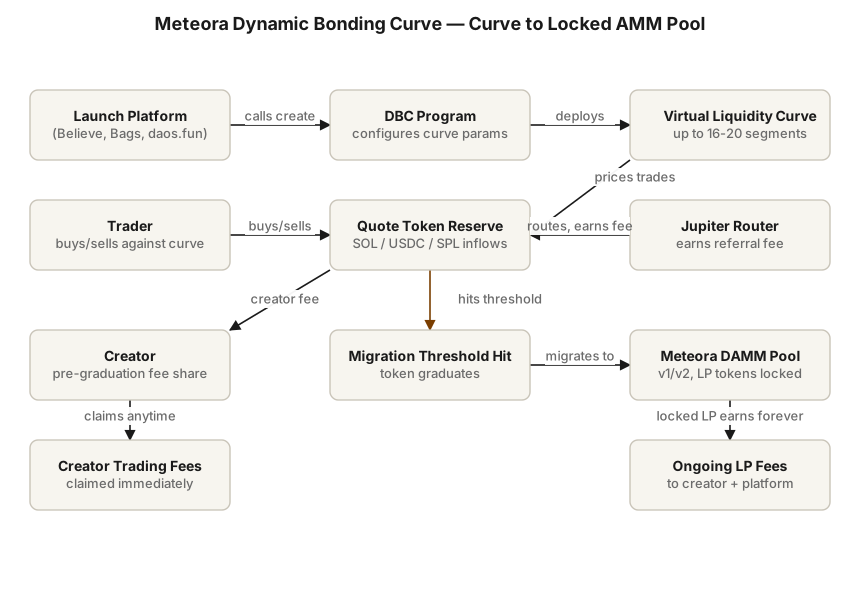 Open full-size diagram
Summary
Dynamic Bonding Curve (DBC) is a launch-pool protocol shipped by Meteora, a Solana liquidity-infrastructure team, in May 2025. It lets any project or platform configure a fully on-chain, customizable bonding curve to sell a new token without first seeding an AMM pool with treasury capital. Trades execute against a virtual liquidity pool defined by up to 16–20 configurable price/liquidity segments; once cumulative "quote" token inflows hit a project-set migration threshold, the token automatically graduates into a permanent Meteora DAMM v1 or v2 pool, with LP tokens locked so creators and the launch partner can keep collecting trading fees indefinitely. DBC is white-label infrastructure rather than a consumer-facing launchpad: it powers third-party launch platforms such as Believe, Bags, and daos.fun, which layer their own UX, curation, and fee-sharing rules on top of the same underlying program.
Design (Mechanism)
DBC generalizes the "pump.fun style" fixed bonding curve into a configurable primitive. A partner platform sets, per token: the shape of the curve (linear, exponential, or multi-segment with distinct price ranges), the quote asset (SOL, USDC, or other SPL tokens), the migration threshold (the amount of quote token that must be raised before graduation), base/dynamic trading fees, and how migrated liquidity and fees are split between the protocol, the launch partner/platform, the token creator, and integrated swap routers (e.g., Jupiter, which earns referral fees). Under the hood, pricing follows a constant-product-style formula generalized across the configured price segments (documentation describes it as x*y = liquidity² applied piecewise). Before graduation there is no external liquidity pool — all trades settle against the virtual curve inside the DBC program itself, which keeps launches cheap (no upfront LP capital) and makes rug-pulls via liquidity withdrawal structurally harder, since there is no real pool to drain until migration. After migration, LP tokens are locked according to the partner's configuration, and in June 2025 Meteora added "Creator Trading Fee Sharing," letting creators earn a cut of trading fees immediately post-launch rather than waiting for graduation. Token2022 and standard SPL tokens are both supported, and the program is open source on GitHub.
Outcome
DBC quickly became one of the dominant pieces of launch infrastructure in the Solana memecoin/creator-token ecosystem during 2025, underpinning platforms including Believe (which graduates tokens around a roughly $100k market-cap threshold), Bags (a creator-royalty-focused launchpad that embeds a default 1% perpetual creator fee), and daos.fun. Meteora itself completed a token generation event (MET) around October 2025. As infrastructure rather than a single "token launch," DBC's outcome is best measured by adoption and durability rather than a pass/fail event: it has processed substantial launch volume and become a standard building block that competing launchpads plug into, alongside Meteora's own DLMM and DAMM v2 products. No DBC-specific exploit or contract-level failure was found in public sources as of this research; the protocol's most significant reputational event was adjacent rather than technical — Meteora co-founder Ben Chow resigned in February 2025 after media reports raised insider-trading allegations connected to the separate LIBRA memecoin collapse (an incident predating and unrelated to the DBC program's mechanics). No charges or adjudicated findings related to those allegations have been reported.
Why it worked
DBC succeeded as infrastructure by solving a real cost problem: earlier bonding-curve launchpads (like pump.fun) used a single fixed curve shape, forcing every launch into the same economics. DBC's configurability let platforms differentiate (different graduation thresholds, fee splits, creator royalties) while reusing audited, battle-tested core mechanics rather than each platform writing its own curve and migration logic. Automatic graduation into a real AMM pool removed a major manual/trust step (teams manually seeding pools after a curve sold out), and locking LP tokens with ongoing fee claims gave both creators and platforms a durable revenue stream beyond the initial sale, incentivizing platforms to build on top of DBC rather than compete with it.
Limitations and criticisms
DBC's risks are largely inherited from the category it serves rather than being unique to the protocol: most tokens launched via DBC-powered platforms do not sustain value after migration, consistent with the broader memecoin-launchpad base rate where most launched tokens end at zero. Because DBC is white-label, quality control, disclosure, and anti-manipulation practices vary entirely by the integrating platform, meaning bad actors on top of good infrastructure (e.g., insider-style front-running or coordinated pump-and-dumps by launch platforms or influencers) remain possible and are not something the bonding-curve mechanism itself prevents — the LIBRA incident, though not built on DBC, illustrates the reputational spillover risk for infrastructure providers in this space.
Lessons
- Generalizing a popular fixed mechanism (single-curve memecoin launches) into configurable, white-label infrastructure can capture more value than competing directly with the platforms that use it.
- Automating the "graduation" step (curve → real AMM pool with locked LP) removes a manual trust bottleneck and a common source of post-launch rug-pull risk.
- Infrastructure-layer protocols inherit reputational risk from what's built on top of them; being technically uninvolved in a controversy (as DBC was with LIBRA) does not fully insulate a team or product from associated fallout.
- Aligning long-term incentives (ongoing fee claims on locked LP, creator fee-sharing pre-graduation) can outperform one-time sale proceeds at encouraging sustained platform and creator participation.
Redesign (EDITORIAL)
EDITORIAL — hypothesis, not fact. A next iteration could push more of the "quality control" responsibility into the protocol layer itself rather than leaving it entirely to integrating platforms: for example, an optional on-chain reputation/attestation layer for launch partners (surfacing historical graduation rates, prior scam flags, or verified-team status) that wallets and aggregators could read and warn users about before a swap. Separately, requiring a small mandatory time-locked or vesting portion of creator-held supply at curve creation (rather than leaving it fully optional per-partner) could reduce the "graduate and dump" pattern without meaningfully raising launch costs, since the core economic advantage of DBC — no upfront LP capital — would be preserved.
Sources
- What is Dynamic Bonding Curve? - Meteora Documentation — primary (docs)
- GitHub - MeteoraAg/dynamic-bonding-curve — primary (code)
- Meteora (@MeteoraAG) DBC announcement — primary (social)
- Meteora Dynamic Bonding Curve Program Address - Bitquery Docs (docs)
- Meteora co-founder Ben Chow resigns amid Libra scandal - The Block (news)
- Meteora on X: Creator Trading Fee Sharing upgrade — primary (social)
Related experiments
Last verified: 2026-07-27 · Spot an error? Suggest a correction