Holoworld AI
A Solana-based 'agentic app store' where creators build no-code AI characters, mint them as onchain IP, and fund them through a launchpad — its AVA and HOLO tokens both illustrating the gap between agent-platform narratives and token performance.
▶ Run interactive simulation animated mechanism with editable parameters
How it works onchain
 Open full-size diagram
Summary
Holoworld AI is a consumer AI-agent platform built by Hologram Labs, a company founded in February 2022 by Tong Pow (CEO, ex-0x Labs) and Hongzi Mao, backed by a $6.5M seed round led by Polychain in July 2022 (participants included Nascent, Arweave's Sam Williams, Quantstamp's Richard Ma, and Linkin Park's Mike Shinoda). The team pivoted from earlier hologram/avatar tooling into "Holoworld AI" — a self-described "agentic app store" where anyone can create AI characters without code, register them as onchain IP on Solana, and monetize them. Its stack includes Ava Studio (text-to-video generation around AI characters), an Agent Market (launched on Base in November 2024, flagship version on Solana in January 2025), HoloLaunch (a launchpad for funding AI-native IP), and an Agent SDK.
The project ran two notable token experiments: AVA, launched November 13, 2024 on Pump.fun as the token of its flagship agent "Ava," and HOLO, the platform's governance/ecosystem token, which debuted September 11, 2025 as Binance's 38th HODLer Airdrop alongside a 60-day Genesis airdrop claim across Solana and BNB Chain. HOLO hit its all-time high ($0.78) on listing day and by mid-2026 traded roughly 90% below it ($0.07), while the platform continued operating.
Design (Mechanism)
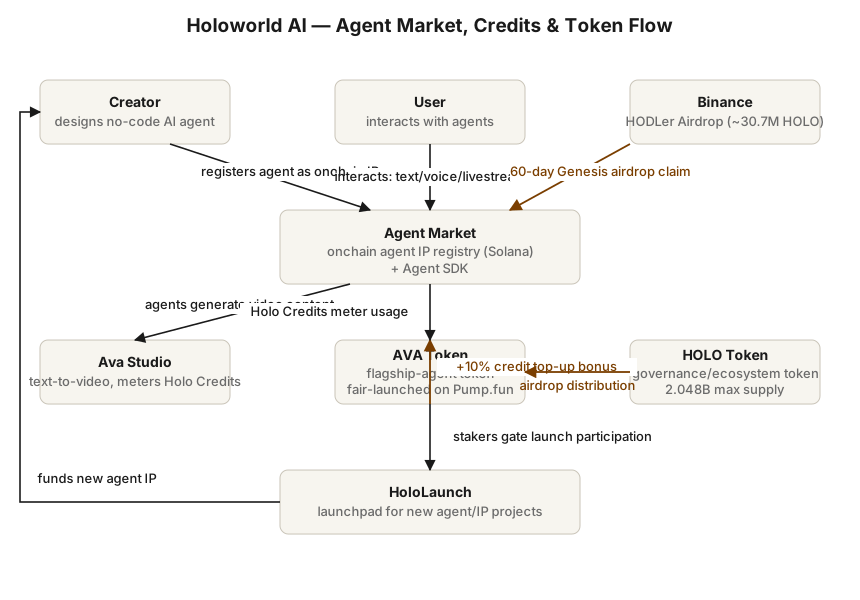
- No-code agent creation + onchain IP. Users compose an agent (personality, voice, 2D/3D avatar) in a browser; agents are registered as verifiable onchain assets on Solana and can be traded/monetized through the Agent Market. Agents interact via text, voice, and livestreams and can pull live data through a plugin ecosystem.
- Ava Studio and credit sinks. The generative-video studio is metered in "Holo Credits." The AVA token (the token of the flagship agent) grants a bonus (reported +10%) when used to top up credits — a soft utility sink tying an agent token to platform usage.
- HoloLaunch. A launchpad for AI-native IP: presale/fundraise mechanics for new agent projects, with participation gated/weighted by staking and points, positioning Holoworld as an incubator rather than just a tool vendor.
- Two-token structure. AVA (fair-launched on Pump.fun, 1B supply) functions as flagship-agent/creator token; HOLO (2.048B max supply) is the governance and ecosystem token used for staking, launch participation, and incentives. HOLO distribution combined a Binance HODLer Airdrop (~30.7M tokens, 1.5% of supply, to BNB stakers) with a community Genesis airdrop for early users and AVA stakers; reported allocations include ~13.5% investors, ~15.6% team, ~3.5% advisors, with only ~17–23% circulating in the months after TGE.
Outcome
Ongoing, with sharply divergent product and token trajectories. The platform shipped its major components (Agent Market, Ava Studio, HoloLaunch, SDK) and secured a top-tier listing path (Binance HODLer Airdrop, September 11, 2025, with USDT/USDC/BNB/FDUSD/TRY pairs). But both tokens performed poorly after launch spikes. AVA's "fair launch" was undermined at genesis: Bubblemaps identified a 23-wallet cluster tied to the deployer — freshly funded via exchanges in a tight window, with no prior activity — that sniped roughly 40% of supply at launch; AVA subsequently fell ~96% from its peak. HOLO printed its all-time high ($0.7757) on listing day and slid ~90% over the following months, pressured by a low initial float against a 2.048B max supply and ongoing unlocks. As of mid-2026 the platform continues to operate and ship, but Holoworld reads as a functioning product wrapped in underwater token economics.
Why it worked
- Real, shipped product surface. Unlike many agent-token projects of the 2024–25 cycle, Holoworld had usable software (no-code agent builder, generative video studio, livestreaming) that non-developers could actually use, plus a credible funded team.
- Distribution leverage. Riding Pump.fun for AVA and the Binance HODLer Airdrop for HOLO gave the project two of the cycle's most powerful distribution channels — instant liquidity, listings, and hundreds of thousands of token holders.
- Coherent flywheel design on paper. Agents-as-IP → studio usage burning credits → launchpad funding new agents → HOLO staking gating access is a legible closed loop connecting token demand to platform activity.
Limitations and criticisms
- Genesis integrity gap on AVA. A deployer-linked wallet cluster capturing ~40% of a nominally fair launch damaged trust in the project's community-launch credentials and preceded a ~96% drawdown in AVA — reputational fallout that bled into HOLO.
- Low-float/high-FDV listing dynamics. HOLO topped on its first day of trading; with under a quarter of supply circulating and large investor/team tranches still unlocking, structural sell pressure has outweighed organic demand.
- Utility demand lags token supply. Credit top-ups and launchpad staking are real sinks but small relative to a 2.048B-token supply; speculative demand for the "AI agent" narrative cooled faster than platform usage grew.
Lessons
- Fair-launch venues do not guarantee fair launches: without anti-sniping design (commit-reveal, capped first-block buys, allowlist audits), deployer-adjacent clusters can capture supply and permanently taint a project's credibility.
- Listing-day all-time highs are a signature of low-float/high-FDV tokenomics; a product's success and its token's performance can decouple entirely when unlock schedules dominate demand.
- Tying an agent token to a metered utility (credit bonuses) is a genuine but weak sink; token demand must scale with actual platform revenue, not with the size of the token supply.
- A two-token system (agent token + platform token) doubles the surfaces on which trust can fail — damage to one migrates to the other.
Redesign (EDITORIAL — hypothesis, not fact)
This section is editorial hypothesis, not reporting. A redesigned Holoworld might: (1) launch agent tokens through its own HoloLaunch with enforced onchain anti-sniping — per-wallet caps in the first N blocks, deployer-cluster screening, and public attestations — rather than outsourcing genesis integrity to Pump.fun; (2) collapse to a single token with usage-linked emission, minting rewards only against verified Ava Studio credit burn and agent revenue so float grows with demand; (3) shrink FDV theater by launching with >50% float and streaming team/investor tranches against revenue milestones instead of time; and (4) make agents genuinely composable onchain assets — revenue-sharing NFTs whose cash flows from streaming/IP licensing are claimable by holders — so the speculative object is the productive asset itself rather than a proxy token.
Sources
- Holoworld official site — primary (docs)
- Holoworld documentation — primary (docs)
- Introducing Holoworld AI (official Medium) — primary (docs)
- Solana AI token Ava hit by launch sniping tied to deployer: Bubblemaps (Cointelegraph) (analysis)
- Holoworld AI (HOLO) lands on Binance — HODLer Airdrop details (CoinGape) (news)
- Holoworld (HOLO) — CoinGecko (contracts, supply, ATH) (analysis)
- Tong Pow — IQ.wiki profile (analysis)
- Wu Blockchain — Vision of Holoworld AI: AI agents, virtual IPs, and Web3 launchpads (founder interview) (analysis)
Related experiments
Last verified: 2026-07-26 · Spot an error? Suggest a correction