HEX
A self-styled 'blockchain certificate of deposit' ERC-20 whose time-locked staking, early/late-unstake penalties, and founder-enriching launch mechanics made it one of the most polarizing tokenomics experiments in crypto.
▶ Run interactive simulation animated mechanism with editable parameters
How it works onchain
 Open full-size diagram
Summary
HEX, launched on Ethereum on December 2, 2019 by serial marketer Richard Heart (legal name Richard J. Schueler), bills itself as the "first blockchain certificate of deposit." It is an ERC-20 token whose entire value proposition is a single on-chain mechanism: lock ("stake") your HEX for a self-chosen term between 1 and 5,555 days, receive share units ("T-Shares"), and earn inflationary rewards plus penalties confiscated from stakers who break their commitments. The contract is immutable, has no admin keys over staking logic, and has run without exploit for over six years — yet HEX became a byword for "ponzinomics" because its launch design routed an enormous share of supply and ETH inflows to a founder-linked Origin Address, and its marketing leaned on self-referential price and "APY" claims. It reached an all-time high around $0.51–0.55 in late 2021 before falling roughly 99.9%.
Design (Mechanism)
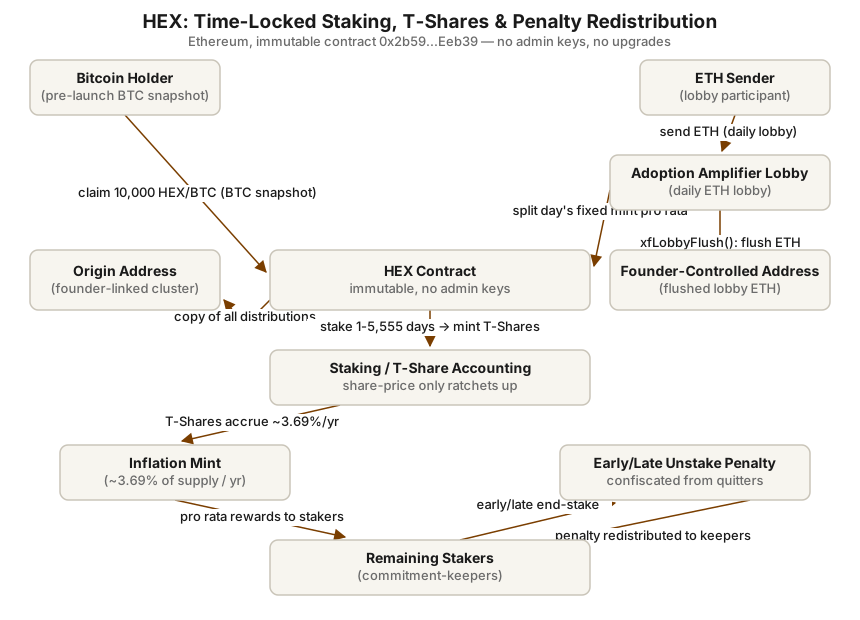
- Time-locked staking. Users stake HEX for 1–5,555 days. Stakes are converted into T-Shares; longer stakes ("Longer Pays Better") and larger stakes get bonus shares, up to a multiplier at the maximum term. The T-Share "price" in HEX only ratchets upward, so earlier stakers get more shares per token.
- Inflation paid only to stakers. The contract mints roughly 3.69% of supply annually and distributes it pro rata to T-Shares. Unstaked HEX earns nothing and is diluted — a strong nudge to lock.
- Penalties as yield. Ending a stake early or more than two weeks late incurs punitive penalties on principal and interest; confiscated amounts are largely redistributed to remaining stakers. Commitment-keepers are paid by commitment-breakers.
- Launch distribution (Dec 2019 – Nov 2020). Bitcoin holders in a snapshot at block 606,227 could claim 10,000 HEX per BTC free (with decaying claims and "we-are-all-Satoshi" forfeiture of unclaimed coins feeding later payouts, including a one-time "Big Pay Day" for stakers around day 353). Everyone else entered the daily "Adoption Amplifier" lobby: send ETH, split that day's fixed HEX mint pro rata.
- Origin Address. For distributions, a matching copy of tokens went to a single Origin Address, and ETH sent to the Adoption Amplifier was flushable to a founder-controlled address (the contract's public
xfLobbyFlushmoves accumulated ETH out). Critics estimate the OA-linked cluster ended up with the large majority of supply; there was no lockup, disclosure, or governance around it. - No treasury, no DAO, no upgrades. The contract (0x2b591e99afE9f32eAA6214f7B7629768c40Eeb39) is immutable; CoinFabrik performed security and economics audits pre-launch, finding no critical issues and verifying that longer stakes strictly outperform composed shorter ones.
Outcome
Technically, HEX did exactly what its code promised: six-plus years of uninterrupted operation, no hack, no rug in the smart-contract sense, and penalty/share accounting that worked as audited. Commercially and reputationally, the picture is grim. HEX pumped spectacularly into 2021 (ATH ~$0.51 on Sep 19, 2021 per CoinGecko; some trackers cite ~$0.556 in November 2021), briefly sporting a headline market cap in the tens of billions — a figure critics noted was self-referential given Origin Address holdings and thin float. It then collapsed ~99.9%, hitting new all-time lows even during later market recoveries. In May 2023 Heart launched PulseChain, which copied Ethereum's state (splitting HEX into eHEX and pHEX) and drained much community attention and liquidity. Exchanges largely refused to list HEX throughout.
Why it worked
- Commitment devices are genuinely powerful. Time-locks with credible penalties created real sell-pressure suppression; a large fraction of supply stayed staked for years, and "longer pays better" produced a measurable behavioral cohort of multi-year lockers.
- Immutability as trust substitute. With no admin keys and two pre-launch audits, believers could verify that the staking game's rules could never be changed under them — rare for 2019.
- Ruthlessly clear incentive story. "Get paid the penalties of quitters" is legible in one sentence, and the T-Share ratchet manufactured urgency better than most token launches before or since.
- Marketing-mechanism fusion. Heart's relentless promotion turned mechanism details (5,555 days, 3.69% inflation, Big Pay Day) into memes, building one of crypto's most cult-like retail communities.
Where the design broke
- Origin Address concentration. The Origin Address copy plus flushable Adoption Amplifier ETH directed well over $1B in ETH and a matching share of token supply to a single founder-linked address, with no lockup or disclosure attached; the resulting concentration permanently capped institutional and exchange acceptance.
- Yield was self-referential. "APY" was denominated in HEX inflation and penalties, not external revenue. Once new inflows slowed, the token price bore the full weight of dilution — a classic closed-loop tokenomics failure.
- Key-man risk. A single promoter was the roadmap, treasury, and media channel, with no separate institution to fall back on; when attention moved to PulseChain, that concentration showed up directly in HEX's trajectory.
- Reputation lock-in. Being the canonical "is it a Ponzi?" case study meant HEX's real mechanism innovations were unciteable in polite DeFi society; no serious protocol integrations followed.
Lessons
- A commitment/penalty staking design can sustain multi-year lockups without any external yield source — but token price will eventually reprice to the closed loop's net inflows, no matter how elegant the share accounting is.
- Immutable, admin-key-free code and supply concentration are independent properties; the Origin Address pattern shows a contract can be structurally un-ruggable while a single founder-linked address still holds the majority of token supply.
- Denominating yield in the token itself ("40% APY") is a marketing device, not an economic one; entries in this atlas that survived (e.g., staking with fee revenue) route exogenous cash flows to lockers instead.
- Single-promoter projects inherit the promoter's personal and reputational risks in full; HEX's drawdown tracked Heart's pivots and public standing as much as market beta.
Redesign (EDITORIAL — hypothesis, not fact)
This section is editorial speculation. Keep the genuinely interesting core — self-chosen lock terms, share-price ratchet, and penalties redistributed from commitment-breakers to commitment-keepers — but remove the founder-directed capture path: no Origin Address copy, no flushable founder ETH; route launch proceeds to an on-chain, vesting, governance-controlled treasury. Replace self-referential inflation with an exogenous yield base (e.g., the lockup pool holds staked ETH or tokenized T-bills), so "longer pays better" amplifies real cash flow rather than dilution. Cap the T-Share early-bird ratchet or decay it, so late joiners aren't structurally exit liquidity. Publish founder allocations with enforced multi-year stakes under the same penalty rules as users — a founder forced to play their own commitment game would have been HEX's most credible marketing claim. Several later protocols (veCRV-style vote-escrow, liquid lockers) effectively shipped sanitized versions of exactly this.
Sources
- HEX official website — primary (docs)
- HEX token contract on Etherscan — primary (contract)
- HEX whitepaper (launch/claim flow) — primary (docs)
- HEX Security Audit by CoinFabrik (Dec 2019) — primary (audit)
- HEX Economics Audit by CoinFabrik — primary (audit)
- Goldman Sats: 'Under A HEX' (critical mechanism analysis) (analysis)
- CoinGecko HEX price page (ATH / drawdown data) (analysis)
Related experiments
Last verified: 2026-07-27 · Spot an error? Suggest a correction