Tomb Finance
A seigniorage algorithmic token on Fantom that pegged TOMB to the price of FTM (not a fiat stablecoin) using expansion/contraction incentives across a three-token system.
▶ Run interactive simulation animated mechanism with editable parameters
How it works onchain
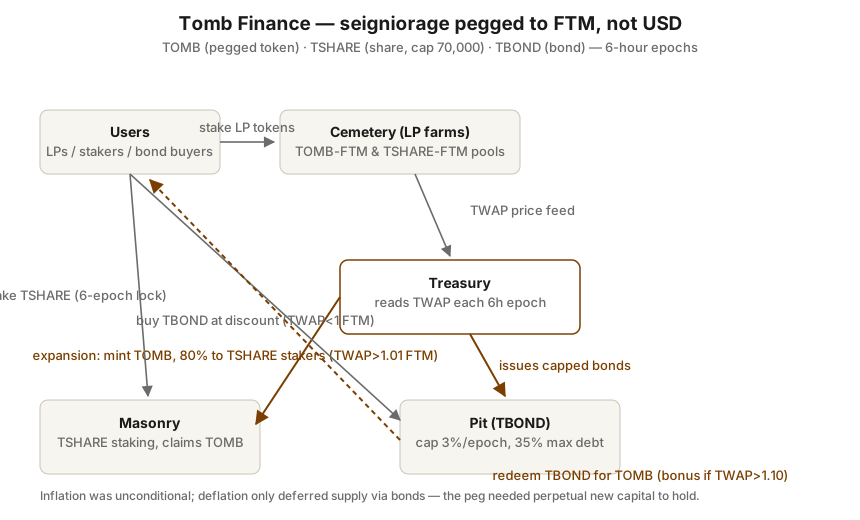 Open full-size diagram
Summary
Tomb Finance was a seigniorage-style algorithmic token protocol on the Fantom Opera chain, launched with Genesis Pools on June 2, 2021. Its distinguishing idea was that its primary token, TOMB, was pegged not to a fiat stablecoin like the US dollar but to the price of one FTM (Fantom's native gas token). The stated goal was to give the young Fantom ecosystem a liquid, FTM-denominated "money" that grew alongside FTM itself while capturing yield through a supply-adjusting mechanism.
The protocol used the Basis / bDollar / soup three-token seigniorage template: TOMB (the pegged token), TSHARE (a hard-capped share/reward token, 70,000 max supply), and TBOND (bonds bought at a discount during contraction to be redeemed at a premium during expansion). Users farmed TSHARE by staking TOMB-FTM and TSHARE-FTM LP tokens in the "Cemetery," then staked TSHARE in the "Masonry" (Boardroom) to earn newly minted TOMB during expansion epochs.
After a September 2021 leadership crisis ("Gatekeeper incident") in which the original pseudonymous team departed, Harry Yeh of Quantum Fintech Group publicly took over the project (announced Sept 5, 2021). Under this leadership Tomb grew from roughly $2.5M TVL to a peak of $1.6B, becoming one of the flagship DeFi protocols on Fantom during the 2021–2022 farming boom. The project ultimately lost its peg permanently after the LUNA/UST collapse in mid-2022 and later pivoted its ecosystem toward the multi-chain Lif3 brand.
Design (Mechanism)
Peg target and TWAP bands. TOMB targeted a 1:1 value ratio with FTM. The protocol read a time-weighted average price (TWAP) each epoch:
- TWAP > 1.01 → expansion (mint new TOMB)
- 1.00–1.01 → at peg, no action
- TWAP < 1.00 → contraction (bonds become buyable)
- TWAP > 1.10 → bond redemption bonus available
Epochs and the Masonry (Boardroom). Epochs were 6 hours. During expansion, new TOMB was minted, with roughly 80% distributed to TSHARE holders who staked in the Masonry. Withdrawals were locked for 6 epochs and reward claims for 3 epochs, deliberately slowing exits during instability.
Cemetery (LP farming) and Genesis Pools. TSHARE (hard-capped at 70,000) was emitted as farming rewards over roughly one year — TOMB-FTM LP earned 35,500 TSHARE and TSHARE-FTM LP earned 24,000 TSHARE, with the remainder to Genesis pools/DAO. Emissions concluded around June 12, 2022, when max supply was reached. TSHARE thus functioned as the value-accrual/governance token: its price reflected expected future seigniorage.
Pit (bonds). When below peg, TBOND could be issued (up to 3% of circulating TOMB per epoch, with a max debt cap of 35% of circulating supply). Bonds were bought with TOMB at a discount and redeemable for more TOMB once the peg recovered — the intended mechanism to soak up excess supply and push price back up.
Key contracts: TOMB (0x6c02...fbB7), TSHARE (0x4cdF...5B37), TBOND (0x2424...4ea0), Masonry (0x8764...3B67), Treasury (0xF50c...6f0d).
Outcome
Outcome status: failed (as an algorithmic peg), while being a genuine commercial and community phenomenon during its run. Tomb reached a peak TVL cited at approximately $1.6B by January 2022, spawned a large family of forks (2omb/3omb, Grape Finance, and dozens of "-omb" clones across chains), and became a cornerstone of the Fantom DeFi ecosystem. It survived multiple temporary de-pegs early on, and its treasury/deployed assets were exposed to the December 2021 Grim Finance reentrancy hack ($30M against the Grim auto-compounder, a separate protocol Tomb users/assets interacted with) without the core protocol collapsing at that time.
However, following the May 2022 LUNA/UST collapse and the broader collapse of confidence in algorithmic pegs, TOMB lost its peg to FTM and never durably recovered. By September 2022 one TOMB traded around 0.17 FTM. The team subsequently redirected effort into the multi-chain Lif3 ecosystem rather than restoring the original peg.
Why it worked (for a while)
- Novel peg framing. Pegging to FTM instead of USD aligned the protocol with a rising Layer-1's own token, so during Fantom's bull run holders got "stablecoin-like" mechanics plus FTM upside — an attractive pitch that USD-pegged algo-stables lacked.
- High, front-loaded yields. Capped TSHARE emissions plus Masonry TOMB rewards produced eye-catching APRs that pulled in liquidity fast, especially as Fantom TVL was exploding in late 2021.
- Credible, public leadership. The Harry Yeh / Quantum Fintech takeover replaced an anonymous team with a named operator, which restored confidence after the September 2021 crisis and coincided with the growth from ~$2.5M to ~$1.6B TVL.
- Anti-bank-run frictions. Epoch-based lockups in the Masonry slowed panic exits and helped early de-pegs self-correct while new capital kept arriving.
Where the design broke
- Structural reflexivity. As the Uğur post-mortem notes, "inflation was permanent, deflation was never permanent." Expansion minted TOMB unconditionally when above peg, but bonds only deferred supply — when the peg recovered, bond redemptions re-inflated circulating supply, so the system required continuous new capital to hold peg.
- Dependence on TSHARE speculation. The peg was ultimately backstopped by belief in future seigniorage priced into TSHARE. Once yields and token prices fell, the incentive to buy TOMB back toward peg evaporated — the classic algorithmic-stablecoin death spiral.
- Contagion and category collapse. The UST implosion destroyed market trust in all algorithmic pegs simultaneously; capital fled Tomb and its fork ecosystem, and no amount of mechanism tuning could offset a systemic loss of confidence.
- Fork saturation. Tomb's own success spawned a flood of copycats that fragmented liquidity and mercenary capital, accelerating the exit once sentiment turned.
Lessons
- A peg backed only by expected future emissions is reflexive, not stable. Seigniorage systems that mint freely above peg but only defer supply below peg have an asymmetry that requires perpetual inflows; that is a growth scheme, not a stability mechanism.
- Re-denominating the peg (FTM instead of USD) changes marketing, not the core failure mode. The reflexive supply dynamics are identical regardless of the reference asset; a rising reference asset merely masks the flaw during bull markets.
- Named, credible operators can buy time and trust but cannot repeal mechanism design. Leadership restored confidence and drove enormous growth, yet the underlying peg still broke once external conditions removed the marginal buyer.
- Contagion risk is a first-class design consideration. Even a protocol that survived earlier shocks and a neighboring $30M exploit was undone by loss of confidence in its entire category after UST.
Redesign (EDITORIAL — hypothesis, not fact)
The following is the researcher's editorial analysis, not established fact.
If rebuilt today, the most defensible redesign would abandon the pretense of an uncollateralized "peg" entirely and reframe TOMB as a partially or fully collateralized FTM-denominated index token. Concretely: back each TOMB with a reserve (FTM, liquid staked FTM, and blue-chip stables) held in a transparent, on-chain PSM-style vault, and let seigniorage/TSHARE rewards be funded only by realized reserve yield and protocol fees rather than by unconditional minting. Expansion would mint TOMB only when reserves exceed the target collateralization ratio, making inflation conditional and symmetric with contraction — directly addressing the "inflation permanent / deflation temporary" flaw.
Bonds would be replaced or supplemented with a hard redemption floor: any holder can always redeem TOMB for a fixed fraction of backing FTM, giving arbitrageurs a mechanical, capital-independent way to defend the floor without relying on speculative demand for TSHARE. TSHARE would shift from "claim on future money-printing" to "claim on protocol fee revenue," aligning it with a cash-flow asset rather than a Ponzi-adjacent emissions token.
Finally, the redesign would cap fork-driven mercenary capital by using longer, cliff-vested reward schedules and reserve-ratio-gated emissions, trading explosive early TVL for durability. This would almost certainly produce lower headline APRs and slower growth — but it would target the actual cause of death (a peg with no capital-independent defense) rather than the symptoms.
Sources
- Tomb Finance Official Documentation (docs.tomb.com) — primary (docs)
- Tomb Finance llms-full docs export (mechanism, thresholds, contracts) — primary (docs)
- The Postmortem Revival of Tomb Finance: Past, Present, and Future — primary (retrospective)
- A Post-Mortem on Tomb.Finance and Its Forks (Doğu Deniz Uğur) (analysis)
- TOMB Genesis Rewards Pool contract (FTMScan) — primary (contract)
- Explained: The Grim Finance Hack (Halborn) (audit)
- Tomb Finance yield-farm explainer (ChainDebrief/Pexx) (analysis)
Related experiments
Last verified: 2026-07-26 · Spot an error? Suggest a correction