Berachain Proof of Liquidity
Berachain's Layer-1 consensus-adjacent incentive system that paid block emissions in a soulbound token (BGT) directed by validators to DeFi liquidity vaults — bootstrapping $3B+ TVL before an 88% collapse forced its replacement with a single-token model in 2026.
▶ Run interactive simulation animated mechanism with editable parameters
How it works onchain
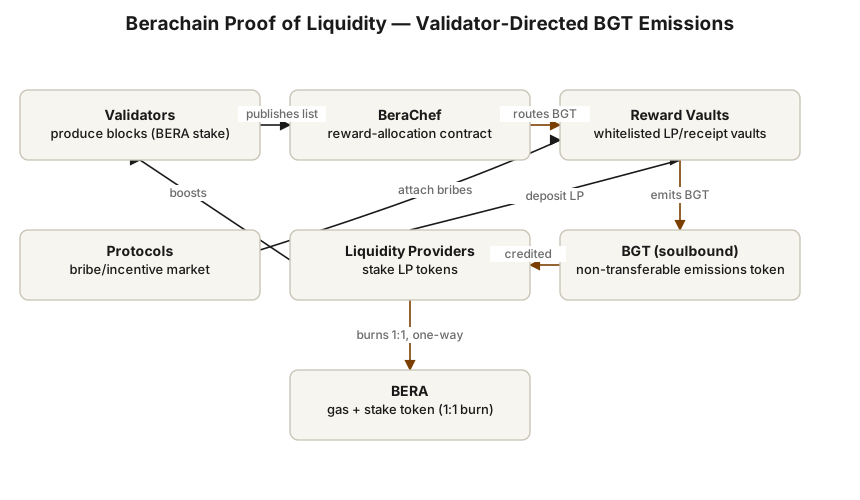 Open full-size diagram
Summary
Berachain is an EVM-identical Layer 1 that grew out of the 2021 Bong Bears NFT community and was founded in 2022 by four pseudonymous builders (Smokey The Bera, Dev Bear, Papa Bear, Man Bera). Its signature experiment, Proof of Liquidity (PoL), tried to redirect the value normally paid to passive stakers toward productive DeFi liquidity: block emissions were paid in a soulbound, non-transferable governance token (BGT) that validators steered into liquidity-provider "Reward Vaults," while protocols competed for those emissions with bribes. Backed by roughly $142M across a Polychain-led Series A and a $100M Series B co-led by Brevan Howard Digital and Framework Ventures, Berachain launched mainnet and its TGE on February 6, 2025 and quickly attracted over $3B in TVL. Within a year TVL had collapsed by ~88% and BERA fell from ~$9 to under $1; in July 2026 the "PoL Next" hard fork permanently ended BGT emissions and consolidated the system into a single-token WBERA/sWBERA model. The chain survives, but the original tri-token PoL design was retired after ~17 months.
Design (Mechanism)
PoL layered a liquidity-incentive market on top of otherwise conventional BFT proof-of-stake:
- Three tokens. BERA (gas + validator stake), BGT (soulbound governance/emissions token, earnable only through Reward Vaults, redeemable one-way 1:1 for BERA via burn), and HONEY (the native stablecoin).
- Validators. The top validators by staked BERA (active set of 69) produce blocks with probability proportional to stake. Block production mints BGT emissions.
- Validator-directed emissions. Rather than paying stakers directly, each validator publishes a reward-allocation list (managed on-chain by the BeraChef contract, 0xfb81E39E3970076ab2693fA5C45A07Cc724C93c2) that splits its block's BGT emissions across governance-whitelisted Reward Vaults.
- Reward Vaults. Users stake protocol receipt tokens (LP tokens, LSTs, etc.) in vaults to earn the BGT routed there. Vaults were the only way to earn BGT, gating entry into the flywheel.
- Boost. BGT holders delegate ("boost") BGT to validators, increasing those validators' emission rates — so validators courted BGT holders, who were by construction liquidity providers.
- Incentive (bribe) market. Protocols attached incentive tokens to their vaults to attract validator allocations, creating a Curve-style bribe economy at the consensus layer.
- Soulbound + one-way exit. BGT could never be bought, only earned; converting BGT to transferable BERA burned it irreversibly, forcing a continuous choice between governance power/yield and liquidity.
The intended flywheel: apps bribe → validators route emissions to app vaults → LPs earn BGT → LPs boost validators or burn to BERA → deeper liquidity attracts more activity → more fees and bribes.
Outcome
The bootstrap phase worked spectacularly: after two incentivized testnets (Artio, January 2024; bArtio, mid-2024) and heavy pre-launch "vault" campaigns, mainnet TVL peaked around $3.1–3.35B in early 2025 with roughly $1B in stablecoins, briefly making Berachain a top-ten DeFi chain. The retention phase did not. Organic activity and fees never grew into the emissions being paid; mercenary capital rotated out after airdrop and points campaigns ended. By late 2025/early 2026 analyses put TVL down ~70–88% (reports range from ~$393M down to ~$180M), with ~$1.2B in net bridge outflows, BERA down ~90% from its highs, team layoffs, and a developer exodus reported. The team shipped "PoL v2" adjustments in 2025, then in July 2026 executed the "PoL Next" hard fork (contract changes July 7, fork July 8) that stopped BGT emissions entirely: blocks now emit fixed WBERA (0.4 to the proposer, 1.305 through Reward Vaults), incentives are auctioned into BERA and accrue to sWBERA stakers, and BGT positions migrate to sWBERA. Verdict: partial success — the mechanism proved it could summon liquidity at scale and the chain persists, but the flagship tri-token design was abandoned.
Why it worked
- It aligned three normally disjoint actors. Validators, LPs, and applications all had direct financial reasons to care about each other's behavior; apps got emissions without paying for them upfront, which was a genuinely novel go-to-market for a new L1's DeFi ecosystem.
- Soulbound BGT filtered for participation. Because BGT could only be earned, governance power initially accrued to actual liquidity providers rather than buyers, and the one-way burn created a real opportunity cost for dumping.
- Community-native distribution. The NFT-origin community and long incentivized testnets produced enormous launch-day engagement and a $3B+ TVL bootstrap that most 2024–25 L1 launches never approached.
Where the design broke
- Reflexivity cut both ways. The flywheel amplified decline exactly as it amplified growth: falling activity → fewer bribes and lower vault yields → LP exit → thinner liquidity → less activity. There was no counter-cyclical damper.
- Emissions subsidized liquidity, not demand. PoL paid for TVL, but TVL is an input, not a product. Without applications generating end-user fee revenue, emissions were a cost with no offsetting sink, and BGT-to-BERA conversions became structural sell pressure.
- Complexity tax. Three tokens, boosts, vault whitelisting, and bribe markets confused retail users and raised integration costs; several post-mortems cite the model's opacity as a drag on adoption.
- Allocation concentration. Token allocation weighted toward VC and insider tranches meant a smaller set of addresses could direct outsized BGT emissions and voting weight relative to the "retail-first" positioning; once price collapsed, that concentration made governance-directed emission routing a focal point for distrust rather than a neutral distribution layer.
Lessons
- Incentive-directed emissions can rent liquidity but cannot buy retention. Any mechanism that pays for TVL must have a credible plan for what replaces the subsidy — fee-generating demand — before mercenary capital rotates out.
- Flywheels need brakes. A reflexive design should include counter-cyclical mechanisms (emission floors/ceilings tied to fees, vesting, or activity-indexed rewards) or the same loop that bootstraps growth will accelerate the unwind.
- Soulbound + one-way burn is a powerful filter but a fragile equilibrium. It works while yields exceed exit value; once expectations flip, everyone burns at once and the "loyal governance class" evaporates.
- Mechanism complexity is a user-acquisition cost. Berachain's own successor design (single-token WBERA/sWBERA) is an implicit admission that a tri-token consensus-layer bribe market exceeded what users and integrators would tolerate.
- Consensus-layer novelty is separable from economic novelty. PoL's block production was ordinary proof of stake; the experiment lived entirely in reward routing — which meant it could be replaced by hard fork without touching security, and eventually was.
Redesign (EDITORIAL — hypothesis, not fact)
This section is editorial speculation. A more durable PoL might have indexed emissions to realized protocol fees rather than validator discretion: vaults earn emissions proportional to a moving average of fees their protocol pays back to the network, capping the subsidy at some multiple of demonstrated demand. Keep BGT soulbound but make redemption vest linearly (e.g., over 6–12 months) to dampen reflexive unwinds, and add an emissions kill-switch governed by a fee-coverage ratio so the network automatically tapers payouts when it is "renting" more liquidity than it monetizes. Finally, launch with one token and add governance separation later — the tri-token model front-loaded complexity precisely when the chain most needed legible UX. Whether any of this would have overcome the underlying demand shortfall is unknowable; PoL's core problem may simply have been that 2025's L1 market had more liquidity mechanisms than reasons to use them.
Sources
- Berachain Core Docs — Proof of Liquidity — primary (docs)
- Berachain Core Docs — BGT Token Contract Reference — primary (docs)
- Berachain Core Docs — BeraChef Contract Reference — primary (docs)
- CoinGecko — What Is Berachain and Proof of Liquidity? (analysis)
- The Block — Meet Berachain: a new Layer 1 born from a community built around bear NFTs (news)
- BlockEden — Berachain One Year Later: From $3.35B Peak TVL to 88% Collapse (analysis)
- The Defiant — Berachain TVL Plummets 70% as Network Activity Dwindles (news)
- BeInCrypto — Berachain Faces $1.2 Billion Net Outflow (news)
- Cointelegraph — Berachain Starts 'PoL Next' Hard Fork for Single-Token Economy (news)
- OAK Research — Berachain (BERA): Is the hate justified? Six months after launch (analysis)
- Decrypt — What Is Berachain? The Latest Ethereum, Solana Challenger to Raise Big Money (news)
Related experiments
Last verified: 2026-07-27 · Spot an error? Suggest a correction