BitConnect
A high-yield 'Lending Program' promising up to 1%/day returns from a proprietary trading bot that turned out to be a $2+ billion Ponzi scheme, collapsing within a day of the platform shutting down its Lending Program.
▶ Run interactive simulation animated mechanism with editable parameters
How it works onchain
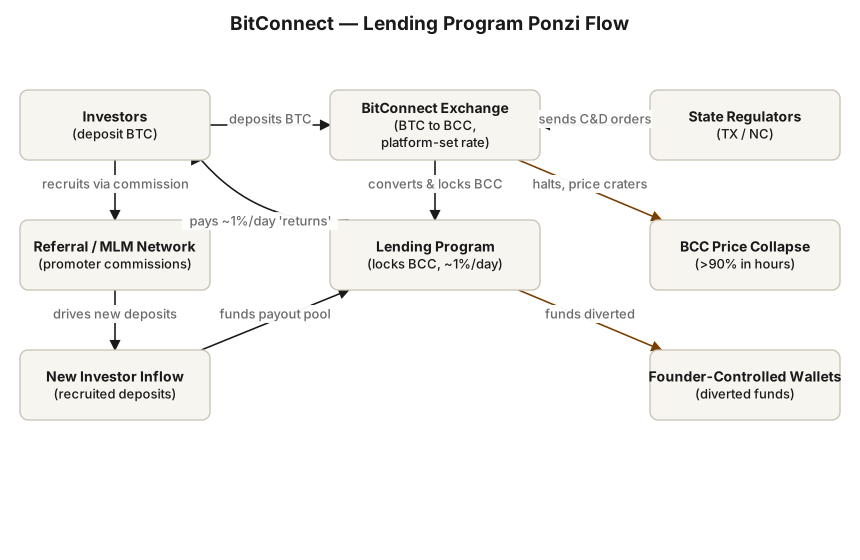 Open full-size diagram
Summary
BitConnect was a 2016-era cryptocurrency platform that offered a "Lending Program": investors purchased BitConnect Coin (BCC) with Bitcoin and locked it into the program in exchange for advertised daily returns of up to 1% (compounding to implausible annualized figures), supposedly generated by a proprietary "volatility software trading bot." A multi-level referral system paid existing investors commissions for recruiting new ones. The scheme collected an estimated $2-2.4 billion from investors globally before abruptly shutting the Lending Program down on January 16, 2018, citing regulatory pressure. BCC's price collapsed more than 90% within hours.
Design (Mechanism)
Investors deposited Bitcoin, which BitConnect converted into its native token, BCC, at the platform's own quoted exchange rate. Locked BCC "loaned" to the platform accrued a daily interest rate that BitConnect published on a variable schedule, often advertised around 1%/day (which implies triple-digit-percent annualized returns before compounding). BitConnect claimed the yield was funded by profits from an automated trading bot that exploited Bitcoin's price volatility. The platform layered a classic multi-level-marketing referral structure on top: promoters earned commissions for recruiting new depositors, and top-tier promoters (like Glenn Arcaro, who reportedly earned roughly $24 million in commissions) were incentivized to run aggressive marketing campaigns, YouTube channels, and conferences. Because BCC's exchange rate was set unilaterally by BitConnect rather than by an open market, the token's paper value could be inflated indefinitely as long as new deposits kept flowing in — the hallmark of a Ponzi structure disguised as a DeFi-style lending product.
Outcome
No legitimate trading bot ever existed to generate the claimed returns; instead, funds from new investors were used to pay obligations to earlier investors. On January 16, 2018, BitConnect announced it was shutting down its Lending and Exchange platforms, citing regulatory pressure and negative press. BCC's price fell from a peak near $525 to a fraction of a dollar within a day, wiping out most investor value; retail investors are estimated to have lost about $2 billion in total.
Why it worked
- Fixed, extremely high advertised daily yields (with visible, unilaterally-set price appreciation of BCC) created powerful FOMO during the 2017 bull market, when investors were primed to expect outsized crypto returns.
- The referral/commission structure converted investors into an army of unpaid marketers with strong financial incentive to recruit, amplifying reach through YouTube, conferences, and social media far beyond what paid advertising could achieve.
- Presenting the scheme as a "trading bot" and "volatility software" gave it a technological veneer that let it masquerade as a legitimate crypto product rather than an obvious cash Ponzi, which slowed public recognition of the scheme even though prominent figures (including Ethereum's Vitalik Buterin) flagged it early as suspicious.
Why it failed or underperformed
- The core economics were unsustainable by design: payouts depended entirely on new deposit inflow rather than any real trading profit, so any slowdown in new investor growth or a regulatory shock guaranteed collapse.
- BCC's exchange rate was set by the platform itself rather than by open markets, meaning the "value" investors saw was largely fictional and could vanish instantly once redemptions were forced onto a real market.
- The shutdown, once triggered, was near-instant and total — a structural feature of any scheme whose survival depends on continuous new inflows rather than real revenue.
Lessons
- Yields that are fixed, high, and disconnected from any transparent, verifiable revenue source are a stronger signal of Ponzi mechanics than any amount of technical branding ("AI," "trading bot," "proprietary algorithm").
- A referral/commission layer on top of a lending product should be treated as a red flag: it rewards recruitment volume over investment quality and accelerates unsustainable growth.
- Platform-controlled, non-market exchange rates for a token used as the unit of account let operators manufacture the appearance of returns; genuine price discovery on open markets is a critical check absent here.
- A single external shock, even a small one, can trigger instant, total collapse of a scheme whose survival depends on continuous new inflows — a useful early-warning indicator for similarly structured products.
Redesign (EDITORIAL)
EDITORIAL — hypothesis, not fact. A legitimate version of BitConnect's stated goal (democratized access to algorithmic trading yield) would need, at minimum: (1) on-chain, auditable trading activity or third-party attestation of actual strategy performance rather than a black-box "bot," (2) yields determined by realized, transparent P&L rather than a fixed advertised daily rate, (3) an exchange rate for any native token set by open order-book markets, not by the platform operator, and (4) no direct financial incentive (commissions) for participants to recruit new depositors, since that structurally rewards growth over legitimacy. Even with all of these fixes, any product promising ~365%+ annualized "risk-free" yield from crypto volatility trading should be treated as presumptively implausible; the honest redesign is closer to a regulated, disclosed, market-neutral yield product with capped, market-consistent returns rather than an attempt to preserve BitConnect's return profile through better tooling.
Sources
- SEC Charges Global Crypto Lending Platform and Top Executives in $2 Billion Fraud — primary (governance)
- BitConnect, BitConnect Coin and the BCC Exchange (governance)
- Bitconnect — Wikipedia (analysis)
Related experiments
Last verified: 2026-07-27 · Spot an error? Suggest a correction