Bittensor
A Substrate-based L1 that turns machine intelligence into a mineable commodity: miners produce AI work, validators score it, and Yuma Consensus converts those scores into TAO emissions across a marketplace of competing subnets.
▶ Run interactive simulation animated mechanism with editable parameters
How it works onchain
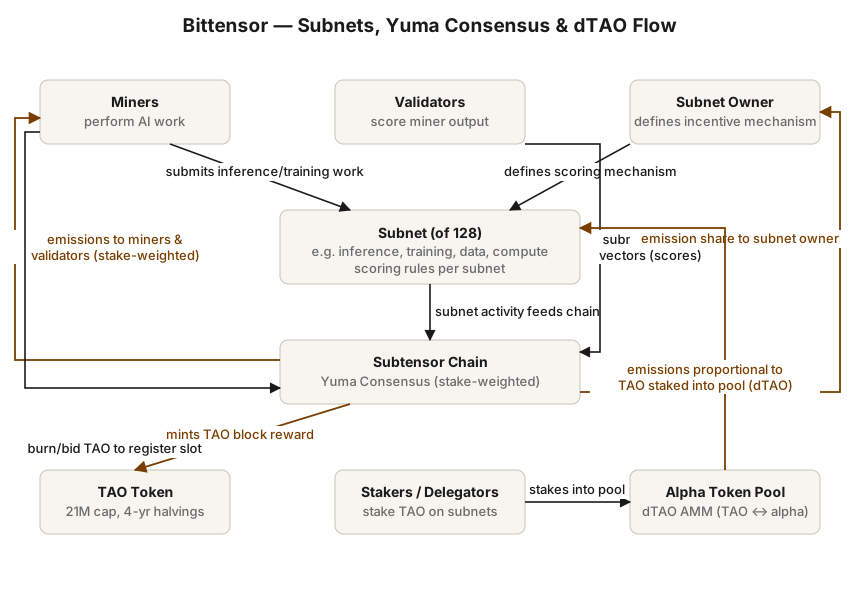 Open full-size diagram
Summary
Bittensor is the largest sustained attempt to price machine intelligence with a token. Conceived by ex-Google engineer Jacob Steeves (working on the idea since ~2016, joined by Ala Shaabana in 2019), described in a 2020 whitepaper, and launched as a network in January 2021, it is a sovereign Substrate-based Layer 1 ("subtensor") rather than a set of contracts on an existing chain. Miners perform AI work (inference, training, data, compute), validators grade that work, and the chain's Yuma Consensus mechanism converts stake-weighted grades into emissions of TAO — a currency deliberately styled on Bitcoin: 21M hard cap, four-year halvings (first halving December 12, 2025, cutting daily issuance from 7,200 to 3,600 TAO). The 2023 "Revolution" upgrade fragmented the network into competing subnets, each an independent incentive market with its own scoring rules; the February 13, 2025 Dynamic TAO (dTAO) upgrade replaced committee-set subnet valuations with market-priced subnet ("alpha") token pools. As of mid-2026 the network runs 128 subnets (expansion toward 256 planned) with TAO around a ~$1.9–2B market cap — far below its April 2024 all-time high, but still the reference design for decentralized AI incentives.
Design (Mechanism)
- Commodity framing. The whitepaper ("Bittensor: A Peer-to-Peer Intelligence Market") treats intelligence as a mineable commodity: instead of hashing, miners earn block rewards by producing useful machine-learning outputs judged by peers.
- Subnets. Post-Revolution (2023), the chain hosts many subnets. A subnet owner defines an incentive mechanism: what miners must do (e.g., LLM inference, model training, price prediction, protein folding, GPU rental) and how validators score it. Emissions are split among miners, validators, and the subnet owner.
- Yuma Consensus. Validators submit weight vectors scoring miners. The chain aggregates them stake-weighted and clips outlier scores toward the consensus median, so validators are economically punished for deviating (whether colluding or lazy) and rewarded for agreeing with the eventual consensus. Validator-miner "bonds" accrue over time, rewarding validators who identify good miners early.
- Registration churn. Miner/validator slots per subnet are scarce; entrants burn or bid TAO to register, and the lowest-scoring participants get deregistered — a continuous auction that recycles slots toward performers.
- Dynamic TAO (dTAO, Feb 2025). Previously 64 root-network validators voted on how emissions split across subnets — a political chokepoint. dTAO gave each subnet its own alpha token paired with TAO in an AMM-style pool; emissions now flow to subnets in proportion to market demand (TAO staked into each pool). Anyone staking TAO effectively votes with capital on which subnets deserve issuance.
- Monetary policy. 21M TAO cap, halvings at supply midpoints; no VC premine at launch — TAO has been emitted to participants since day one, a genuinely fair-launch distribution unusual for AI tokens.
Outcome
Ongoing, and by most measures the flagship of "DeAI." The network grew from a single text-generation market to 128 heterogeneous subnets; notable ones (Chutes for inference, Targon, pretraining subnets that trained multi-billion-parameter models permissionlessly) demonstrated real, non-simulated AI production. TAO reached an all-time high in April 2024 and a peak market cap in the tens of billions; by July 2026 it trades near $196–202 ($1.9–2B cap), a deep drawdown that tracks the broader altcoin cycle. dTAO succeeded in depoliticizing emissions — subnet alpha tokens reached $1.12B combined market cap by March 2026 (27% of TAO's cap) — but also unleashed reflexive speculation on alpha tokens and constant sell pressure from subnet teams funding operations. The first halving (Dec 2025) executed cleanly and is squeezing marginal "zombie subnets" whose emissions no longer cover costs. Persistent criticisms, including a 2025 empirical arXiv study, target validator stake concentration, weight-copying validators who free-ride on others' scores, and the difficulty of proving that scored work equals valuable work.
Why it worked
- Incentives before product. Bittensor bootstrapped real GPU fleets and ML teams by paying emissions for measurable work, solving the cold-start problem that kills most decentralized compute markets.
- Bitcoin-shaped scarcity plus fair launch gave TAO a credible monetary story and a community of aligned long-term holders rather than a VC unlock overhang.
- Yuma Consensus made subjective evaluation tractable: clipping to stake-weighted consensus turns "is this AI output good?" into a Schelling game that mostly resists individual manipulation.
- Subnets as permissionless experiments. Externalizing mechanism design to subnet owners let the network discover product-market fit in parallel instead of betting on one task.
- dTAO replaced committee politics with price discovery, removing the root-validator chokepoint that had become the network's biggest governance liability.
Limitations and criticisms
- Verification gap. Validators often cannot cheaply verify that miner output is genuinely valuable (versus plagiarized, cached, or gamed), so some subnets reward benchmark-overfitting rather than intelligence.
- Validator centralization and weight-copying. Stake is concentrated in a few large validators; copying the consensus weight vector is profitable and information-free, degrading the signal Yuma is supposed to aggregate.
- Reflexivity over revenue. Most subnet value is emission-denominated; little external revenue flows in, so the system leans on token appreciation. dTAO added a second speculative layer (alpha tokens) with heavy sell pressure.
- Complexity tax. Understanding subnets, alpha pools, and Yuma dynamics is hard, limiting demand-side adoption relative to centralized AI APIs.
Lessons
- A commodity market for intelligence needs a cheap, robust verification function; where scoring is gameable, emissions subsidize the gaming.
- Fair-launch, hard-cap monetary policy is a powerful legitimacy device — it bought Bittensor community durability through an 80%+ drawdown that would have killed a VC-token project.
- Delegating mechanism design to subnet owners (a market of markets) beats central planning of tasks, but only if the meta-layer allocating emissions across markets is itself incentive-robust — the pre-dTAO root network showed committee allocation becomes political.
- Consensus-clipping peer scoring resists individual cheaters but invites herding: rewarding agreement with the median makes weight-copying rational and must be explicitly penalized (e.g., commit-reveal on weights, which Bittensor later added).
- Emission halvings act as a network-wide fitness test, defunding marginal participants; designers should plan for that cull rather than treat issuance as permanent subsidy.
Redesign (EDITORIAL — hypothesis, not fact)
This section is editorial speculation. A redesigned Bittensor would attack the verification gap first: require every subnet to ship a machine-checkable evaluation spec (deterministic replays, spot-audit sampling with slashing, or zk/optimistic proofs of inference where feasible), and route a larger emission share to subnets in proportion to external revenue burned or locked (paying customers), not just staked speculation — making dTAO pools price cash flow rather than attention. Weight-copying could be neutralized by scoring validators on the marginal information content of their weights (penalizing correlation with lagged consensus), and validator stake caps or quadratic stake-weighting would blunt centralization. Finally, sunset rules for zombie subnets — automatic deregistration when demand-side metrics stay below threshold across a halving epoch — would recycle scarce emission bandwidth toward subnets that sell intelligence to the world instead of to the token.
Sources
- Bittensor documentation — primary (docs)
- Opentensor subtensor node (chain source code) — primary (contract)
- Bittensor community links (official handle listing) — primary (docs)
- Bittensor — Wikipedia (archive)
- Bittensor on the Eve of the First Halving — Grayscale Research (analysis)
- Bittensor (TAO) and dynamic TAO (dTAO) — OAK Research (analysis)
- Bittensor Protocol: The Bitcoin in Decentralized AI? A Critical and Empirical Analysis (arXiv 2507.02951) (analysis)
- Bittensor TAO price prediction: what the December halving means (halving date/emissions) (news)
Related experiments
Last verified: 2026-07-27 · Spot an error? Suggest a correction