Blast
An Ethereum L2 that made yield the default — auto-rebasing ETH and stablecoin balances plus an aggressive points-and-invites deposit campaign — attracting $2.3B before mainnet even existed, then losing ~97% of TVL after its token airdrop.
▶ Run interactive simulation animated mechanism with editable parameters
How it works onchain
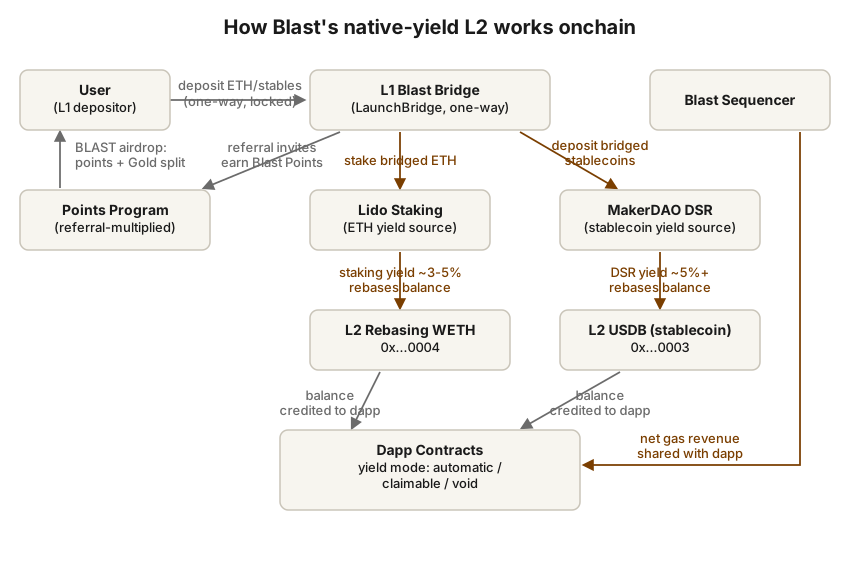 Open full-size diagram
Summary
Blast is an Ethereum optimistic rollup announced on November 20, 2023 by Tieshun "Pacman" Roquerre, founder of the NFT marketplace Blur, with roughly $20M in backing from Paradigm and Standard Crypto. Its core pitch was "native yield": instead of ETH and stablecoins sitting idle on an L2, balances on Blast rebase upward by default — bridged ETH is routed into Lido staking and bridged stablecoins into MakerDAO's DAI Savings Rate, with the yield passed through to L2 balances (ETH/WETH and the USDB stablecoin). Layered on top was one of the most aggressive pre-launch deposit campaigns ever run: an invite-only points program with a one-way bridge that locked deposits for months before any chain existed. It worked spectacularly as a deposit magnet — $2.3B bridged by 181,888 users before the February 29, 2024 mainnet — and then unwound almost as spectacularly after the June 2024 BLAST airdrop, with TVL falling ~97% from its ~$2.2–2.7B peak and daily active users collapsing from ~180,000 to a few thousand by mid-2025.
Design (Mechanism)
- Native yield via rebasing balances. ETH bridged to Blast is staked (initially via Lido); stablecoins are deposited into the DAI Savings Rate. On L2, user ETH balances and USDB rebase automatically, so holding assets on Blast earns ~3–5% (ETH) and ~5%+ (stables) "by default." Contracts can opt into yield modes (automatic, claimable, void) via the Blast yield precompiles, letting dapps programmatically claim or redirect yield from their own balances.
- Gas revenue sharing. Unlike most L2s, Blast rebates net sequencer gas revenue to the dapp contracts that generated it — a programmable subsidy meant to give developers a business model beyond token sales.
- Pre-launch one-way bridge + points. From November 2023, users could deposit into an L1 contract ("LaunchBridge") with no withdrawal path until mainnet, earning Blast Points multiplied by invite-based referrals. This illiquid-by-design structure converted airdrop speculation into months of locked TVL. The launch drew public criticism — including from Paradigm's own Dan Robinson — over labeling as a "bridge" a contract that was, until mainnet, just a multisig-controlled staking mechanism with no withdrawal path.
- Airdrop split. The June 26, 2024 BLAST airdrop allocated roughly half to depositors (points) and half to developers/users of Blast-native apps (Gold), attempting to reward builders, not just mercenary deposits.
Outcome
Blast hit $2.3B locked before launch and peaked around $2.2–2.7B TVL in mid-2024, briefly ranking among the largest L2s, with 200+ dapps and breakout apps like Fantasy.top ($11M revenue in its first 10 days). The airdrop was widely judged underwhelming relative to the capital locked; farmers exited, and TVL fell from ~$2.2B in June 2024 to roughly $65–105M by 2025 (96–97% decline). Daily active users fell from 180,000 (June 2024) to ~3,800 (mid-2025). BLAST hit its all-time high ($0.029) the day after the airdrop and later traded down 98%. The ecosystem also suffered early credibility hits: the RiskOnBlast incident, in which roughly 500 ETH of user liquidity was withdrawn by the project's deployer (Feb 2024), and the Super Sushi Samurai exploit ($4.6M). The team pivoted toward a "Phase 2 / full-stack chain" vision with Blast Mobile and a consumer wallet app. As of mid-2026 the chain still operates, but as a marginal player versus Base and Arbitrum. The mechanism itself — default yield — was technically delivered and widely copied (restaking L2s, yield-bearing bridged assets), while the commercial outcome was poor.
Why it worked
- Yield-as-default reframed the L2 value proposition. Making the base asset productive removed a real user cost (idle ETH) and gave Blast a one-line differentiator in a crowded L2 field.
- Points + invites + lockup was ruthlessly effective at capital acquisition. The one-way bridge converted airdrop expectation into committed TVL, creating social proof and headline numbers no marketing budget could buy.
- Founder distribution playbook. Pacman reran the Blur playbook (points seasons, trader/builder segmentation) with an existing community, and the dev-side airdrop half seeded 200+ apps quickly.
Where the design broke
- Mercenary capital has no retention curve. TVL was rented, not earned; once the airdrop cleared,
97% left. Native yield (4%) could not compete with points-driven expected returns elsewhere. - Airdrop disappointment destroyed goodwill. Allocations felt small versus $2B+ locked for six months; a second lock-up/vesting design for large claims deepened resentment.
- Trust debt from launch. A "bridge" that was, until mainnet, a multisig with no withdrawal path, plus early exploits on Blast-native apps, branded the chain as degen-first, deterring durable builders and institutions.
- No structural moat. Rebasing yield was trivially replicable, and Blast lacked Base's distribution or Arbitrum's DeFi depth once incentives ended.
Lessons
- Incentive campaigns buy TVL, not users; retention must be designed for the day after the airdrop, or the campaign merely schedules the exodus.
- Default (opt-out) yield is a genuinely good primitive — it survived Blast and spread across the industry — but a primitive is not a moat if any competitor can bolt it on.
- Locking user funds in a withdrawal-less multisig while marketing it as an L2 creates trust debt that compounds; even your own investors will call it out, and the reputational cost outlasts the TVL.
- Splitting airdrops between depositors and builders is directionally right, but if the headline number ($2.3B locked) sets expectations, almost any allocation will disappoint.
Redesign (EDITORIAL — hypothesis, not fact)
This section is editorial hypothesis, not established fact. A redesigned Blast might: (1) replace the one-way multisig LaunchBridge with a withdrawable escrow whose points accrue with time-weighted multipliers, so commitment is incentivized rather than coerced; (2) convert the airdrop into a streaming distribution keyed to post-launch retention (e.g., points vest only while assets remain deployed in dapps, not idle), directly pricing the day-after cliff; (3) route native yield into a protocol-owned insurance and builder-grant pool by default, with users opting into full pass-through — turning the yield primitive into an ecosystem moat instead of a commodity; and (4) publish the sequencer-revenue-sharing terms as enforceable onchain contracts from day one, making the "dapps earn gas" promise a credible business model rather than marketing.
Sources
- Blast developer docs — mainnet contract addresses — primary (docs)
- blast-io/blast (GitHub) — primary (contract)
- Blast official site — primary (docs)
- Blast on X — official account clarification — primary (archive)
- Blast TVL crosses $2B as it targets mainnet launch on Feb. 29 (news)
- Ethereum L2 Blast Launches Mainnet, Unlocks $2.3B (news)
- BLAST Chain in 2025: From $2.7B TVL to Near-Collapse in Under Two Years (analysis)
- What Is Blast? An Optimistic Rollup That Offers Native Yield (CoinGecko) (analysis)
- Blast (BLAST) market data — CoinGecko (analysis)
Related experiments
Last verified: 2026-07-27 · Spot an error? Suggest a correction