Blend (Blur)
Blur and Paradigm's oracle-free, perpetual peer-to-peer NFT lending protocol that used interest-rate Dutch auctions for refinancing and briefly captured ~90%+ of all NFT lending volume before the sector collapsed.
▶ Run interactive simulation animated mechanism with editable parameters
How it works onchain
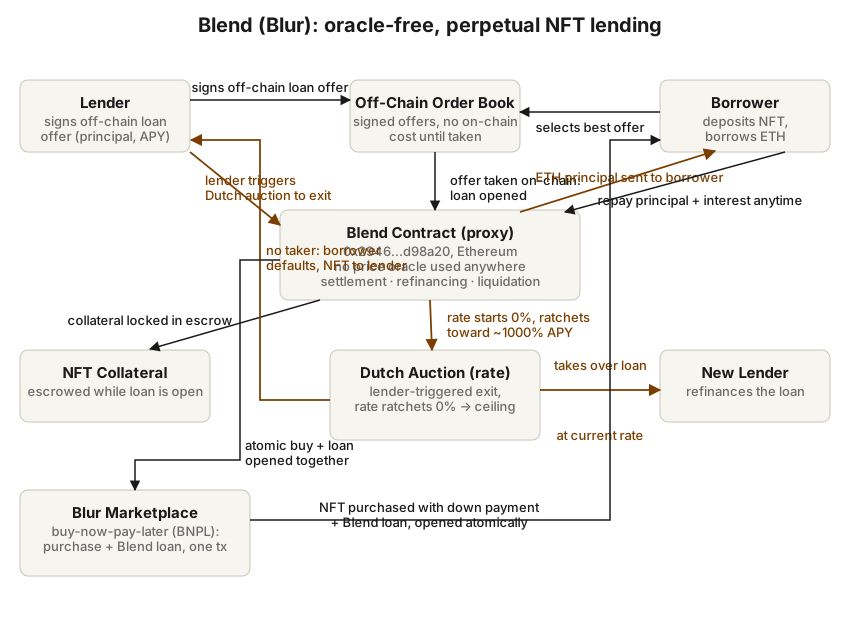 Open full-size diagram
Summary
Blend ("Blur Lending") is a peer-to-peer NFT-collateralized lending protocol launched on Ethereum on May 1, 2023 by the Blur NFT marketplace, designed with Paradigm researchers Dan Robinson and transmissions11 (the whitepaper credits Robinson, transmissions11, Galaga, Toad, and Blur founder "Pacman," Tieshun Roquerre). Its core wager was that NFT lending had been strangled by two dependencies — price oracles and fixed loan expiries — and that both could be removed. Blend loans are perpetual fixed-rate positions that stay open until the borrower repays or a lender-triggered Dutch auction in interest-rate space fails to find a replacement lender, at which point the collateral is liquidated to the lender. Plugged into Blur's dominant marketplace and its points/airdrop incentive machine, Blend loaned 8,875 ETH in its first 24 hours, quickly became Ethereum's largest NFT lending venue, and at peak (Q1 2024) processed roughly $2 billion in quarterly volume with ~90%+ market share. It then fell with the NFT market itself: by 2025 NFT lending volume had collapsed ~95% from its 2024 high, Blend's TVL dropped from over $115 million to around $3 million, and newer competitors like Gondi took majority market share.
Design (Mechanism)
- Perpetual, fixed-rate loans with no expiry. A borrower deposits an NFT from a supported collection (initially blue-chips such as wrapped CryptoPunks, Azuki, and Miladys) and borrows ETH against it. Interest accrues continuously; the borrower can repay at any time. There is no maturity date and no need to "roll" the loan.
- Off-chain offer matching, on-chain settlement. Lenders sign off-chain loan offers (principal, collection, APY, max borrow). Borrowers take the best offer; only settlement, refinancing, and liquidation touch the chain, keeping costs low — the same signature-heavy architecture Blur's exchange used.
- No oracles. Loan-to-value is never checked against a price feed. Risk is priced entirely by lenders choosing what principal and rate to offer against a given collection.
- Exit via Dutch auction in rate space. A lender who wants out triggers a refinancing auction: the offered interest rate starts at 0% and ratchets upward over time toward a very high ceiling (on the order of 1,000% APY). Any new lender can step in and take over the loan at the current rate. If the auction tops out with no taker, the position is deemed unbackable, the borrower defaults, and the original lender takes the NFT. Liquidation is thus triggered by market refusal to refinance, not by an oracle-observed price threshold.
- Borrow-then-buy (BNPL). Blend composed with Blur's marketplace so a buyer could purchase an NFT with a down payment, financing the remainder as a Blend loan opened atomically in the same transaction.
- Fees and governance. Blend launched with zero protocol fees for borrowers and lenders; after a 180-day period, BLUR token governance could turn on fees and tune auction parameters and rate caps. Lending activity earned Blur points toward BLUR airdrops, which heavily subsidized both sides of the market.
- Contracts. Upgradeable proxy at 0x29469395eaf6f95920e59f858042f0e28d98a20b ("Blur: Blend" on Etherscan), listed in Blur Foundation docs; audited pre-launch (ChainLight published a Blend audit completion note dated to late April 2023).
Outcome
Blend was, for about a year, the most successful NFT-fi product ever shipped. It lent 8,875 ETH in its first day, rapidly overtook incumbents (NFTfi, BendDAO, Arcade, ParaSpace) and, per CoinGecko/DappRadar-cited figures, drove NFT lending to a $2.02B quarterly volume high in Q1 2024, with Blend at roughly 93% market share ($562M in March 2024 alone). The mechanism itself worked as designed: no oracle failures, and refinancing auctions cleared or liquidated positions without protocol insolvency. The downside surfaced in 2024's NFT bear market: falling floor prices on collections like BAYC and Azuki led lenders to trigger auctions en masse, and many borrowers were liquidated — painful for users, but the losses landed on individual lenders/borrowers rather than as socialized protocol bad debt (contrast BendDAO's 2022 crisis). As BLUR airdrop incentives wound down and NFT flipping activity evaporated, volume collapsed 95% from the 2024 peak; Blend's TVL fell from >$115M to ~$3M, and its lending market share dropped from ~96% to ~30% as Gondi (54%) overtook it. Blend remains deployed and usable — a technically sound protocol serving a market that largely disappeared.
Why it worked
- Removing oracles removed the classic NFT-lending failure mode. BendDAO-style spirals came from oracle-based liquidation thresholds on illiquid collateral; Blend replaced them with a market test ("will anyone refinance this at any rate?"), which is the correct oracle for one-of-a-kind assets.
- Perpetual loans matched borrower psychology. NFT holders wanted leverage without deadline anxiety; lenders got a clean, unilateral exit ramp via the auction.
- Distribution and subsidies. Blend launched into Blur's existing pro-trader user base with points incentives, solving the two-sided cold-start problem that standalone NFT lenders never cracked.
- Composability with the marketplace (BNPL) turned lending into a sales-boosting feature, not just a leverage venue.
Where the design broke
- The underlying market evaporated. Blend priced NFT risk well but could not make NFTs worth borrowing against; when floors and flipping volume collapsed, so did loan demand.
- Incentive-driven volume was not organic. Much of the lending was farming Blur points; when airdrop expectations faded, both sides withdrew — the DappRadar-cited decline explicitly ties the drop to the end of airdrop-fueled flipping.
- Lender call-in risk was borrower pain. Lenders could trigger auctions at any moment, so downturns produced sudden forced refinancings at punitive rates and mass liquidations, amplifying short-term volatility and souring retail borrowers.
- Zero fees meant no protocol moat or revenue while competitors (e.g., Gondi) iterated on terms and took share once subsidies stopped.
Lessons
- Oracle-free, auction-based liquidation is a genuinely robust design for illiquid, non-fungible collateral: let the refinancing market, not a price feed, decide when a position is dead.
- Mechanism quality cannot substitute for durable organic demand; token-points subsidies can bootstrap a two-sided lending market but the volume they create leaves with them.
- Where risk lands matters as much as how much risk exists: Blend individualized losses (lender takes the NFT) instead of socializing bad debt, so a 95% market collapse produced user pain but no protocol insolvency.
- Perpetual instruments with unilateral lender exit shift duration risk onto borrowers; in a downturn that becomes a synchronized margin call even without oracles.
Redesign (EDITORIAL — hypothesis, not fact)
This section is editorial hypothesis, not established fact. A redesign might soften the lender call-in shock: require a minimum notice period or rate-cap schedule before auctions can escalate to liquidation, giving borrowers a bounded window to top up or self-refinance. Adding an opt-in "duration tranche" market — lenders committing to no-call periods for a rate premium — would let the market price call risk explicitly. Turning on a small protocol fee routed to a first-loss buffer per collection could smooth liquidation cliffs without reintroducing oracles. Finally, decoupling incentives from raw loan volume (rewarding loan duration and repayment instead) would have reduced wash-style points farming and produced a truer read on organic demand.
Sources
- Blend: Perpetual Lending With NFT Collateral (Paradigm) — primary (docs)
- Blur Foundation docs — Contracts — primary (docs)
- Blur: Blend contract on Etherscan — primary (contract)
- ChainLight — Completion of Audit for Blend — primary (audit)
- Blur, Paradigm devs unveil p2p lending protocol for NFTs (The Block) (news)
- NFT Lending Volume Surpass $2.1B, Led by Blend (CoinGecko Research) (analysis)
- NFT Lending Volume Plummets 95% From 2024 High: DappRadar (The Defiant) (news)
- NFT Lending TVL Nears All-Time Lows (The Defiant) (news)
- Blur co-founder Pacman reveals identity (CoinDesk) (news)
Related experiments
Last verified: 2026-07-27 · Spot an error? Suggest a correction