Blitmap
One of the earliest fully on-chain pixel-art NFT collections, built through a two-stage 'community crafting' mint that combined 100 artist-made originals into 1,600 derivative 'siblings,' and among the first released under CC0.
▶ Run interactive simulation animated mechanism with editable parameters
How it works onchain
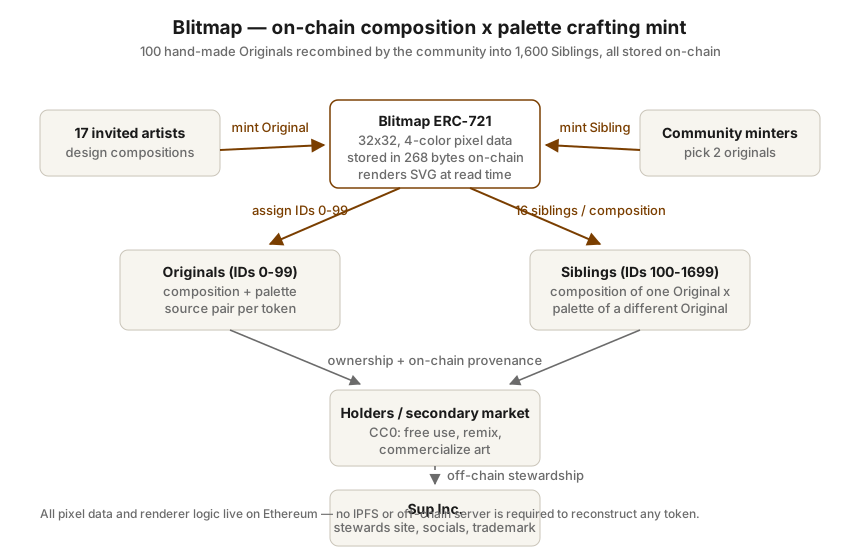 Open full-size diagram
Summary
Blitmap is a 1,700-piece collection of fully on-chain pixel-art NFTs on Ethereum, created by Dom Hofmann (co-founder of Vine, later creator of Loot) and released in 2021. It is remembered as one of the earliest works to store generative pixel art entirely on-chain and one of the earliest NFT collections released under the CC0 public-domain dedication. Rather than a conventional "blind mint," Blitmap used a two-stage "community crafting" process: a group of 17 invited artists first minted 100 hand-made "original" compositions (each a 32x32 image limited to four colors, encoded in 268 bytes), and then the broader community minted 1,600 "siblings" by recombining the composition of one original with the color palette of another. Minting opened May 31, 2021 and completed July 2, 2021. The project seeded a broader holder-governed "sci-fantasy universe" (Blitnauts, Blitkin, comics, physical goods) and its CC0 status made it a frequently cited reference point for the NFT CC0 movement.
Design (Mechanism)
Blitmap's core innovation was combining full on-chain storage with a compositional mint that made every token both scarce and derivative-by-construction:
- Fully on-chain art: Each Blitmap's pixel data and metadata (name, properties) are written directly to Ethereum. The data format constrains images to 32x32 pixels with up to 4 colors, fitting within 268 bytes so that the SVG/image can be regenerated on-chain from stored bytes without any off-chain server, IPFS pin, or maintenance. Permanence was an explicit design goal: the art persists as long as Ethereum does.
- Originals (100): 17 artists (on-chain handles include dom, worm, spacedoctor, zod, ceresstation, jstn, and others) each created a small number of the 100 originals under two hard constraints — a 32x32 canvas and a four-color palette. These occupy token IDs 0-99.
- Siblings (1,600): Each of the 100 original compositions could be minted up to 16 additional times as "siblings" (token IDs 100-1699). A minter selected any original composition and applied the palette of a different original, producing a recombined piece. This produced exactly 16 siblings per composition and even distribution rather than intentional rarity or randomized roulette.
- Deliberately non-random distribution: Hofmann explicitly rejected the era's standard "plunk down ETH, get-what-you-get" blind mint. Because siblings are deterministic combinations of existing originals, provenance and lineage are legible on-chain — every sibling traces to a composition source and a palette source.
- CC0 public domain: The original collection was dedicated to the public domain under CC0, allowing anyone to use, remix, and commercialize the art with no attribution or open-source requirement.
- Holder-governed universe: Blitmap positioned holders as stewards of an evolving "sci-fantasy universe," with airdrops, expansion packs, and community direction of lore over time. Stewardship of the website, socials, and trademark later passed to Sup Inc. (sup.xyz), an entity founded by two of the original artists.
Outcome
Blitmap became a canonical early-2021 "fully on-chain art" and CC0 reference project. Secondary trading was strong: reporting from September 2021 cited roughly $11.46M in volume across ~177 sales with an average sale price around $64,700, and multiple originals sold in the hundreds of thousands of dollars (e.g., #81 and #15 "Mask" reportedly ~$399,000 each). The collection completed its mint on schedule and spawned a durable ecosystem: Blitnauts (a separate ERC-721 collection airdropped/available to holders), Sugar (Genesis) airdrops (January 2022), comics, and physical goods (Blitkicks, Blitsocks). In February 2022, Dom Hofmann raised roughly $12M to build a decentralized sci-fi universe associated with this body of work. As of 2026 the contract remains live, art renders on-chain without maintenance, and the collection is still traded on secondary markets. Given lasting cultural influence, a completed mint, a functioning holder ecosystem, and the CC0 precedent it helped popularize, the outcome is best characterized as a major_success as an art/cultural experiment, though floor prices have retreated sharply from 2021-2022 peaks.
Why it worked
- Genuine technical firsts: Fully on-chain pixel art with an efficient 268-byte encoding was rare in early 2021 and gave the project a credible "permanence" narrative that survives server/IPFS decay.
- A novel, legible mint mechanic: Composition-plus-palette crafting produced provenance and lineage that felt curated and meaningful rather than random, differentiating Blitmap from the flood of blind-mint PFP drops.
- Founder credibility and network: Hofmann's track record (Vine, and soon Loot) plus a roster of respected pixel artists brought attention, talent, and secondary demand.
- CC0 as a growth flywheel: Public-domain dedication invited derivatives (e.g., Flipmap and other community works), turning the IP into an open cultural primitive frequently cited in the CC0 thesis.
- A universe, not just a JPEG: Airdrops, expansion packs, and holder-guided lore gave holders forward-looking reasons to stay engaged.
Limitations and criticisms
- Speculative valuations proved unsustainable: Six-figure original sales and high average prices in 2021 receded substantially as the broader NFT market cooled; floor prices are far below cycle highs.
- Roadmap and stewardship complexity: The universe fragmented across many spin-offs (Blitnauts, Blitkin, Sugar, comics, physical goods) and organizational stewardship moved to Sup Inc., which can dilute a single clear narrative and make "who is driving the universe" ambiguous to newcomers.
- CC0 double edge: Public-domain status maximized cultural spread but weakened the ability of holders to capture exclusive commercial upside from the IP, a recurring tension in CC0 projects.
Lessons
- On-chain permanence is a design constraint, not a slogan: Blitmap's four-color/32x32/268-byte format shows that "fully on-chain" is achievable only by aggressively bounding the art's dimensionality to keep encoding and rendering gas-viable — the constraint became part of the aesthetic.
- Mint mechanics can encode provenance: Making tokens deterministic recombinations of a small curated base (composition x palette) yields transparent lineage and even distribution, an alternative to randomized rarity that other collections can borrow.
- CC0 trades captured value for cultural reach: Open licensing accelerates derivative ecosystems and canonical status but should be chosen deliberately, since it limits holders' exclusive commercial leverage over the IP.
- A "universe" needs clear stewardship: Long-lived holder-governed ecosystems benefit from an explicit, accountable steward (here, Sup Inc.) — but multiplying spin-offs without a unifying narrative can dilute attention.
Redesign (EDITORIAL — hypothesis, not fact)
The following is the researcher's editorial hypothesis, not established fact.
If relaunched today, Blitmap could preserve its strongest ideas (fully on-chain art, curated originals, deterministic recombination, CC0) while addressing the value-capture and stewardship weaknesses. One approach: keep originals and siblings fully on-chain and CC0, but formalize on-chain governance so holders provably steer the universe (e.g., token-weighted or one-per-wallet signaling contracts that gate airdrops, canon lore, and treasury use), replacing off-chain, entity-mediated stewardship with transparent on-chain processes. The composition x palette mechanic could be generalized into an open, permissionless "crafting" primitive: rather than capping siblings at a fixed 1,600, allow ongoing on-chain remixing where new derivative mints pay a small fee routed to the source composition's artist and to a community treasury — giving creators durable, programmatic royalties even under CC0 (royalties enforced by the minting path, not by marketplaces). To reconcile CC0's openness with holder value, the redesign could separate the art (CC0, maximally spreadable) from time-bound utility (governance rights, crafting priority, universe access) attached to holding, so cultural reach and holder incentives no longer directly conflict. Finally, consolidating the sprawling spin-offs behind a single on-chain registry/canon contract would keep the "one universe" narrative legible as it expands. These are hypotheses; each adds contract-surface and governance-capture risk that would need careful auditing.
Sources
- Blitmap Official Info / FAQ — primary (docs)
- Blitmap Official Homepage (links to Twitter, Discord, contract) — primary (docs)
- Blitmap Original Blitmaps ERC-721 contract (Etherscan token page, linked from official site) — primary (contract)
- Original Artists' retrospective (blitmap.mirror.xyz) — primary (retrospective)
- Blitmap - IQ.wiki encyclopedia entry (analysis)
- Primer on Blitmap and Why Flipmap is Material to the CC0 Thesis - NiftyPins / NFT x IRL (analysis)
- Creator of Vine and Loot raises $12 million for decentralized sci-fi project - The Block (news)
- Dom Hofmann - Wikipedia (analysis)
Related experiments
Last verified: 2026-07-26 · Spot an error? Suggest a correction