Blur
Pro-trader NFT marketplace and aggregator that used retroactive token airdrops, zero fees, and optional royalties to seize the majority of Ethereum NFT volume from OpenSea, then added Blend, an oracle-free perpetual NFT lending protocol.
▶ Run interactive simulation animated mechanism with editable parameters
How it works onchain
 Open full-size diagram
Summary
Blur is an Ethereum NFT marketplace and aggregator "for pro traders" that launched on October 19, 2022, founded by Tieshun Roquerre (then pseudonymous as "Pacman," a Thiel Fellow and MIT dropout who had previously sold Namebase to Namecheap) with backing from Paradigm and Standard Crypto. Blur's core experiment was mechanism-design-as-go-to-market: zero marketplace fees, optional creator royalties (later a 0.5% minimum), a fast trading UX with portfolio analytics and multi-marketplace sweeping, and — decisively — a months-long retroactive points campaign ("care packages") that converted trading and bidding activity into a BLUR token airdrop. Within months of the February 14, 2023 token launch (an airdrop worth roughly $100M+ at listing), Blur flipped OpenSea to command an ~80% share of Ethereum NFT trading volume. In May 2023 it extended the experiment with Blend, a peer-to-peer perpetual NFT lending protocol co-designed with Paradigm's Dan Robinson and transmissions11, which quickly dominated NFT lending. Blur's volume proved heavily incentive-dependent: as rewards migrated to Pacman's Blast L2 and the NFT market contracted, activity decayed, and by 2025 OpenSea had reclaimed the majority of Ethereum NFT volume.
Design (Mechanism)
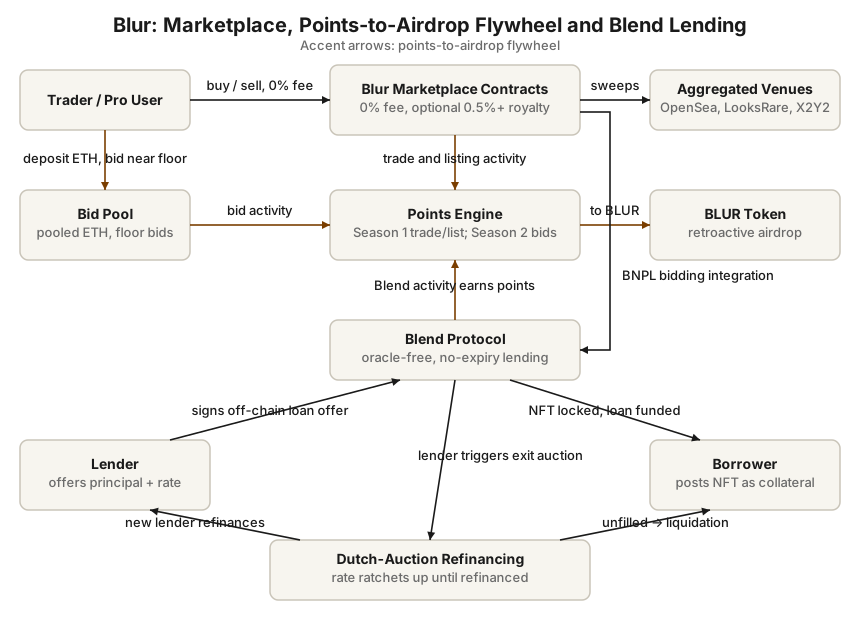
Marketplace + aggregator. Blur aggregates listings from OpenSea, LooksRare, X2Y2 and its own order book, with batch "sweeping," real-time price feeds, and trait-level bidding. Marketplace fees are 0%; creator royalties were made optional (minimum 0.5%), directly undercutting OpenSea's fee model. Core exchange contracts on Ethereum include the original marketplace at 0x0000...0B95127 and successors (Marketplace 2 and 3), with the BLUR ERC-20 governance token at 0x5283...208b44.
Points-to-airdrop flywheel. Instead of upfront liquidity mining, Blur ran seasonal retroactive rewards. Season 1 (pre-token) awarded "care packages" for trading and for listing NFTs on Blur; Season 2 shifted emphasis to bidding: traders earned points for placing collection-wide bids close to the floor price via pooled bid liquidity (deposited ETH in the Blur bid pool), with loyalty multipliers for listing exclusively on Blur. Points converted to BLUR at season end, so market-making itself was the farmed activity — the airdrop paid users to become the order book. The token launched February 14, 2023, triggering an immediate volume explosion and the flip of OpenSea.
Blend (May 2023). Blend is a peer-to-peer perpetual lending protocol using NFTs as collateral: no oracles, no expiries. Lenders sign off-chain offers (principal, rate) against a collection; loans persist until repaid or until the lender triggers a Dutch auction in which the interest rate ratchets upward until a new lender refinances the position — if none does, the borrower is liquidated and the lender takes the NFT. Blend also powered "buy now, pay later" bidding on the marketplace. Blend points fed the same seasonal airdrop machine.
Outcome
Blur succeeded spectacularly at capturing share: by early-to-mid 2023 it held roughly 80% of Ethereum NFT trading volume (versus ~15% for OpenSea), forced OpenSea to cut fees to 0% and make royalties optional, and Blend rapidly became the dominant NFT lending venue. The site reports several billion dollars in cumulative GMV. But the experiment also demonstrated the limits of incentive-driven volume: a large fraction of activity was wash-adjacent farming by a small cohort of point-maximizing whales; BLUR's price fell steeply after each unlock and season; and creator royalties across the industry were structurally crushed. When Pacman launched the Blast L2 (late 2023) and Season 3 rewards moved there, Blur's own market makers stepped back. Amid the broader NFT contraction, OpenSea regained majority share of Ethereum NFT volume by 2025 (reported at ~50-70%+ in various months). Blur still operates, but as a diminished venue in a diminished market — hence: partial success.
Why it worked
- Retroactive rewards targeted the right users. Paying points to bidders near the floor manufactured deep two-sided liquidity, which is the actual product of an exchange; pro traders followed the liquidity.
- Fee/royalty undercutting was a credible one-way ratchet. Incumbents earning 2.5% + royalties could not match 0% without destroying their own model — until they had to.
- Vertical integration compounding: aggregation captured flow, the bid pool captured liquidity, Blend captured leverage demand, and all three fed one points system.
- Blend's oracle-free, expiry-free design (Dutch-auction refinancing) was a genuinely novel lending primitive that minimized trust assumptions and admin overhead.
Where the design broke
- Mercenary liquidity did not convert to retention. Volume tracked emissions; when Season rewards shifted (and Blast cannibalized attention), farmers left and organic volume proved thin.
- Token reflexivity cut both ways: BLUR emissions financed the flywheel, but persistent sell pressure from farmers and unlocks eroded the token's value and thus the subsidy's power.
- The royalty race to the bottom alienated creators — the supply side of NFTs — undermining the ecosystem Blur depended on.
- Macro headwind: the 2022-2025 NFT market collapse shrank the prize; dominant share of a shrinking market is a Pyrrhic win. Blend leverage also amplified drawdowns in blue-chip collections (loan spirals and liquidation cascades during floor declines).
Lessons
- Points-for-liquidity airdrops are the single most effective marketplace bootstrap discovered onchain — and among the least durable; design for the day emissions end before you start emitting.
- Incentivizing bids (market making) rather than raw volume buys real order-book depth, but it selects for professional farmers whose loyalty is exactly as deep as the subsidy.
- Fee wars are asymmetric warfare: a zero-fee entrant with a token treasury can force incumbents to give up their revenue model, but the equilibrium (0% fees, optional royalties) can leave the whole category poorer.
- Oracle-free lending via Dutch-auction refinancing (Blend) shows you can replace price oracles with a market process — the lender exit auction is the price discovery.
- Founder attention is a protocol dependency: routing Season 3 to the founder's next venture (Blast) revealed how much of the "protocol" was really a campaign.
Redesign (EDITORIAL — hypothesis, not fact)
This section is editorial speculation. A redesigned Blur would (1) vest airdropped tokens against future retention metrics — e.g., points convert over 12 months proportional to continued (non-emission-boosted) liquidity provision — to filter mercenary flow; (2) hard-code a modest creator royalty (1-2%) at the exchange-contract level and market it as a creator alliance, converting the supply side into distribution rather than an adversary; (3) turn the bid pool into a shared, fee-earning liquidity layer (an NFT AMM/vault where passive LPs earn spread plus Blend interest) so depth persists without emissions; and (4) govern reward-season parameters via a BLUR tokenholder process with commitments against redirecting incentives to affiliated ventures. The bet: slightly slower capture in exchange for volume that survives the end of the subsidy.
Sources
- Blur official site — primary (docs)
- Blur.io: Marketplace contract (Etherscan) — primary (contract)
- BLUR token contract (Etherscan) — primary (contract)
- Blend: Perpetual Lending With NFT Collateral (Paradigm) — primary (docs)
- Blur announcement of Blend (X thread) — primary (docs)
- NFT Marketplace Blur Co-Founder 'Pacman' Reveals Identity (CoinDesk) (news)
- Blur's Pacman doxxes himself and outlines plan to become the Binance of NFTs (The Block) (news)
- Blur, Paradigm devs unveil p2p lending protocol for NFTs (The Block) (news)
- Blur's decline fuels OpenSea's market share surge amid broader NFT struggles (The Block) (news)
- Blur Overtakes OpenSea as NFT Market Leader Following Airdrop (BeInCrypto) (news)
- Blur airdrop recipients get leg up in upcoming Blast airdrop (DL News) (analysis)
- The Rise of Blur and Reflexivity in the NFT Market (Coinmonks) (analysis)
Related experiments
Last verified: 2026-07-27 · Spot an error? Suggest a correction