Shibuya
pplpleasr's Ethereum-based film platform where audiences crowdfund productions via Producer Pass NFTs and vote on story direction, producing the Emmy-winning interactive anime White Rabbit.
▶ Run interactive simulation animated mechanism with editable parameters
How it works onchain
 Open full-size diagram
Summary
Shibuya is a "direct-to-community" film platform founded by NFT artist Emily "pplpleasr" Yang (creator of the Uniswap V3 launch animation and the "Stay Free" Edward Snowden NFT) and concept artist Maciej Kuciara (previously a visual-development artist on Marvel films). Launched March 1, 2022 on Ethereum, its pitch was to become "the A24 of web3": let audiences crowdfund long-form animation and film by buying Producer Pass NFTs, then let those same backers vote on the creative direction of each chapter — a blockchain-native choose-your-own-adventure production model. Its flagship project, the interactive anime White Rabbit, raised roughly 400 ETH (~$1.2M) in about 30 minutes and ultimately won the 2025 Primetime Emmy for Outstanding Innovation in Emerging Media Programming — widely reported as the first crypto-native project to win an Emmy. Shibuya itself raised a $6.9M seed round in December 2022 led by a16z crypto and Variant, with participation from Paris Hilton and Kevin Durant, at a reported ~$50M valuation.
Design (Mechanism)
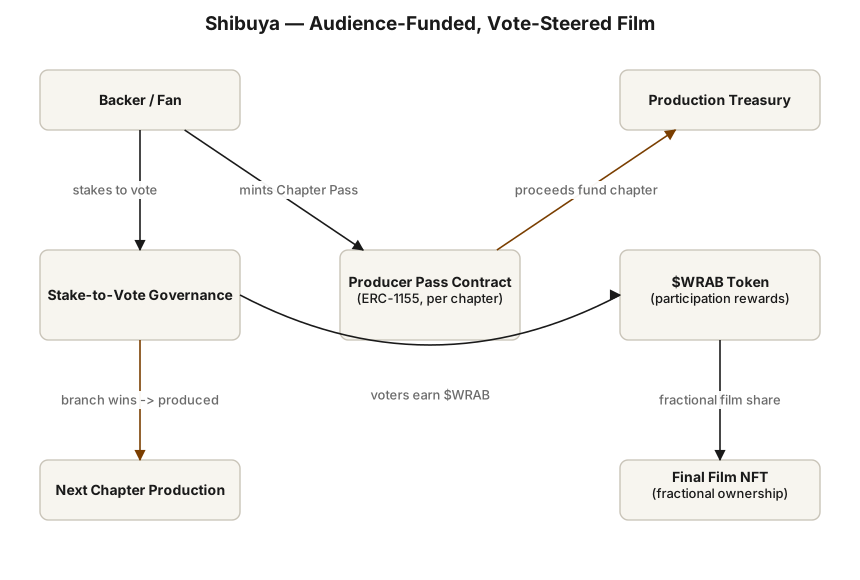
The core mechanism stack, as implemented for White Rabbit:
- Producer Pass NFTs (crowdfunding): Each story chapter had its own ERC-1155 Producer Pass (Chapter 1: 5,000 passes at 0.08 ETH, max five per wallet), styled after movie ticket stubs. Mint proceeds funded production of that chapter. Contract:
0x97ed92E744C10FdD5D403A756239C4069e415e79. - Stake-to-vote narrative governance: At the end of each chapter, pass holders staked their NFT to vote between two branching story paths. The winning path was then produced as the next chapter — the audience literally steered the plot.
- $WRAB participation rewards: Voters earned $WRAB, an Ethereum token representing fractionalized ownership of the final film NFT. Bonuses accrued for voting early and for backing the winning branch, creating a prediction-market-like incentive to engage. pplpleasr explicitly disclaimed guaranteed financial benefit, framing it as experimental.
- Reputation layer: A DegenScore-powered system customized the viewing experience and generated live-updating "credits" leaderboards ranking top producers.
- Post-relaunch model (shibuya.film): After a quiet period, the platform relaunched (covered in May 2025) with a softened model: films stream free, audiences "greenlight" projects with fiat donations that are fully refunded if targets aren't met, and Base (Coinbase's L2) sponsored the first season, with deeper onchain integration deferred.
Outcome
Mixed but historically significant. The White Rabbit crowdfund was an emphatic short-term success ($1.2M in ~30 minutes) and validated NFT-based film financing at a moment of peak NFT enthusiasm. The interactive series was completed through its chapter-vote structure and, in September 2025, won the Primetime Emmy for Outstanding Innovation in Emerging Media Programming — mainstream cultural validation few onchain experiments ever achieve. However, the original token-heavy model did not persist: floor prices for Producer Passes collapsed with the broader NFT market (the OpenSea collection later listed around 0.003 ETH), the shibuya.xyz domain now redirects to shibuya.film, and the relaunched platform de-emphasized NFTs, staking, and $WRAB in favor of free streaming plus refundable fiat donations. The company remains active as of mid-2026 with a slate of live-action and animated shorts. Detailed public accounting of $WRAB distribution and final-film fractional ownership outcomes: Unknown / not found.
Why it worked
- Founder distribution: pplpleasr was one of the most recognizable artists in crypto in 2021–22; her audience was pre-sold on funding her next work, which made the initial mint nearly frictionless.
- Real utility, not just membership: The pass did something — it gated a genuinely binding vote on the story, so holders felt like producers rather than speculators (even if many were both).
- Aligned incentive loop: Fund → watch → vote → earn ownership tokens tied the financial instrument to actual engagement with the content, rather than passive holding.
- Craft credibility: Kuciara's AAA visual pedigree meant the output was legitimately high-quality anime, culminating in Emmy recognition that transcended crypto circles.
Where the design broke
- Market dependence: The 0.08 ETH mint model was viable only in a bull market; when NFT demand evaporated in 2022–23, the per-chapter crowdfund engine lost its fuel and pass values collapsed.
- Speculation/patronage tension: Fractionalized film ownership via $WRAB attracted flippers whose exit crushed secondary prices, souring the community signal.
- Binary votes are shallow governance: Choosing between two pre-authored branches is engagement theater more than creative control; the cost of producing both branches' groundwork limits how much agency can really be given.
- Crypto UX excluded the film audience: Requiring ETH, wallets, and staking filtered out mainstream film lovers — which the relaunch tacitly admitted by moving to free streaming and refundable fiat donations.
Lessons
- Attaching funding instruments to verifiable participation (stake-to-vote, early/winning-vote bonuses) produces far stronger community engagement than passive NFT membership — but also imports prediction-market speculation into creative decisions.
- Crowdfunding models denominated in a volatile asset inherit that asset's cycle: a mechanism that raises $1.2M in 30 minutes in a bull market can be unusable eighteen months later. Sustainable media platforms need fiat-graceful degradation, which Shibuya eventually adopted.
- Cultural legitimacy can outlive the mechanism that funded it: the Emmy came three years after the NFT model peaked, suggesting onchain funding's durable value may be as a bootstrapping tool for IP, not the permanent business model.
- Fractional ownership promises ("this token represents a share of the film") create expectations that are hard to honor; explicit experimental disclaimers only partially mitigate this.
Redesign (EDITORIAL — hypothesis, not fact)
This section is editorial analysis — a hypothesis, not a factual account. A modern redesign would keep Shibuya's best invention — binding audience votes funded by the audience itself — while removing the volatility and ownership-claim ambiguity. Denominate crowdfunds in stablecoins on an L2 (Base, where Shibuya already has a relationship) with an all-or-nothing escrow contract that auto-refunds if the target isn't met, formalizing onchain what the relaunch does with fiat. Replace $WRAB-style fractional ownership with a non-financial, soulbound "producer credit" that accrues voting weight and on-screen credit across seasons — rewarding curation reputation instead of promising cash flows — and route any actual revenue sharing through an explicit, clearly documented agreement with backers. Deepen the governance from binary endings to staged greenlighting (loglines → animatics → episodes), where each vote allocates real budget, so audience agency is substantive rather than cosmetic. Finally, abstract wallets entirely at purchase time (email sign-in, embedded wallets, fiat on-ramp) so the mechanism is invisible to the median filmgoer and the chain serves as settlement and provenance, not as the product.
Sources
- Pplpleasr's Shibuya Video Platform Uses Ethereum NFTs to Fund and Shape Films (Decrypt) (news)
- Shibuya official site (shibuya.film) — primary (docs)
- White Rabbit Producer Pass contract (Etherscan) — primary (contract)
- Investing in Shibuya: Decentralized Creativity (Variant Fund) (analysis)
- NFT artist pplpleasr just raised $7M to reinvent film (Fortune) (news)
- Outstanding Innovation in Emerging Media Programming 2025 (Television Academy) — primary (archive)
- pplpleasr Relaunches Shibuya, a Blockchain-Powered Film Platform (SignalPlus, May 2025) (news)
- Crowd-funding an Emmy-award winning short film through audience participation (Artechouse) (analysis)
Related experiments
Last verified: 2026-07-26 · Spot an error? Suggest a correction