Centrifuge
Real-world-asset tokenization protocol that pioneered onchain securitization with tranched Tinlake pools, became MakerDAO's first RWA collateral pipeline, and migrated from a Polkadot parachain to an EVM-native multichain protocol managing ~$1.5B+ in tokenized funds.
▶ Run interactive simulation animated mechanism with editable parameters
How it works onchain
 Open full-size diagram
Summary
Centrifuge is the longest-running serious attempt to put private credit and traditional securities onchain. Founded in Berlin in 2017 by four Taulia alumni — Lucas Vogelsang (CEO), Martin Quensel (COO), Maex Ament, and Philip Stehlik — it started from a supply-chain-finance insight: small businesses hold billions in illiquid invoices and receivables that banks finance poorly, while DeFi holds idle stablecoin liquidity looking for yield. Its flagship dApp, Tinlake, launched on Ethereum (pools live from 2020) as an open securitization marketplace where "asset originators" tokenize invoices, real-estate bridge loans, or freight receivables as NFTs and borrow against them from two-tranche pools. Centrifuge became the first protocol to put RWA collateral into MakerDAO (DROP tokens backing DAI vaults from 2021) and later ran a dedicated Polkadot parachain before reversing course in July 2025 with Centrifuge V3, an EVM-native multichain protocol. By 2025–26 it had pivoted decisively from small-business credit toward institutional tokenized funds — Janus Henderson's AAA CLO fund (JAAA, ~$1B on Centrifuge by October 2025), the Anemoy/JTRSY treasury fund, and a tokenized S&P 500 index product — with protocol TVL reported near $2B at its April 2026 peak.
Design (Mechanism)
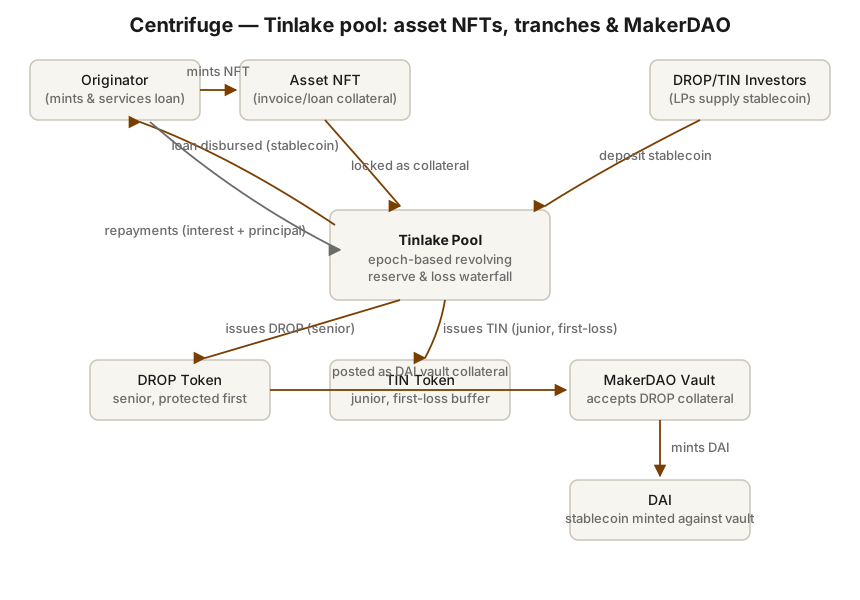
Asset NFTs as collateral. Originators mint an NFT representing each real-world asset (an invoice, a mortgage, a royalty stream), with off-chain documents anchored via hashes (the "Centrifuge P2P/POD" document layer). The NFT is locked into a Tinlake pool as loan collateral, priced by the pool's appointed underwriter.
Two-tranche securitization. Each pool issues two ERC-20 investment tokens, explicitly modeled on structured finance: DROP (senior tranche, stable fixed-rate yield, protected from first losses) and TIN (junior tranche, higher variable yield, absorbs defaults first). A minimum TIN "buffer" ratio forces the originator and risk-seeking investors to hold skin-in-the-game first-loss capital before senior money can enter. When an asset defaults, the writedown hits TIN's token price before DROP is touched.
Epoch-based revolving pools. Rather than fixed-term deals, pools run continuous epochs in which invest/redeem orders are batched and a solver executes them subject to tranche-ratio and reserve constraints — an onchain approximation of a revolving credit facility.
Stablecoin liquidity plumbing. DROP tokens were onboarded as MakerDAO vault collateral (New Silver and others from 2021; BlockTower Credit later at nine-figure scale), letting pools mint DAI directly against senior tranches. An Aave RWA market (2021) offered a similar permissioned route.
Chain architecture and token. Centrifuge Chain launched as a Proof-of-Stake Substrate chain (mainnet 2020, later a Polkadot parachain) with CFG as its gas/governance token, bridged to Ethereum as WCFG. In 2025, governance approved consolidating CFG+WCFG 1:1 into a single ERC-20 (0xcccCCCcCCC33D538DBC2EE4fEab0a7A1FF4e8A94), with a migration window May 20–November 30, 2025, and the legacy parachain deprecated. V3 deploys natively across Ethereum, Base, Arbitrum, Avalanche, BNB Chain, Plume, and extends to Solana and Stellar, focusing on tokenized fund infrastructure and "deRWA" freely transferable fund tokens.
Outcome
Ongoing, and one of the few 2017-vintage projects whose original thesis (RWAs onchain) became a leading industry narrative. Tinlake financed hundreds of millions across dozens of pools and made MakerDAO the first major protocol holding RWA collateral. But the SME-credit era also produced real credit losses: the ConsolFreight CF4 pool disclosed in August 2023 a risk of total or partial loss on receivables owed by the Hanhwa entities, and junior/senior investors in several legacy pools experienced defaults and frozen redemptions — demonstrating the mechanism worked as designed (TIN absorbed losses first) but that underwriting quality, not smart contracts, was the binding constraint. The 2024–25 institutional pivot changed the product entirely: rated, regulated fund wrappers (JTRSY passed $500M AUM within weeks; JAAA reached ~$1B on Centrifuge in October 2025; a licensed S&P 500 index fund followed), pushing platform TVL to a reported ~$2B peak in April 2026. The Polkadot bet was abandoned as a strategic dead end; liquidity and distribution lived on EVM chains.
Why it worked
- Honest financial engineering. Instead of inventing exotic tokenomics, Centrifuge ported a battle-tested TradFi structure (senior/junior securitization with first-loss buffers) into transparent smart contracts — legible to both DeFi users and institutional credit people.
- Founder-market fit. The Taulia founding team had spent a decade in supply-chain finance and knew originators, servicers, and the legal plumbing (SPVs per pool) that pure-crypto teams underestimated.
- Anchor demand from MakerDAO. Plugging DROP into DAI vaults gave pools a scaled, credible liquidity source and gave Maker diversification — a genuine two-sided win that bootstrapped the RWA category.
- Willingness to kill its own architecture. Migrating off its bespoke parachain to EVM-native deployment (and consolidating the token) followed liquidity rather than defending sunk costs.
Limitations and criticisms
- SME credit hasn't scaled onchain. Small pools, bespoke underwriting, per-pool SPVs, and KYC'd tranches mean high fixed costs and thin DeFi-native demand; several pools took defaults (ConsolFreight CF4 among the documented cases), souring retail appetite for junior tranches.
- The parachain detour cost years. Running a sovereign Substrate chain added a bridge, a wrapped token (CFG/WCFG), and ecosystem isolation with little compensating benefit; V3 is an implicit admission that settlement should live where liquidity is.
- Trust remains off-chain. Asset existence, servicing, and recovery all depend on legal agreements and honest originators; the chain verifies token flows, not trucks or invoices — a structural oracle problem the design mitigates but cannot remove.
Lessons
- Tranching is the right primitive for onchain credit: first-loss junior capital aligns originators and protects senior lenders far better than overcollateralization theater — but it only prices risk correctly if underwriting is competent.
- RWA protocols succeed on distribution, not technology: the pivot from "DeFi users buy freight invoices" to "asset managers issue rated funds onchain" is what unlocked billions in TVL.
- App-specific chains are a liability for asset issuers; issuance infrastructure should deploy to wherever settlement liquidity already lives, even at the cost of a painful token migration.
- Credit losses are survivable if the loss waterfall is explicit and honored onchain; hidden or discretionary loss allocation is what kills lending protocols.
Redesign (EDITORIAL — hypothesis, not fact)
This section is editorial speculation. A redesigned Centrifuge might have skipped the sovereign-chain phase entirely and shipped Tinlake as a multichain EVM protocol from 2020, spending the parachain-era engineering budget on standardized originator underwriting and disclosure instead (mandatory third-party servicer attestations, streaming loan-tape oracles, and an onchain reserve/insurance tranche capitalized by protocol fees to backstop junior-tranche defaults). It could also have separated the two businesses earlier: a permissionless securitization protocol for crypto-native credit, and a regulated fund-tokenization stack for institutions — the eventual V3 shape — rather than stretching one pool design across both audiences. Finally, tying CFG value capture to pool fees from day one (rather than gas/governance on a low-activity chain) might have avoided the token's long disconnect from protocol traction.
Sources
- Centrifuge Docs — Centrifuge V1 (Tinlake, legacy) — primary (docs)
- Centrifuge Docs — Legacy CFG/WCFG Migration to Ethereum — primary (docs)
- Centrifuge blog — We're Migrating the CFG Token — primary (docs)
- Lucas Vogelsang — A tale of two tokens: Introducing TIN & DROP — primary (retrospective)
- Centrifuge governance forum — ConsolFreight CF4 Pool Update August 2023 (default notice) — primary (governance)
- Janus Henderson press release — first tokenized fund with Anemoy and Centrifuge — primary (news)
- CFG token on Etherscan — primary (contract)
- The Defiant — Centrifuge Migrates to Ethereum with Cross-Chain EVM-Native Protocol (news)
- The Defiant — Centrifuge Surpasses $1 Billion in TVL (news)
- Token Terminal — The state of Centrifuge (analysis)
- Gemini Cryptopedia — Centrifuge: Tokenization of Real-World Assets (analysis)
Related experiments
Last verified: 2026-07-27 · Spot an error? Suggest a correction