Ondo Finance
A DeFi structured-products protocol that pivoted into the leading tokenized real-world-asset issuer, bringing US Treasuries (OUSG, USDY) and later tokenized stocks onchain under a compliance-gated token model.
▶ Run interactive simulation animated mechanism with editable parameters
How it works onchain
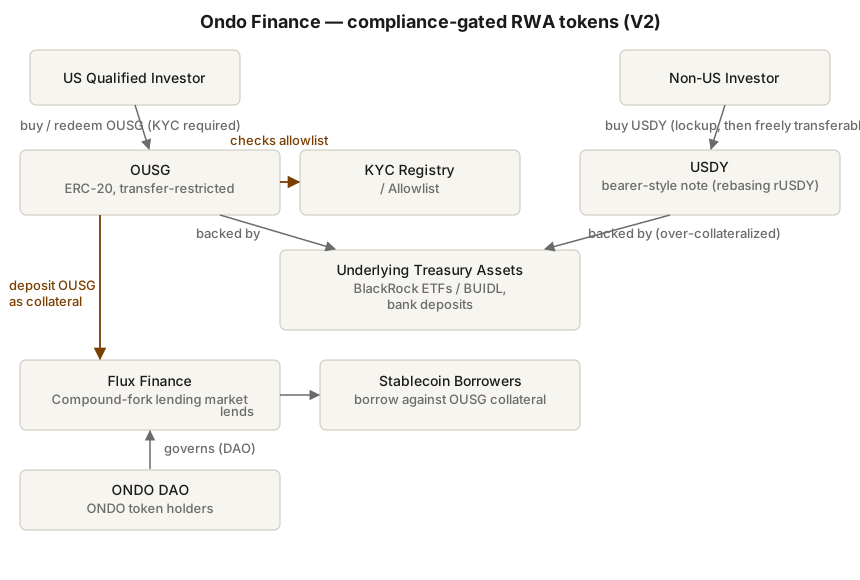 Open full-size diagram
Summary
Ondo Finance is one of the clearest examples in DeFi of a successful mid-flight pivot. Founded in 2021 by Nathan Allman and Pinku Surana, both formerly of Goldman Sachs, Ondo launched in August 2021 as a structured-finance protocol offering tranched liquidity vaults, then a "Liquidity-as-a-Service" (LaaS) product with Fei Protocol. When DeFi-native yields collapsed in 2022 while US Treasury rates rose above them, Ondo wound down V1 and relaunched in January 2023 as an issuer of tokenized real-world assets: OUSG (tokenized short-term US Treasuries for qualified investors), USDY (a permissionless-transfer "yieldcoin" for non-US users, launched August 2023), the Flux Finance lending market governed by the ONDO-token DAO, and eventually Ondo Global Markets / Ondo Stocks (100+ tokenized US equities and ETFs, September 2025) and a purpose-built L1, Ondo Chain (announced February 2025). By 2026 Ondo held roughly $3.5B in TVL across products and had become the reference design for compliance-gated RWA tokens. Founder Nathan Allman died unexpectedly in May 2026 at age 35; former McKinsey partner Ian De Bode became CEO.
Design (Mechanism)
V1 (2021–2022): tranched vaults and LaaS. Ondo Vaults split a Uniswap V2 LP position into a fixed tranche (senior, targeting a fixed return with downside protection) and a variable tranche (junior, levered exposure to fees and price movement). LaaS applied this to protocol-owned liquidity: a DAO deposited its governance token into the variable side while a stablecoin issuer (Fei, later Frax and others) matched with stablecoins on the fixed side, bootstrapping AMM liquidity without liquidity mining. Over ten protocols participated and V1 facilitated over $210M in liquidity before being wound down.
V2 (2023–): compliance-gated RWA tokens. OUSG is a tokenized fund holding short-term US Treasury exposure (initially via BlackRock ETFs, later including BUIDL). The ERC-20 is transfer-restricted: a KYC registry/allowlist is checked on every transfer, so tokens only move between approved addresses — the template most subsequent institutional RWA tokens copied. USDY inverted the tradeoff: it is a bearer-style tokenized note backed by Treasuries and bank deposits, over-collateralized, transferable permissionlessly after an initial lockup — but offered only to non-US persons. Yield accrues via price appreciation (with a rebasing variant, rUSDY). Flux Finance, a Compound-fork lending market governed by the Ondo DAO via the ONDO token, let OUSG serve as collateral to borrow stablecoins, giving the gated asset DeFi utility. Ondo Stocks extends the model to tokenized equities, and Ondo Chain proposes a permissioned-validator L1 where institutions validate an RWA-native network.
Outcome
The pivot succeeded on essentially every axis crypto markets measure. OUSG was among the first tokenized Treasury products (January 2023) and helped ignite the tokenized-Treasury category that grew from near zero to billions of dollars. As of mid-2026 the official site reports about $2.16B in USDY, ~$395M in OUSG, and over $1B across 440+ tokenized stocks with ~83,000 holders; press coverage cites ~$3.5B total TVL. Ondo raised a $20M Series A (Founders Fund, Pantera, Coinbase Ventures, Tiger Global), the ONDO token became a top-100 asset after unlocking in January 2024, and partners/design advisors include Franklin Templeton, Wellington Management, WisdomTree, BlackRock (as underlying asset manager), and Google Cloud. The original V1 product, by contrast, was a commercial dead end and was formally deprecated.
Why it worked
- Macro timing: rising rates made a 4–5% "risk-free" onchain yield the single most demanded product in crypto exactly when Ondo relaunched.
- Segmented compliance design: rather than one compromise product, Ondo shipped OUSG (fully gated, for US qualified purchasers) and USDY (freely transferable, non-US only), matching legal structure to user segment.
- Credibility arbitrage: ex-Goldman founders, blue-chip backers, and BlackRock-managed underlying assets let TradFi institutions treat Ondo as a peer, not a crypto counterparty.
- Willingness to kill V1: winding down a live product with $200M+ of historical volume freed the team before the 2022 bear market destroyed structured-yield protocols.
Limitations and criticisms
- V1 vaults/LaaS never found durable demand; fixed-tranche yields could not compete once DeFi yields compressed, and LaaS depended on partners (notably Fei/Tribe, which itself shut down in 2022) — a genuine dead end that was wound down rather than a hidden success.
- The compliance gating that makes OUSG legally robust also strangles composability; Flux Finance was needed precisely because the token could not flow through open DeFi, and Flux remained small relative to Aave/Compound.
- USDY excludes US persons entirely — the protocol's home market — illustrating the unresolved US regulatory position for yield-bearing stablecoins.
- ONDO token value accrual is indirect (governance over Flux/DAO), a recurring criticism given the equity-like value concentrating in Ondo's operating companies.
Lessons
- A protocol's real moat can be legal engineering, not smart-contract engineering: Ondo's transfer-restricted ERC-20 plus offshore note structure became the industry template.
- Pivot to where the yield is. When the risk-free rate exceeds DeFi-native yield, tokenizing the risk-free rate beats financial engineering on top of DeFi.
- Product segmentation by jurisdiction (gated OUSG vs. permissionless-but-non-US USDY) beats a single one-size-fits-all compliance compromise.
- Gated RWAs need purpose-built venues (Flux, Ondo Chain) to regain the composability that gating removes — expect vertical integration pressure in RWA design.
- Key-person risk is real even in "decentralized" finance companies; Ondo's succession after Allman's death in 2026 tested, and so far demonstrated, organizational depth.
Redesign (EDITORIAL — hypothesis, not fact)
This is editorial speculation. A redesign could attack the composability tax directly: instead of allowlisting every counterparty address, OUSG-style assets could be held in a wrapper vault that issues a freely transferable claim whose redemption (not transfer) is KYC-gated — pushing compliance to the fiat boundary, as USDY partially does, but uniformly across products. Second, ONDO governance could be given enforceable economics (fee switch on management fees across OUSG/USDY/Stocks) to close the token-vs-equity value gap. Third, rather than a permissioned L1, an ERC-4337/intents layer on Ethereum with attested-KYC paymasters might deliver the same institutional guarantees without fragmenting liquidity onto a new chain. Whether regulators would accept redemption-gating in lieu of transfer-gating is untested and is the load-bearing assumption of this redesign.
Sources
- Ondo V1 — Vaults & LaaS (official docs) — primary (docs)
- Ondo Finance official site (products, TVL, X link) — primary (docs)
- OUSG token contract (Etherscan) — primary (contract)
- Ondo and Fei's Liquidity-as-a-Service launches with $100M committed capital — primary (docs)
- Ondo debuts USD Yield (USDY) for global (non-US) investors (PR, Aug 2023) (news)
- Introducing Ondo Chain (official blog, Feb 2025) — primary (docs)
- Flux Finance launches lending collateralized by US Treasurys (CoinDesk, Feb 2023) (news)
- Ondo rolls out tokenized US stocks and ETFs (CoinDesk, Sep 2025) (news)
- Ondo Finance founder Nathan Allman passes away (CoinDesk, May 2026) (news)
- Onward: Remembering Nathan Allman and the Road Ahead (official blog) — primary (docs)
Related experiments
Last verified: 2026-07-27 · Spot an error? Suggest a correction