RealT
Fractional tokenized ownership of US rental homes via series-LLC RealTokens with daily stablecoin rent — a pioneering RWA experiment whose onchain rails outperformed its offchain property management.
▶ Run interactive simulation animated mechanism with editable parameters
How it works onchain
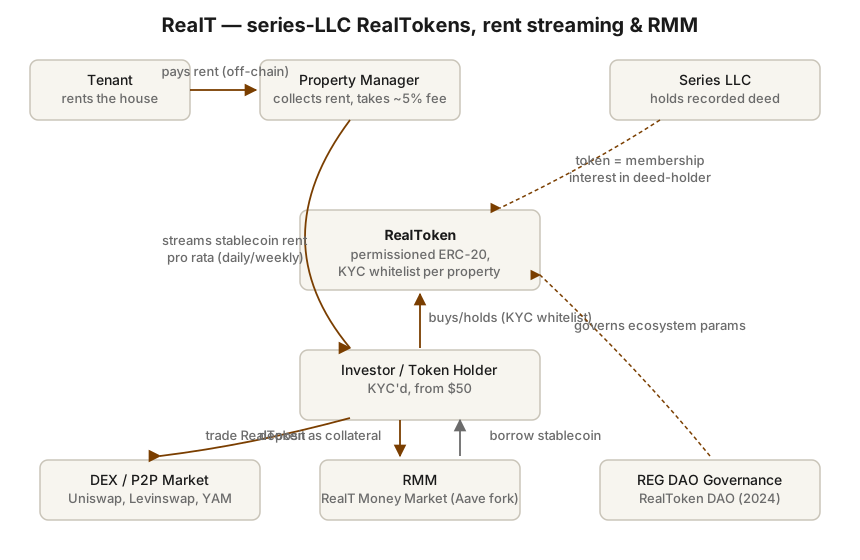 Open full-size diagram
Summary
RealT, founded in 2019 by brothers Remy and Jean-Marc Jacobson (early Bitcoin miners and co-founders of the Montreal Bitcoin Embassy), was the first platform to put fractional ownership of individual US rental houses onchain at scale. Each property is held by a dedicated series of a Delaware series LLC; membership interests in that series are issued as permissioned ERC-20 "RealTokens" sold under Reg D/Reg S private placements, with minimum buy-ins around $50. Rent flows to token holders in stablecoins, originally daily on Ethereum, later weekly on Gnosis Chain. The first property, 9943 Marlowe St in Detroit, went live in May 2019 and was famously listed on Uniswap — arguably the first real house with an AMM liquidity pool. RealT grew into a genuine ecosystem (500+ tokenized properties, ~$100M raised, investors in 150+ countries, plus the RMM lending market, YAM P2P marketplace, and a REG governance-token DAO announced in 2024). But the offchain half collapsed: investigative reporting found hundreds of blighted, tax-delinquent properties and yield paid on homes that weren't generating rent. Rent distributions were suspended in February 2026, and RealT stands as the canonical cautionary tale of the "oracle problem" in real-world assets.
Design (Mechanism)
- Legal wrapper: Real Token LLC is a Delaware series LLC; each house is an independent series (later some properties used Inc. structures). RealTokens are digital membership interests — ownership of the tokens is ownership of the series that holds the deed. Offerings are exempt private placements (accredited US investors under Reg D; non-US investors under Reg S), documented in per-property Private Placement Memoranda.
- Token: One permissioned ERC-20 per property (e.g. REALTOKEN-S-9943-MARLOWE-ST-DETROIT-MI). Transfers are restricted to KYC-whitelisted addresses via a transfer-hook/registry pattern (TrustedIntermediary-style compliance layer), so tokens remain compliant securities while still being composable.
- Cash flow: A property-management company collects rent (taking ~5% of rents plus repair markups per the original PPM); net rent is converted to stablecoin (originally DAI, later USDC/xDAI-based) and streamed to holders pro rata — daily at launch, one of the first "daily dividend" securities anywhere.
- Liquidity: Marlowe was seeded into Uniswap in late 2019; after gas costs bit, RealT migrated operations to xDai/Gnosis Chain, where Levinswap pools and the fee-free YAM ("You-and-Me") offer-based P2P marketplace provide exit liquidity, alongside platform buyback programs.
- DeFi extension: The RMM (RealT Money Market, launched 2022, an Aave v2/v3 fork on Gnosis) lets holders post RealTokens as collateral to borrow stablecoins while keeping rent rights — mortgage-like leverage on tokenized houses.
- Governance: In April 2024 RealT announced the RealToken DAO with a REG governance token airdropped on Gnosis Chain, intended to progressively decentralize ecosystem decisions.
Outcome
Commercially, RealT was the category leader for five years: 500+ properties (concentrated in Detroit, plus Cleveland, Chicago, Toledo, Florida and others), roughly $100M tokenized, and a claimed community of 16,000+ active investors across 150+ countries. The onchain machinery — issuance, whitelisting, rent streaming, RMM, YAM — worked essentially as designed and still functions.
The offchain reality unraveled publicly in 2024–2025. Local reporting (Outlier Media, WXYZ) found $3.6M+ in unpaid Detroit property taxes, hundreds of blight tickets, roughly 140 vacant properties still shown as income-producing, and dividends paid on homes collecting no rent for months or years — including, in some cases, homes whose deeds RealT had not actually taken title to. RealT suspended rent distributions in February 2026 and has signaled asset sales.
Why it worked
- Real legal engineering, not metaphor: the series-LLC + PPM + whitelisted-ERC-20 stack gave token holders an actual equity claim, a template now copied across the RWA sector.
- Visceral product: $50 fractions of a specific, photographable house with daily stablecoin rent made "DeFi meets Main Street" tangible in a way index-like products never did.
- Composability as a moat: Uniswap/Levinswap pools, RMM borrowing, and the YAM marketplace made RealTokens the most DeFi-integrated security tokens in existence, creating stickiness competitors lacked.
- Regulatory arbitrage on demand: most buyers were non-US investors under Reg S, hungry for US real-estate yield they couldn't otherwise access at small size.
Where the design broke
- The trust bottleneck never moved onchain: deeds, taxes, tenancy, maintenance, and occupancy data all depended on RealT and its property managers. Token holders had no reliable oracle for "is this house occupied, maintained, and actually owned by my LLC?"
- Adverse asset selection: ultra-cheap Detroit housing produced high headline yields but sat in a market where taxes, blight enforcement, and rehab costs routinely exceed rents — fragility tokenization cannot fix.
- Dividend smoothing masked operational failure: paying "rent" on vacant or unowned homes kept yields attractive but obscured, rather than fixed, the underlying non-performance until journalists surfaced it.
- Accountability diffusion: 165 LLCs, offshore investors, and a Reg S structure left no strong local stakeholder; the city of Detroit and tenants bore the externalities of absentee ownership.
- No independent verification layer: no third-party audits of title, occupancy, or tax status were published; investors discovered problems from journalists, not disclosures.
Lessons
- RWA tokens are only as good as their weakest offchain covenant. Perfect onchain settlement plus unverified deeds, taxes, and occupancy equals unverified tokens. Title, tax, and occupancy attestations need independent, recurring, published verification.
- Distribution ≠ performance. Streaming yield is trivially easy onchain, which makes it trivially easy to simulate. Any RWA design should force distributions to be traceable to actual, evidenced receipts (e.g., property-manager attestations posted onchain, escrowed rent flows).
- Fractionalization exports slumlord risk globally. Selling $50 slices of distressed housing to foreign retail investors severed every feedback loop — tenants couldn't reach owners, and owners couldn't see tenants.
- DeFi composability amplifies both success and contagion: RealTokens as RMM collateral meant property-level failures threatened a lending market, previewing systemic RWA risk.
- Legal wrappers work — that's the good news. The series-LLC template gives token holders a real, enforceable equity claim in the underlying property, a structural advance over purely synthetic RWA wrappers even though no independent layer verified title, tax, and occupancy status against that claim.
Redesign (EDITORIAL — hypothesis, not fact)
This section is editorial speculation. A redesigned RealT would move verification, not just ownership, onchain: (1) title held by a bankruptcy-remote trustee that must post the recorded deed hash before tokens can mint — no deed, no sale; (2) rent distributions routed through an escrow contract that only releases what a licensed, bonded property manager attests as collected, with attestations signed onchain and slashable via a surety bond; (3) an independent "occupancy oracle" (postal data, utility usage, or periodic third-party inspections committed onchain) that automatically flags vacant properties and pauses yield marketing; (4) a tax-lien watchdog that reads county records and freezes distributions to the sponsor — not holders — when property taxes go delinquent; (5) local stakeholding: reserve a token tranche and board seat for tenants or a community land trust so upkeep failures create internal, not just municipal, pressure; and (6) portfolio-level circuit breakers in the lending market so a single city's collapse cannot cascade through collateral. The core insight RealT validated — compliant, composable, fractional property equity — deserves to survive the collapse of its offchain data layer; the missing primitive was adversarial verification of the physical world.
Sources
- Private Placement Memorandum — Real Token LLC Series #1, 9943 Marlowe (2019) — primary (docs)
- RealToken 9943 Marlowe St token contract (Etherscan) — primary (contract)
- RealT FAQ — Guide to Real World Asset Tokens (RMM, YAM, RealToken Wallet) — primary (docs)
- Introducing RealT: Tokenizing Real Estate on Ethereum — David Hoffman (May 2019) (analysis)
- RealT announces DAO / REG governance token — primary (governance)
- RealT collected millions from investors for Detroit properties it doesn't own — WXYZ (July 2025) (news)
- Interview with Remy Jacobson, founder and CEO of RealT — SafetyDetectives (retrospective)
- RealT: invest in tokenized real estate from $50 — Cointribune (analysis)
Related experiments
Last verified: 2026-07-27 · Spot an error? Suggest a correction