Maple Finance
Institutional credit protocol that pioneered undercollateralized on-chain lending via staked 'pool delegates,' absorbed ~$50M in defaults during the 2022 contagion, then pivoted to secured/overcollateralized lending and rebranded around SYRUP to become one of the largest on-chain asset managers.
▶ Run interactive simulation animated mechanism with editable parameters
How it works onchain
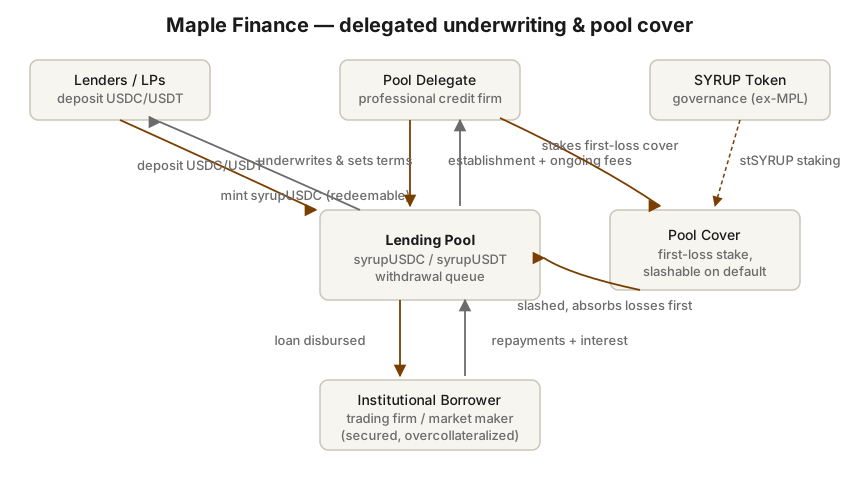 Open full-size diagram
Summary
Maple Finance is the longest-running large-scale experiment in bringing corporate-style credit underwriting on-chain. Founded in 2019 by Australian debt-capital-markets professionals Sid Powell and Joe Flanagan (the company's site also credits Matt Collum and Ryan O'Shea as founders) and launched on Ethereum mainnet in May 2021, Maple's original thesis was that DeFi's overcollateralization requirement made lending capital-inefficient, and that human credit assessment could be re-introduced on-chain through incentive-aligned "pool delegates." The first era ended painfully: roughly $50M+ of defaults in late 2022 — most notoriously Orthogonal Trading's $36M default, after which delegate M11 Credit said Orthogonal's actual FTX exposure was far larger than what it had reported — forced a redesign. Maple 2.0 and the subsequent pivot to secured, overcollateralized institutional lending, treasury-bill cash management, and the permissionless syrupUSDC yield product turned the protocol into one of the largest on-chain asset managers, with the MPL token migrated to SYRUP in late 2024 and AUM reported in the multi-billion-dollar range by 2025–2026.
Design (Mechanism)
Era 1 — delegated undercollateralized credit (2021–2022). Maple's core primitive was the lending pool run by a pool delegate — a professional credit firm (e.g., Orthogonal Credit, M11 Credit/Maven 11, Celsius briefly) that performed off-chain due diligence on institutional borrowers (mostly crypto trading firms and market makers), negotiated terms, and issued fixed-rate, largely uncollateralized or undercollateralized loans on-chain. Alignment came from three mechanisms: (1) delegates staked pool cover (MPL/USDC BPT positions) as first-loss capital that would be slashed on default; (2) delegates earned establishment and ongoing fees, giving them a franchise to protect; (3) lenders received pool tokens representing pro-rata claims, with interest streamed on-chain. The MPL token captured fees and could be staked into cover. Loans were legal obligations — enforcement of a default ultimately relied on off-chain contracts and courts, not liquidation bots, because there was little collateral to liquidate.
Era 2 — Maple 2.0 and the secured pivot (Dec 2022 onward). After the defaults, Maple 2.0 rearchitected the contracts (instant default recognition, pro-rata loss accounting, withdrawal queues) and the business shifted toward overcollateralized lending against liquid crypto collateral, plus cash-management pools holding U.S. Treasury exposure for accredited/institutional lenders. In mid-2024 Maple launched Syrup, a permissionless wrapper: anyone can deposit USDC/USDT and receive syrupUSDC/syrupUSDT, tokenized shares of diversified, collateralized institutional loan books — composable across DeFi. In November 2024 the MPL governance token migrated to SYRUP (100:1 style swap; >60% migrated by the April 2025 deadline per Maple's treasury reporting), with stSYRUP staking reintroduced. Verified token contracts: MPL 0x33349B28... (legacy) and SYRUP 0x643C4E15... on Ethereum.
Outcome
Era 1 scaled fast — over $500M TVL across four pools within its first year — then failed its stress test. In December 2022 Orthogonal Trading defaulted on eight loans totaling $36M after repeatedly telling delegate M11 Credit its FTX exposure was only ~$2.5M; remaining lenders in M11's USDC pool took roughly an 80% hit, and the WETH pool ~17%. Combined with other sour debt ($54M cited by press at the time), TVL collapsed and MPL fell sharply. The pool-cover first-loss buffers proved trivially small relative to losses.
The redesigned protocol, however, compounded: Maple reported roughly 10x growth in 2024, $2.6B AUM at end of Q2 2025, and (per its own 2025–2026 reporting) $4.6B+ AUM with cumulative originations in the many billions, expansion to Solana and other chains, and institutional partnerships (e.g., Cantor, Bitwise). Overall verdict: the original undercollateralized-delegate experiment failed under stress, but the entity and its second design are an ongoing commercial success — hence "partial_success" for the experiment as a whole.
Why it worked
- Real demand for capital efficiency: trading firms genuinely needed unsecured working capital, and lenders wanted sustainable, non-ponzi yield sourced from real borrowing demand — Maple found product-market fit quickly in 2021.
- Delegated underwriting scaled trust: outsourcing credit assessment to named, staked professionals let a protocol do what pure smart contracts cannot — evaluate counterparty solvency.
- Post-crisis adaptability: the team treated 2022 as a design lesson, not a death sentence — shipping Maple 2.0, moving to collateralized lending, and packaging institutional yield for retail via syrupUSDC.
Where the design broke
- First-loss cover was too thin: pool cover recovered only ~$2.5M against $36M of Orthogonal defaults; the slashing mechanism was symbolic relative to loan sizes.
- Delegates depended on borrower-reported financials: underwriting relied on self-reported numbers, and Orthogonal's reported FTX exposure (~$2.5M) turned out to be far below its actual exposure, per M11 Credit's public postmortem. On-chain transparency covered the loan, not the borrower's balance sheet.
- Correlated counterparty base: borrowers were overwhelmingly crypto-native trading firms with shared exposure to the same exchanges (FTX) and the same market cycle, so a pool spanning multiple named borrowers still carried concentrated, correlated risk rather than diversified risk.
- No on-chain recourse: with no collateral to liquidate, defaults became slow off-chain legal processes (Orthogonal entered provisional liquidation), leaving LPs locked and impaired.
Lessons
- Undercollateralized lending re-imports the entire trust stack of TradFi — audited financials, covenants, legal enforcement — and putting the loan on-chain does not remove any of those requirements; it only makes the cash flows transparent.
- First-loss capital must be sized to plausible loss, not to signaling: cover worth a few percent of pool size provides alignment theater, not protection. If slashing can't meaningfully absorb a top-borrower default, the mechanism is decorative.
- Correlation is the killer in credit pools: a "diversified" pool of eight crypto trading firms is one bet on crypto market structure. Sector-concentrated on-chain credit needs explicit exposure caps and third-party verification of borrower balance sheets.
- A protocol can survive its flagship mechanism failing if the team owns the failure publicly, rearchitects quickly, and pivots toward the risk model the market will actually fund (secured lending, T-bill yield).
Redesign (EDITORIAL — hypothesis, not fact)
This section is editorial speculation. A v1-era Maple redesign could have required (1) continuous, cryptographically attested proof-of-reserves/liabilities from borrowers (e.g., exchange-balance attestations or zk-attested custodian statements) as a covenant, with automatic borrowing-base reductions when attestations lapse; (2) first-loss cover mandated at a fixed percentage of outstanding principal (say 10–20%) funded jointly by delegate and borrower, not a discretionary stake; (3) per-borrower and per-sector concentration limits enforced in the pool contracts; and (4) a junior/senior tranche structure so risk-seeking capital knowingly absorbs first losses instead of pari-passu LPs discovering their true seniority at default. Interestingly, Maple's own Era 2 — collateral, withdrawal queues, diversified secured books wrapped in syrupUSDC — is a partial implementation of exactly this direction, which supports the hypothesis.
Sources
- Maple Finance official site (products, founders, X handle) — primary (docs)
- Etherscan — MPL Token (legacy) — primary (contract)
- Etherscan — SYRUP Token — primary (contract)
- M11 Credit Update on Orthogonal Trading (delegate postmortem) — primary (retrospective)
- Maple: Turning Vision Into Action — Scaling Maple in 2025 — primary (docs)
- Maple: syrupUSDC and syrupUSDT — Built for Scale — primary (docs)
- The Block — Orthogonal Trading defaults on $36M of loans on Maple Finance (news)
- CoinDesk — Maple severs ties with Orthogonal Trading over misrepresented financials (news)
- OAK Research — Maple Finance: complete overview of a hub for on-chain institutional lending (analysis)
- The Defiant — Maple Finance's SYRUP Token Soars Ahead of Solana Expansion (news)
Related experiments
Last verified: 2026-07-27 · Spot an error? Suggest a correction