Certified Top Blaster
A gamified Base ERC-20 where a 6.9% sell tax funds a recurring ETH prize pool that pays out to the largest buyer of each timed epoch.
▶ Run interactive simulation animated mechanism with editable parameters
How it works onchain
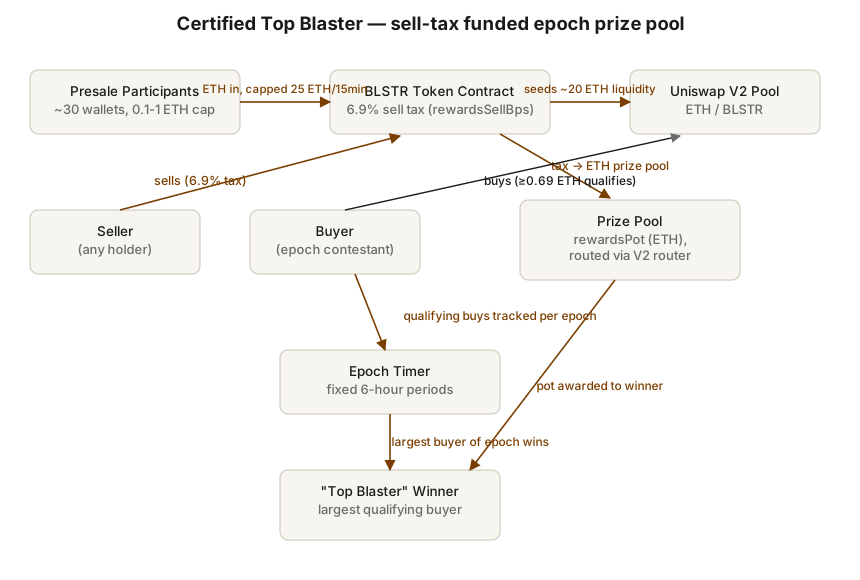 Open full-size diagram
Summary
Certified Top Blaster (ticker BLSTR, "TopBlaster") was the fourth experiment released by TokenWorks, a self-described "playground for onchain financialized ideas." It launched on Base on 17 January 2025 as a competitive, tax-funded trading game. Sellers paid a 6.9% tax; the entirety of that tax accumulated into an on-chain ETH prize pool, and at the end of each fixed epoch the trader who had spent the most buying tokens (subject to a per-buy minimum) won the accumulated pot. The idea reframed a normal tax-token into a repeating skill/whale competition rather than a passive-yield or reflection token. Distribution used a tightly capped presale explicitly intended as an anti-sniping measure. Technically the launch went cleanly — the contract is verified on Basescan and TokenWorks reports no bugs — but the game loop failed to sustain competitive play, and by the project's own post-mortem it produced no revenue for the team and little holder incentive beyond chasing the pot. It is best characterized as technically successful but commercially unsuccessful, and it was retired into the TokenWorks archive.
Design (Mechanism)
The core is a modified ERC-20 on Base. According to the verified contract and the project's own writeup:
- Sell tax → prize pool. A sell tax (documented as 6.9%; the contract exposes a configurable
rewardsSellBpsand apercentOfSaleForFirstPot) is skimmed on qualifying sells. "ALL of the taxes enter a prize pool" denominated in ETH (therewardsPot), routed through the Uniswap V2 router. - Epoch competition. Trading was divided into fixed periods (6 hours). Within each period the address that spent the most ETH buying BLSTR — with a per-buy qualifying minimum of 0.69 ETH — became the epoch's "Top Blaster" and won the accumulated pot. New epoch, new pot, repeat.
- Capped, anti-sniper presale. Rather than a stealth launch vulnerable to snipers, TokenWorks ran a capped presale: it would run 15 minutes or until 25 ETH was raised, whichever came first. Contributions were bounded to 0.1–1 ETH per wallet, and the presale allocated 48.5% of supply. In practice it filled in roughly 24 seconds across ~30 holders.
- Liquidity. Initial liquidity was seeded at ~20 ETH against 485 million tokens, giving an initial market cap around $300k.
- Uniswap V2 dependency. Because the token carried a transfer tax, it was incompatible with Uniswap V3 concentrated liquidity, so it relied on V2 for pool and fee routing.
The mechanism is a novel blend: a "reflection/tax" primitive redirected into a discrete, winner-take-all tournament, with the presale used as a fairness/anti-concentration lever rather than a fundraising maximizer.
Outcome
The launch mechanics executed as designed. The presale sold out almost instantly (24 seconds), demonstrating demand and validating the anti-sniping framing, and the contract ran without reported bugs. The first prize pool grew to ~22 ETH and was awarded to a participant whose 0.69 ETH qualifying buy landed at a peak-price moment.
Beyond that first cycle the game did not sustain itself. TokenWorks' post-mortem reports that the 6-hour epochs were too long: as the price moved, the competition drifted out of most participants' reach and the expected recurring rivalry did not materialize. The token offered little reason to hold outside of actively contesting a pot, and the team captured no revenue from the design while players competed for the fees. External conditions worsened timing — attention was diverted by the concurrent launch of the Trump memecoin. Ownership was ultimately transferred to a TokenWorks archive contract and the experiment was wound down, with a commemorative NFT planned. Outcome status: technically_successful_commercially_unsuccessful.
Why it worked
- Clean execution and branding. A polished, intuitive "biggest buyer wins the pot" concept plus a bug-free verified contract lowered friction and made the game legible.
- Effective anti-sniping distribution. The capped, per-wallet-bounded presale spread the initial supply across ~30 holders and blunted the usual bot/sniper concentration that plagues stealth tax-token launches — and it proved real demand by filling in seconds.
- Genuinely novel primitive. Turning a sell tax into a recurring, on-chain, winner-take-all tournament (rather than passive reflections) was a fresh take that generated an immediate, exciting first cycle.
Where the design broke
- Epoch length killed the loop. Six hours was too long; price could run away from participants, so the competitive tension that was supposed to recur simply dissipated after the first pot.
- No team revenue and weak hold incentive. All tax went to the prize pool, leaving the studio with no sustainable revenue, and holders had no reason to stay once they weren't actively chasing a pot — so liquidity and attention bled out.
- Structural tech constraint. The transfer tax forced reliance on Uniswap V2 and blocked Uniswap V3 integration, limiting fee-recovery and liquidity-efficiency options.
- Adverse timing. A major competing memecoin narrative (Trump token) pulled speculative attention away during the critical early window.
Lessons
- Match the game clock to the asset's volatility. Winner-take-all "biggest buyer" competitions need short enough epochs that the target stays contestable; long epochs let price drift out of reach and collapse participation. Shorter, faster cycles were the team's own top corrective.
- A prize pool is not a business model. Routing 100% of tax to players leaves the operator uncompensated; sustainable versions need a protocol take-rate or separate value capture, or the studio subsidizes a demo that cannot persist.
- Design holding incentives beyond the meta-game. If the only reason to hold is to compete for the pot, everyone exits between rounds; the token needs an independent reason to be held (yield, utility, staking) to retain liquidity.
- Anti-sniping presales work — treat them as a reusable primitive. The capped, per-wallet-bounded presale demonstrably curbed sniper concentration and produced a broad, fast, fair distribution; that lever generalizes even when the surrounding game does not.
- Tax mechanics carry hidden DEX constraints. Transfer taxes lock you out of Uniswap V3; account for AMM compatibility at design time, not after launch.
Redesign (EDITORIAL — hypothesis, not fact)
The following is the researcher's editorial hypothesis, not documented project fact.
A stronger v2 would attack the three named failure modes — epoch length, zero operator revenue, and empty inter-round holding — while keeping the anti-sniper presale intact.
Adaptive, short epochs. Replace fixed 6-hour rounds with short rounds (15–60 min) whose length auto-tightens with volatility, plus a "last-buyer resets the timer" auction-style extension (Gnosis/Fomo3D-lite) so the pot stays contestable and the ending is dramatic. This directly fixes the "price ran away" problem that dissolved competition.
Split the tax three ways. Route the sell tax into (a) the current prize pool, (b) a permanent protocol/treasury cut so the studio has revenue, and (c) a staker-rewards bucket. This turns "no revenue, no hold incentive" into a self-funding flywheel.
Stake-to-hold yield. Let holders stake between rounds to earn a share of bucket (c), giving a concrete reason to hold across epochs and stabilizing liquidity instead of the observed round-to-round exodus.
AMM-native design. Move tax collection to a router/hook-level mechanism (e.g., a Uniswap V4 hook) rather than a transfer tax, restoring V3/V4 concentrated-liquidity compatibility and better fee capture — removing the structural constraint the team flagged.
Sybil-resistant "biggest buyer." Since a single lucky 0.69 ETH buy won the first pot, weight winning by cumulative qualified volume over the epoch (not a single peak-timed buy) to reward sustained participation over timing luck and reduce single-tx gaming.
Net hypothesis: the original proved the primitive and the fair-launch mechanics were sound; the failure was economic sustainability and pacing, both of which are addressable without abandoning the core "tax-funded tournament" idea.
Sources
- TokenWorks archive — Certified Top Blaster (004) project page and post-mortem — primary (retrospective)
- TopBlaster (BLSTR) verified contract on Basescan — primary (contract)
- TokenWorks official site (product/archive index, X link) — primary (docs)
- TokenWorks archive index (project ordering and dates) — primary (docs)
- What TokenWorks Is Building Next (Bankless) (news)
Related experiments
Last verified: 2026-07-26 · Spot an error? Suggest a correction