Resupply
A CDP-style stablecoin protocol built jointly by Convex Finance and Yearn Finance that lets users borrow the reUSD stablecoin against yield-bearing lending-market positions (e.g. crvUSD/frxUSD deposited on Curve Lend/Fraxlend), only to lose ~$9.6-10M weeks after launch to a first-depositor/donation exchange-rate manipulation exploit.
▶ Run interactive simulation animated mechanism with editable parameters
How it works onchain
 Open full-size diagram
Summary
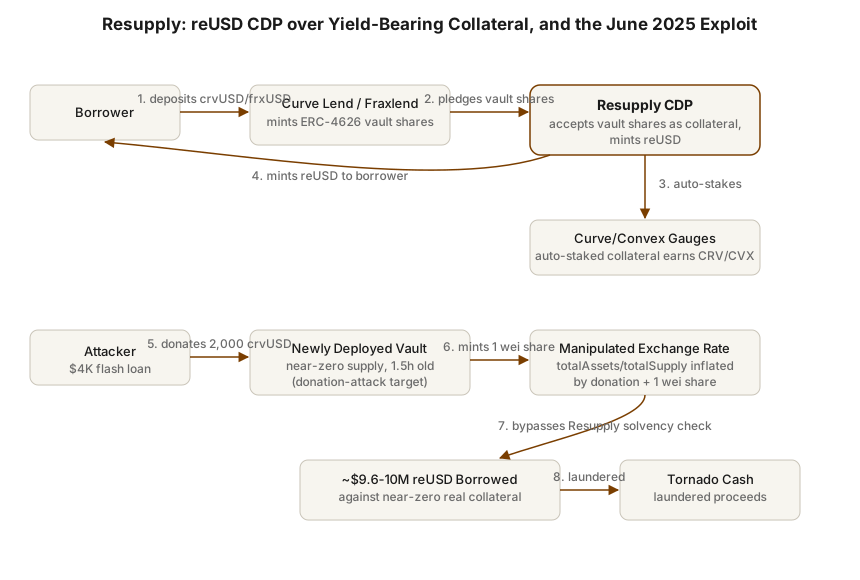
Resupply is a decentralized CDP (collateralized debt position) stablecoin protocol launched jointly as a "SubDAO" collaboration between Convex Finance and Yearn Finance, with support from Curve Finance. It mints a stablecoin called reUSD, which is borrowed against collateral that is itself already yield-bearing: users deposit assets like crvUSD or frxUSD into designated lending markets (e.g., Curve Lend, Fraxlend), and the resulting interest-bearing lending-market position (an ERC-4626-style vault share) is pledged inside Resupply as collateral for reUSD. The pitch was that because the underlying collateral is already earning yield, Resupply could offer unusually cheap reUSD borrow rates while collateral kept compounding, and the whole system routed activity back through the Curve/Convex/Yearn ecosystem (auto-staking collateral for CRV/CVX rewards). The protocol launched around March 2025 and quickly drew capital — Curve Lend TVL reportedly more than doubled within days of Resupply's debut. In June 2025, roughly three months after launch, an attacker exploited a newly deployed lending market via a classic ERC-4626 "first depositor / donation" attack, manipulating an exchange rate to zero and borrowing about $9.6-10 million in reUSD against effectively no real collateral.
Design (Mechanism)
Resupply's core mechanism layers a CDP stablecoin on top of already-yield-bearing collateral, rather than on top of raw assets. A user deposits a stablecoin (crvUSD, frxUSD, etc.) into an established lending market such as Curve Lend or Fraxlend, receiving a yield-bearing vault-share token. That vault-share token is then deposited into Resupply as collateral, and the protocol mints reUSD against it up to a collateralization/loan-to-value threshold, similar to MakerDAO/Liquity-style CDPs. Because the collateral itself continues to accrue lending yield while backing the loan, borrowers in theory get "yield-subsidized" cheap debt. Collateral could also be auto-staked to capture CRV/CVX-style incentive rewards, tying Resupply's flywheel directly to the Curve/Convex ecosystem's existing gauge and bribe economy. New markets (specific collateral/lending-market pairs) were deployed and onboarded over time by governance, each with its own exchange-rate/price-per-share accounting inherited from the ERC-4626 vault standard. reUSD stability and peg mechanics (redemption, stability pool-style liquidation backstops) were documented in the protocol's "Stability Mechanics" docs, echoing designs used elsewhere in the Curve/Frax/Liquity family of CDP stablecoins.
Outcome
Resupply attracted meaningful capital quickly after launch, contributing to a jump in Curve Lend TVL from roughly $38M to about $84M within days, consistent with the protocol's design goal of recycling yield-bearing collateral into cheap stablecoin credit. However, in June 2025 an attacker targeted a newly deployed market roughly 1.5 hours after it went live. Using a $4,000 flash loan (USDC swapped to crvUSD from Morpho), the attacker donated 2,000 crvUSD directly into the freshly deployed, near-empty ERC-4626 vault, then minted a single wei of vault shares. Because the vault's share price is calculated as totalAssets/totalSupply, the donation combined with a share supply of one wei made that single share appear worth the entire donated balance, collapsing/inflating the exchange rate and letting the attacker bypass Resupply's solvency/collateral checks. The attacker then borrowed roughly $9.6-10 million in reUSD against essentially negligible real collateral and laundered the proceeds through Tornado Cash. Resupply's team subsequently proposed a recovery plan involving a token burn (reported around $6M) to help make affected parties whole. The project's status is best characterized as "exploited" — it launched, gained real usage, and was then compromised by a well-known DeFi vulnerability class (first-depositor/inflation/donation attacks on ERC-4626-style vaults) in a newly launched market that had not yet accumulated meaningful TVL or share-supply "seeding."
Why it worked
- Layering a stablecoin on top of already-yield-bearing collateral (crvUSD/frxUSD lending positions) gave Resupply a genuine capital-efficiency pitch that resonated within the Curve/Convex/Yearn ecosystem, driving rapid TVL growth in linked Curve Lend markets.
- Backing from three established, credible DeFi protocols (Convex, Yearn, Curve) gave Resupply an unusually strong initial trust and integration advantage compared to a stand-alone new stablecoin launch.
Why it failed or underperformed
- A newly deployed lending market was launched with negligible initial liquidity/share supply, making it vulnerable to the well-documented ERC-4626 "first depositor / donation" inflation attack — a vulnerability class with known mitigations (e.g., virtual shares/assets, minimum initial deposits) that were evidently not fully applied to this new market.
- The exploit occurred just ~1.5 hours after the new market's deployment, suggesting insufficient market-seeding, monitoring, or staged-rollout safeguards for freshly launched markets even though the base protocol had been live and audited for months.
- The composability of Resupply's design — accepting yield-bearing vault-share tokens as collateral — inherited the accounting risk of the underlying ERC-4626 vaults, meaning a bug/edge-case in a newly added market could compromise protocol-wide solvency assumptions.
Lessons
- Composable "collateral on top of collateral" designs (CDP over yield-bearing vault shares) inherit every accounting edge case of the underlying vault standard, including well-known exploits like ERC-4626 donation/inflation attacks.
- Newly deployed markets with near-zero initial liquidity are disproportionately vulnerable; protocols should require seeded minimum deposits, virtual shares, or time-locked/rate-limited borrowing before a fresh market is trusted with full solvency logic.
- Strong ecosystem pedigree (Convex + Yearn + Curve) accelerates adoption and TVL but does not substitute for market-specific security review at launch time — each new listed market is effectively a new attack surface.
- Rapid, transparent post-exploit response (public recovery/token-burn proposal) can preserve some protocol credibility, but does not undo the fact that user/protocol funds were lost due to a preventable, previously-catalogued vulnerability class.
Redesign (EDITORIAL)
EDITORIAL — hypothesis, not fact. A materially more robust version of Resupply would treat "new market deployment" as a distinct, higher-risk state machine rather than an instant switch-on: require a mandatory protocol-owned seed deposit (minimum shares) into any new ERC-4626-derived collateral vault before it is whitelisted for borrowing, combined with OpenZeppelin-style virtual shares/assets offsets to make donation attacks economically irrational. Borrowing limits on brand-new markets could ramp up gradually (e.g., capped total reUSD mintable in the first 24-72 hours) rather than opening to full capacity immediately, giving monitoring systems and bug-bounty watchers time to catch anomalous first-transaction patterns like a flash-loan-funded donation followed immediately by a large borrow. Pairing this with real-time on-chain anomaly detection tuned specifically to detect share-price/exchange-rate discontinuities on freshly deployed vaults (as later recommended by post-mortem write-ups) could have caught or blocked the attack within its 1.5-hour window before the borrow was finalized.
Sources
- Resupply.fi docs — Stability Mechanics — primary (docs)
- Resupply.fi docs — Tokenomics — primary (docs)
- Curve Finance news — Curve x Resupply: Unlocking capital efficiency for crvUSD — primary (primary)
- Convex Finance on X — announcement of Resupply / reUSD — primary (primary)
- Halborn — Explained: The Resupply Hack (June 2025) (post-mortem)
- BlockSec — In-depth Analysis and Reflections on the Resupply Protocol Attack Incident (post-mortem)
- QuillAudits — Resupply Hack: How a donation attack led to $9.5M in Losses (post-mortem)
- crypto.news — Resupply protocol outlines recovery plan post $10M exploit, proposes $6M token burn (news)
Related experiments
Last verified: 2026-07-27 · Spot an error? Suggest a correction