CryptoKitties
The first mainstream ERC-721 game, letting users collect, breed, and auction unique on-chain cats — and the demand shock that congested Ethereum in December 2017.
▶ Run interactive simulation animated mechanism with editable parameters
How it works onchain
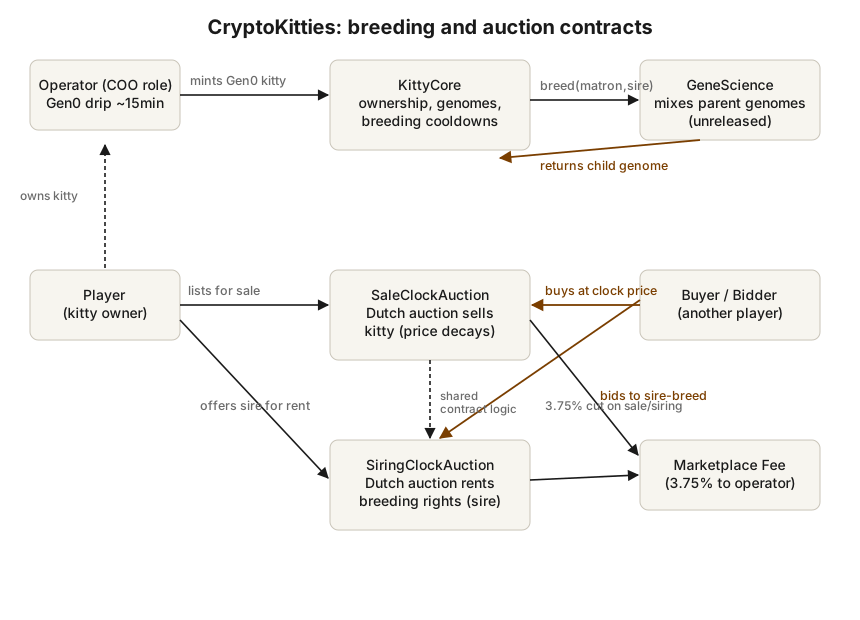 Open full-size diagram
Summary
CryptoKitties launched on Ethereum mainnet on 28 November 2017, built by the Canadian studio Axiom Zen (which spun out Dapper Labs in early 2018). Each "kitty" is a unique, non-fungible token conforming to the then-emerging ERC-721 standard — a standard co-authored by CryptoKitties' own chief architect, Dieter Shirley, who had opened the reference GitHub issue (#721) that September. Players buy, sell, and breed cartoon cats whose appearance is determined by a 256-bit on-chain "genome." It became the first blockchain application to reach a mainstream, non-financial audience, and within weeks its transaction volume accounted for roughly a quarter of all Ethereum traffic, causing visible network congestion and spiking gas fees. CryptoKitties is widely credited as the canonical proof-of-concept for NFTs as a consumer product, seeding the entire NFT sector that followed. It remains live, though activity is now a small fraction of its peak.
Design (Mechanism)
The system is a set of Solidity contracts (per the official bounty spec): KittyCore holds ownership and mediates breeding; SaleClockAuction and SiringClockAuction run the marketplaces; and an unreleased GeneScience contract computes offspring genes.
- Digital scarcity via ERC-721. Every kitty is a distinct token with its own genome, rather than a fungible balance. This required a per-token ownership standard — ERC-721 — which CryptoKitties helped pioneer and popularize.
- Generative breeding. Any two kitties (that are not siblings or parent/child, and are co-owned or offered via siring) can breed. Kitties have no fixed gender and can act as matron or sire. The GeneScience contract mixes the two 256-bit parent genomes to produce a child genome; a hierarchy of dominant/recessive genes (and occasional "mewtations") introduces new traits, giving breeding a speculative, lottery-like appeal.
- Breeding cooldowns. After breeding, both parents enter a cooldown that lengthens with each successive breed (indexed into a cooldown array). Higher-generation cats start with longer cooldowns. This throttles supply inflation and creates scarcity pressure on low-generation, fast-breeding cats.
- Gen0 supply drip. New "Generation 0" cats are minted and auctioned by the operator (the "COO" role) on a fixed cadence — a Gen0 sale roughly every 15 minutes — controlling primary issuance.
- Dutch (clock) auctions. Both sales and siring rights use a clock auction where the price moves linearly from a start price toward an end price over a set duration, then holds at the final price. Sale auctions transfer the cat; siring auctions rent breeding rights (the bidder supplies the matron).
- Marketplace fee. The auction contracts take a cut on successful sales/sirings (reported at 3.75%), the core protocol revenue stream alongside Gen0 primary sales.
Outcome
Status: major_success (as an experiment / cultural milestone). CryptoKitties achieved viral consumer adoption almost immediately. In December 2017 it reportedly reached ~25% of Ethereum network traffic, pushed transaction counts to record highs, and slowed the chain enough to become a case study in on-chain scalability limits. Individual cats sold for extraordinary sums during the mania — the "Genesis" kitty fetched roughly $117,000 in late 2017, and a cat reportedly sold for ~$140,000 by May 2018. By October 2018 the game had bred over 1 million cats across 3.2 million+ contract transactions. Dapper Labs raised institutional capital ($15M, then a larger round led by a16z and Union Square Ventures) on the strength of the launch, and went on to build NBA Top Shot and the Flow blockchain. The core Ethereum contract remains verified and live. Activity, however, collapsed from its peak: by 2022 daily sales were often fewer than 100, totaling under $10,000 in value. Dapper announced in 2021 a shift of focus toward Flow.
Why it worked
- Approachable, non-financial framing. Cute, collectible cats gave a mainstream audience an emotional reason to touch a blockchain — no trading pairs or DeFi jargon required.
- Genuine on-chain scarcity and provenance. ERC-721 made each cat verifiably unique and ownable, and breeding produced open-ended, unpredictable novelty that fueled collecting and speculation.
- Right team, right standard, right moment. The creators literally co-authored ERC-721, launching during the 2017 bull market when curiosity and speculative capital were abundant.
- Composable speculation loops. Gen0 drips, breeding cooldowns, mewtations, and siring rentals created intertwined markets (rare traits, low generations) that gave players reasons to keep transacting.
Limitations and criticisms
- Base-layer throughput ceiling. Its own success exposed Ethereum's capacity limits: congestion and spiking gas fees degraded the experience at peak demand and became an early case study in the scaling challenges facing consumer dApps on L1.
- Speculation-driven engagement. Much of the demand was flip-driven; once the 2018 bear market arrived, breeding economics and floor prices deflated and daily activity fell sharply, showing the model leaned on speculative inflow rather than recurring utility.
- Genome opacity and centralization. The GeneScience contract was unreleased/obfuscated, and operator roles controlled Gen0 issuance — friction for a "trustless" ethos and a target for genome-hacking efforts.
- Gas cost as an ongoing tax. Breeding and trading incurred real ETH fees, which made casual play less economic once novelty faded.
Lessons
- A killer consumer use case can be its own denial-of-service. Product-market fit on a constrained base layer can congest the network and throttle the very growth it creates — scalability must be designed for before, not after, virality.
- Standards win by being used. ERC-721's dominance owed less to the spec text than to a flagship app that made non-fungibility tangible; canonical demos can bootstrap entire ecosystems.
- Novelty-driven scarcity needs sustained sinks. Breeding mania faded once speculative inflows stopped; mechanisms that depend on ever-new buyers are fragile without recurring utility or fun.
- Emotional/collectible framing lowers the on-ramp. Non-financial metaphors (pets, art) can onboard users who would never open a DEX.
Redesign (EDITORIAL — hypothesis, not fact)
The following is the researcher's opinion, not established fact. A modern CryptoKitties would almost certainly not launch on Ethereum L1 for gameplay. I would settle ownership on an app-optimized chain or L2 (rollup/appchain) so that breeding and trading are near-free, keeping only settlement and provenance anchored to a base layer — sidestepping the congestion that both made and hobbled the original. I would publish the gene-mixing logic transparently (verifiable randomness via VRF and open GeneScience) to remove the "black box" trust gap and let a builder community extend the genome. To combat boom-bust dynamics, I would add durable sinks and utility beyond flipping — cosmetic crafting, seasonal play, staking of rare traits, or interoperable use across games — so demand does not rest solely on speculative breeding. Finally, I would reconsider Gen0 issuance and cooldown curves as tunable, possibly governance-adjustable, monetary policy for the collectible supply, rather than fixed constants, to manage inflation across market cycles. The core insight worth preserving: emotionally resonant, verifiably scarce digital objects are a uniquely strong crypto on-ramp — the redesign is about making the plumbing invisible.
Sources
- CryptoKitties: Core contract (KittyCore) on Etherscan — primary (contract)
- dapperlabs/cryptokitties-bounty — CryptoKitty Basics (official mechanics spec) — primary (docs)
- CryptoKitties official website — primary (docs)
- Dieter Shirley — Meet the Team (Flow / Dapper Labs) — primary (retrospective)
- Dapper Labs raises $15M (newsroom) — primary (news)
- CryptoKitties (Wikipedia) (analysis)
- Hacking the CryptoKitties Genome (HackerNoon) (analysis)
- CryptoKitties: Smart Contract Breakdown (Better Programming) (analysis)
Related experiments
Last verified: 2026-07-26 · Spot an error? Suggest a correction