Rare Pepes / Pepe Cash
Community-curated Pepe the Frog trading cards issued as Counterparty tokens on Bitcoin from 2016, with PEPECASH as the scene's native currency — widely considered the birth of crypto art and a direct ancestor of NFTs.
▶ Run interactive simulation animated mechanism with editable parameters
How it works onchain
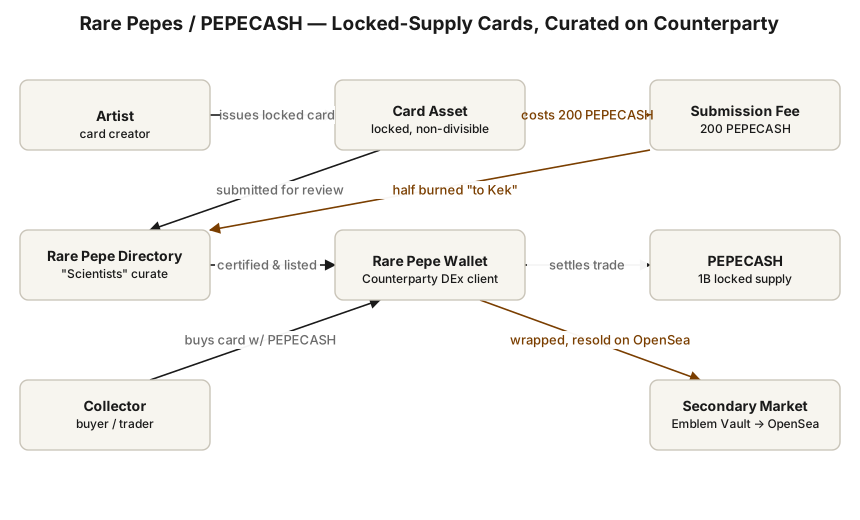 Open full-size diagram
Summary
Rare Pepes were meme trading cards issued as tokens on Counterparty, a metaprotocol that embeds asset data in Bitcoin transactions. The experiment began on September 9, 2016, when a pseudonymous user known as "Mike" issued RAREPEPE — the "Nakamoto Card," depicting Dorian Nakamoto as Pepe the Frog, in an edition of 300 — and posted it to the Counterparty Telegram. A community formed around a curation site, the Rare Pepe Directory, which certified 1,774 cards across 36 series before submissions closed. PEPECASH, a fungible Counterparty token launched September 14, 2016 with a locked supply of 1 billion, became the "currency of the Pepesphere": it paid directory submission fees (partially burned) and priced cards inside Joe Looney's Rare Pepe Wallet, the first practical web marketplace for on-chain art. Rare Pepes predate Ethereum's ERC-721 and are broadly credited as a founding moment of crypto art; individual cards later resold for six figures, while PEPECASH itself faded as a currency.
Design (Mechanism)
- Token substrate. Counterparty lets anyone create a named asset for 0.5 XCP (plus Bitcoin miner fees), with issuance permanently lockable. Rare Pepe cards were Counterparty assets with locked, non-divisible supplies — scarcity enforced by Bitcoin itself, years before ERC-721.
- Community curation as the scarcity layer. Token issuance alone can't make art "rare" — anyone can issue a Pepe token. The Rare Pepe Directory solved this socially: self-styled "Rare Pepe Scientists" reviewed submissions against published rules (400×560 px images, original work, locked issuance, non-divisible, supply between 100 and 100,000, no NSFW/QR codes/websites, one submission per artist per day). Only certified cards appeared in the directory and wallet, making the curated list — not the protocol — the real registry of authenticity.
- PEPECASH as fee token and currency. Submitting a card cost 200 PEPECASH; per the directory, half of fees were sent to a burn address ("sacrificed to Kek"), making the token deflationary while funding operations and giveaways. By February 2023 roughly 303.6 million PEPECASH (~30%) had been burned.
- Marketplace. Rare Pepe Wallet (Joe Looney, 2016) was a client-side web wallet that let collectors buy, sell, and gift cards using Counterparty's on-chain DEX and PEPECASH pricing — effectively the first crypto-art exchange, complete with the novelty of buying art with a meme currency.
Outcome
The directory certified 1,774 cards from hundreds of artists across 36 series before closing submissions. PEPECASH was whitelisted for trading in Japan and listed on Zaif, and at the 2017 peak surged more than 250% in a week on Japanese demand. On January 13, 2018, at the Rare Digital Art Festival in New York, the 1-of-1 HOMERPEPE sold live for 350,000 PEPECASH ($38,500) — a headline event for early crypto art; buyer Peter Kell resold it in 2021 for 205 ETH ($312,000–320,000) to collector TokenAngels. In August–September 2021, a Nakamoto Card wrapped via Emblem Vault fetched roughly $500,000 on OpenSea. The collection was culturally rehabilitative for Pepe (Matt Furie's character, hijacked by 2016 politics) and is now canonized in NFT history; the Fake Rares scene and the 2023 PEPE memecoin (unrelated tokenomics) both trace lineage to it. PEPECASH itself, however, declined to near-irrelevance as a medium of exchange after 2018. Verdict: a landmark cultural and mechanism-design success whose native currency and platform did not sustain commercial momentum — partial success.
Why it worked
- Credible scarcity on the most credible chain. Locked Counterparty issuance on Bitcoin gave collectors provable editions in 2016, before NFTs had a name.
- Curation created the value layer. The Scientists' gatekeeping turned an open token system into a bounded, collectible canon — the directory listing, not the token, was the certificate.
- A native economy. PEPECASH tied submissions, burns, and card pricing into one loop, giving the community a shared asset that appreciated with the scene's growth.
- Tooling lowered friction. Rare Pepe Wallet made buying art as easy as 2016 crypto allowed, and events like the Rare Digital Art Festival gave the scene a public stage.
- Memes as distribution. Pepe was already the internet's most liquid meme; the project imported an existing culture instead of manufacturing one.
Why it failed or underperformed
- Platform gravity shifted to Ethereum. ERC-721, CryptoPunks/Kitties, and later OpenSea captured the NFT market; Counterparty's UX, XCP dependency, and Bitcoin fees left Rare Pepes stranded until Emblem Vault wrappers bridged them.
- Curation didn't scale or persist. Submissions closed, the directory site decayed (today it has certificate errors), and canonical metadata survives mainly through community mirrors like Book of Kek — fragile stewardship for a historic registry.
- PEPECASH lacked a durable sink. Once submissions ended, the burn/fee loop stopped; a currency whose main utility was paying curators had no ongoing demand driver.
- Speculative whiplash. The 2017 Japan-driven surge and 2018 collapse tracked the broader altcoin cycle; the currency never decoupled from speculation.
Lessons
- Scarcity is social, not just cryptographic: the curation registry (who certifies what's "real") is the actual product; it needs succession planning and durable hosting as much as the tokens need a chain.
- A fee-burn loop tied to submissions only works while submissions continue; native currencies need recurring sinks (trading fees, upgrades, events) to outlive their bootstrap phase.
- Being first on the "wrong" platform can still win historically — provenance and priority (pre-ERC-721, on Bitcoin) later became the core of the collection's value, once wrappers restored market access.
- Importing an existing meme culture is the cheapest distribution strategy in crypto, but it couples the asset's fate to that culture's volatility.
Redesign (EDITORIAL — hypothesis, not fact)
This section is editorial speculation. A modern redesign would keep the two-layer structure — permissionless issuance plus a socially governed canon — but make the canon durable: publish the certified-card registry itself on-chain (a curated list hash updated by a multisig of rotating "Scientists"), with content mirrored on Arweave/IPFS so the directory can't rot. PEPECASH would be redesigned with ongoing sinks: a small burn on every DEX card sale and on canon-update proposals, plus staking by curators who can be slashed for certifying plagiarized work. Artist royalties (absent in 2016) could be encoded at the registry layer. Finally, native bridges or attestations (rather than third-party vault wrappers) would let cards surface on whichever marketplace layer dominates, decoupling the collection's liquidity from any single platform's lifespan.
Sources
- Rare Pepe Directory — Submit Your Rare Pepe (submission rules) — primary (docs)
- Rare Pepe Directory — What is PepeCash — primary (docs)
- Book of Kek — The Rare Pepe Directory (archive)
- Book of Kek — What is PEPECASH? (archive)
- A Brief History of Rare Pepe (Right Click Save) (analysis)
- Rare Pepe Wallet & The Birth of CryptoArt (Artnome, 2018) (analysis)
- CoinDesk — 'Rare Pepe' Steeped in Bitcoin History Fetches $500K on OpenSea (2021) (news)
- The Paris Review — Scenes from the First Rare Digital Art Auction (Homer Pepe, Jan 2018) (news)
- Matt Kane — Rarest Pepe 'most important NFT in art history' sells for 205 ETH (news)
- Rare Digital Art Festival Anniversary: Joe Looney (Right Click Save) (retrospective)
Related experiments
Last verified: 2026-07-27 · Spot an error? Suggest a correction