DAOhaus
No-code platform for summoning and operating Moloch-framework DAOs, community-owned via the HAUS token and the DAO-of-DAOs UberHaus.
▶ Run interactive simulation animated mechanism with editable parameters
How it works onchain
 Open full-size diagram
Summary
DAOhaus is the canonical "DAO factory" of the Moloch lineage: a no-code platform for summoning, joining, and operating Moloch-framework DAOs. It began as a hackathon project at ETHBerlin 2019 by the three-person studio Odyssy (Dekan Brown, Sam Kuhlmann, Ven Gist), who had already built Pokemol, a mobile-first Moloch frontend. Launched publicly in August 2019, DAOhaus let anyone deploy a Moloch fork "in under 5 minutes," and became the default home for the MetaCartel-era ecosystem of grants DAOs, guilds, and venture clubs (Raid Guild, Meta Gamma Delta, and hundreds of others; MolochDAO counted ~697 Moloch forks by early 2022). In March 2021 the project decentralized itself: the HAUS token launched with a majority-community treasury and governance by UberHaus, a "DAO of DAOs" whose members were themselves Moloch DAOs. The team (organized as the "Warcamp" DAO) went on to co-develop Moloch v3 ("Baal"), a modular governance layer over Gnosis Safe/Zodiac treasuries, unveiled at ETHDenver 2022 and now deployed across Ethereum, Gnosis, Polygon, Optimism, Arbitrum, and Base. DAOhaus remains live and canonical infrastructure, though activity and the HAUS token have faded from their 2021–22 peak.
Design (Mechanism)
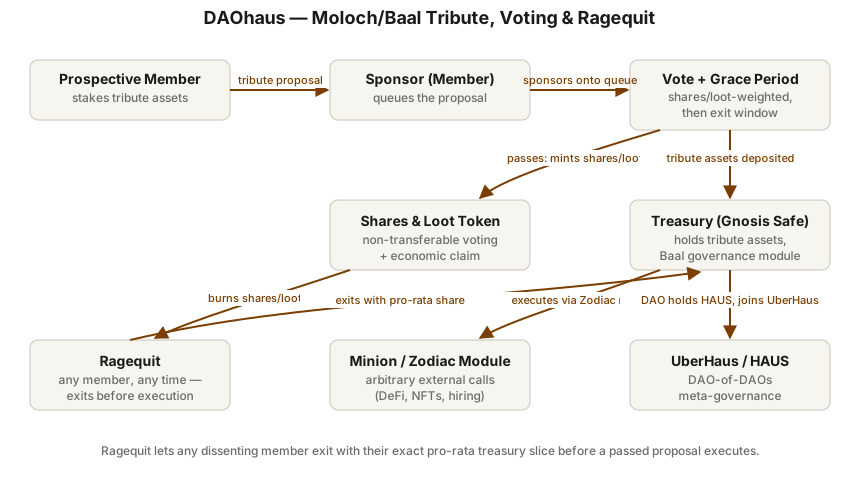
- Moloch core (v1/v2): DAOhaus productized the Moloch pattern — non-transferable shares for voting and pro-rata treasury claims, loot for economic-only membership, tribute proposals to join (stake assets for shares), sponsored proposal queues, a voting period followed by a grace period, and the signature ragequit: any member who dislikes a passed proposal can burn shares/loot and exit with their exact pro-rata slice of the treasury before execution. This makes majority attacks on the treasury nearly pointless — dissenters leave with their money.
- Minions → Zodiac: v2 "Minion" contracts gave Moloch DAOs arbitrary external call execution (DeFi, NFTs, hiring), extending them beyond simple grant-voting. Moloch v3 (Baal) generalizes this: the DAO is a governance module (per Gnosis Zodiac standards) controlling a Safe treasury; shares and loot become (optionally transferable) ERC-20s; proposals support arbitrary multi-call execution.
- Summoner factory: a factory/template pattern (cloneable Baal template contracts per chain) plus a subgraph-indexed web app, so non-developers can configure share/loot settings, shamans (permissioned minters), and treasury parameters and deploy in minutes.
- Meta-governance (UberHaus + HAUS): HAUS launched March 2021 with ~60.5% to the community treasury, distributions via airdrops to 70+ Moloch DAOs and two Community Contribution Offerings (CCOs) — a DAO-native fundraise on xDai where contributors received shares and retained ragequit rights, rather than a VC sale. UberHaus governed HAUS and the protocol, with membership restricted to DAOs (not individuals); later superseded by "PublicHaus," a governance DAO running on DAOhaus's own v3 stack.
Outcome
Partial success. DAOhaus achieved its core goal: it turned MolochDAO's minimalist contracts into infrastructure that hundreds of real communities used — the MetaCartel ecosystem, service guilds (Raid Guild), grants DAOs, investment clubs, and NFT communities — and its multichain expansion (notably cheap summoning on xDai/Gnosis) meaningfully broadened who could run a DAO. Moloch v3/Baal is a respected, composable governance primitive still deployed on six-plus chains, and DAOhaus's ragequit-centric design remains one of the most cited minority-protection mechanisms in DAO design. However, the platform lost mindshare after 2022 to Snapshot+Safe off-chain governance, Aragon/Governor-token systems, and the general DAO downturn: HAUS never gained durable market traction (price feeds went stale by 2025 on some aggregators), development activity slowed markedly, and DAOhaus today persists as maintained public-goods infrastructure rather than a growing platform. No major exploit of the Moloch/Baal contracts is known.
Why it worked
- Minimalism inherited from Moloch: small, auditable contracts with one killer safety property (ragequit) made "putting shared money onchain with strangers" tolerable in 2019–21.
- Radically lowered deployment cost: a 5-minute no-code summoner plus xDai deployments took DAO creation from "hire Solidity devs" to "fill out a form."
- Ecosystem-first, dogfooded governance: the team lived inside its own product (Warcamp, Raid Guild, UberHaus), and distribution via airdrops-to-DAOs and ragequittable CCOs aligned the platform with its actual users instead of speculators.
- Composability bet paid off technically: rebuilding v3 as a Zodiac module over Gnosis Safe let Moloch governance ride the dominant treasury standard rather than compete with it.
Where the design broke
- Off-chain governance ate the market: Snapshot voting + Safe multisig execution was free and flexible; DAOhaus's fully-onchain model carried gas and UX costs most DAOs stopped paying.
- Token without a sink: HAUS had governance and fee/incentive ambitions but little enforced value capture; when the 2022 bear hit, there was no revenue engine to sustain momentum ("Bear Eat Moloch").
- DAO-of-DAOs governance was slow: UberHaus's two-layer voting (individuals → member DAOs → UberHaus) added coordination latency, and it was eventually restructured into PublicHaus.
- Category contraction: the broader "DAO tooling" market shrank after 2022; even excellent infrastructure underperformed against that tide.
Lessons
- Ragequit is one of the most robust minority protections ever shipped: guaranteed pro-rata exit before execution converts governance disputes from capture battles into clean forks, and it deserves reuse far beyond grants DAOs.
- Distribute to users-as-organizations, not just wallets: airdropping to DAOs and gating governance to DAOs filtered for genuine participants — but adds latency; meta-governance layers need explicit fast paths.
- A fundraise where contributors keep exit rights (CCO) builds trust: letting funders ragequit their unspent capital is a stronger commitment device than any vesting schedule — and a model still underused.
- Governance tooling is a public good with a business-model problem: without a protocol-level sink or paid service layer, tokens attached to open-source DAO infra tend to decay; plan sustainability before decentralizing.
- Build on the dominant treasury standard, not beside it: v3's move to Safe/Zodiac composability was correct; earlier standalone treasuries fought the ecosystem's gravity.
Redesign (EDITORIAL — hypothesis, not fact)
This section is a hypothesis, not a factual record. A modern DAOhaus would keep ragequit-protected shares/loot as the core but invert the cost structure: run proposal creation and voting on a cheap L2 or via signed intents with onchain settlement only at execution, so it matches Snapshot's UX while retaining onchain enforceability. Value capture could come from a small, protocol-enforced "summoning + treasury throughput" fee streamed to a staking module — giving HAUS an actual sink — with fee-abatement for public-goods DAOs voted by PublicHaus. Meta-governance should be delegated-bicameral rather than DAO-of-DAOs: member DAOs elect ragequittable delegates with short terms, cutting the two-layer latency that slowed UberHaus. Finally, shamans (permissioned minters) foreshadowed today's agent-operated treasuries; a redesigned Baal could ship first-class, scoped "agent shaman" modules with ragequit as the human override — the mechanism DAOhaus already proved is the right circuit breaker.
Sources
- DAOhaus developer documentation (contracts, Moloch v3/Baal) — primary (docs)
- HausDAO GitHub organization (Baal, apps, subgraphs) — primary (contract)
- HAUS Launch! — James Waugh, DAOhaus.club (token distribution, UberHaus) — primary (governance)
- Meet Odyssy: the DAO Launchers (MetaCartel, founder profiles) (archive)
- Moloch — 2019 Year in Review (MolochDAO) — primary (retrospective)
- DAO Framework Builder Moloch Launches V3 at ETHDenver (Decrypt) (news)
- DAOrayaki Research: Comprehensive Analysis of DAOhaus Governance Mechanism (analysis)
- Baal / Moloch v3 documentation — primary (docs)
Related experiments
Last verified: 2026-07-26 · Spot an error? Suggest a correction