Djed
Formally verified 'autonomous bank' stablecoin from IOG research, run by COTI on Cardano, that pairs an overcollateralized DJED stablecoin with a SHEN reservecoin absorbing ADA volatility within a 400–800% reserve band.
▶ Run interactive simulation animated mechanism with editable parameters
How it works onchain
 Open full-size diagram
Summary
Djed is a crypto-backed stablecoin protocol designed by researchers at Input Output Global (IOG, Cardano's core developer) and billed as the first stablecoin whose stability claims were formally verified — proven with bounded model checking and interactive theorem proving rather than merely asserted. The 2021 paper (IACR ePrint 2021/1069, by Joachim Zahnentferner, Dmytro Kaidalov, Jean-Frédéric Etienne, and Javier Díaz) models the protocol as an "autonomous bank" that buys and sells a stablecoin around a target price while holding a volatile crypto reserve. The first minimal implementation was SigmaUSD on Ergo (Q1 2021, the first algorithmic stablecoin on a UTXO ledger); the flagship deployment is DJED on Cardano, operated by COTI, which went live on mainnet on January 31, 2023 after more than a year of development. Backed by ADA at a targeted 400–800% reserve ratio and paired with the SHEN reservecoin, DJED has held roughly $0.97–$1.03 for the vast majority of its life, with notable exceptions: a reserve-ratio breach below 400% weeks after launch, and a flash depeg to about $0.55 during the October 10, 2025 market crash, from which it recovered within roughly five hours. It succeeded as a mechanism but remained small — tens of millions of ADA in reserves — never challenging centralized stablecoins even within Cardano.
Design (Mechanism)
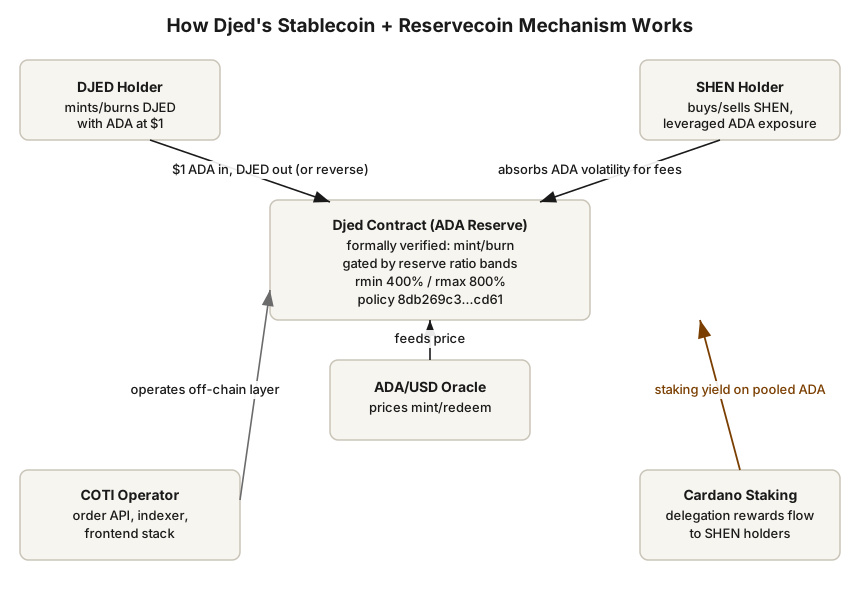
Djed's contract acts as an automated market maker of last resort with two tokens:
- DJED (stablecoin): anyone can mint DJED by paying the contract $1 worth of ADA (per oracle price) plus a fee, or burn DJED to redeem $1 of ADA — provided the reserve ratio stays within bounds.
- SHEN (reservecoin): anyone can buy SHEN, adding ADA to the reserve, or sell it back. SHEN holders own the reserve's equity: they absorb ADA downside and capture upside, effectively holding a leveraged ADA position, compensated by mint/burn fees (shared into the reserve) and, in COTI's implementation, Cardano staking (delegation) rewards on the pooled ADA.
Stability comes from reserve-ratio bands: the protocol targets 400–800% collateralization. If the ratio would fall below rmin (400%), DJED minting and SHEN selling are disallowed, conserving reserves for redemptions; if it would exceed rmax (800%), new SHEN purchases are blocked so reservecoin holders' equity is not diluted below useful leverage. The paper proves theorems for both "Minimal Djed" and "Extended Djed" (which adds continuous pricing and dynamic fees), including peg-maintenance bounds and a no-insolvency property under stated oracle assumptions. On Cardano, DJED and SHEN are native assets under policy ID 8db269c3ec630e06ae29f74bc39edd1f87c819f1056206e879a1cd61, with an off-chain operator stack (order API, indexer, frontend) run by COTI — key parts of which COTI open-sourced in 2025 alongside announcing a multi-chain "Private DJED" using garbled-circuit encryption.
Outcome
Partial success. DJED launched at ~600% collateralization and initially attracted around 27–30M ADA in reserves within days; integrations followed on Minswap, WingRiders, MuesliSwap, Liqwid, VyFinance, Bitrue, and a ChainPort bridge to BNB Chain. The mechanism behaved as specified: within weeks of launch, falling ADA prices pushed the ratio to ~300%, and the contract correctly halted DJED minting rather than becoming undercollateralized. By its first anniversary (January 2024) the protocol held ~40M ADA, had paid ~900K ADA in delegation rewards to SHEN holders, and sat at ~505% collateralization. Charles Hoskinson claimed DJED traded between $0.97 and $1.03 for 99.9% of its life. Exceptions were real: thin liquidity produced a spike to $2.46 on secondary markets, and on October 10, 2025, amid a broad tariff-shock crash, DJED fell to about $0.55 before mean-reverting within ~5 hours as the deposit-freeze and redemption arbitrage worked. Commercially, however, DJED remained a niche asset with a market cap in the low millions, dwarfed even within Cardano by fiat-backed entrants; COTI's 2025 pivot to open-sourcing and "Private DJED" is an implicit acknowledgment that the original product plateaued.
Why it worked
- Deep overcollateralization with hard bands. A 400% floor meant ADA had to lose ~75% of its value against outstanding redemptions before solvency was threatened; the rmin gate automatically stopped new issuance in stress instead of printing into a death spiral.
- The reservecoin cleanly prices the risk. SHEN gave leverage-seeking ADA bulls an explicit, fee-compensated product for absorbing volatility — the opposite of Terra's design, where stablecoin holders themselves bore reflexive seigniorage risk.
- Formal verification constrained the design. Proving peg and solvency theorems forced simple, analyzable state transitions; the mechanism's behavior in the 2023 ratio breach and the 2025 flash depeg matched the paper's predictions (temporary price deviation, guaranteed eventual redeemability).
- Staking-reward passthrough made holding SHEN yield-bearing without external subsidies, sustaining reserves through a bear market.
Why it failed or underperformed
- Capital inefficiency capped growth. Every $1 of DJED requires $4–$8 of ADA locked; SHEN demand — appetite for leveraged ADA exposure — is the binding constraint on stablecoin supply, so DJED could never scale to meet demand the way fiat-backed coins do.
- Peg quality is "eventual," not instantaneous. With minting frozen in stress and thin DEX liquidity, secondary-market prices could stray badly ($2.46 upside; $0.55 in October 2025) even while primary redemption at $1 of ADA remained sound — unacceptable for payments or as DeFi collateral pricing.
- Small host-chain gravity. Cardano's limited DeFi TVL and user base bounded organic demand; the ChainPort BNB bridge did little.
- Operator centralization. Despite a decentralized on-chain core, COTI ran the oracle-feeding and frontend stack for years before open-sourcing, and "official stablecoin of Cardano" branding tied DJED's fate to two organizations' roadmaps.
Lessons
- Overcollateralization plus hard reserve-ratio gates genuinely prevents death spirals — Djed weathered the exact macro shocks (2023 bear, October 2025 crash) that killed seigniorage designs — but the cost is severe capital inefficiency and frozen issuance precisely when demand for stability peaks.
- Splitting the system into a stable claim and an explicit leveraged equity claim (reservecoin) is the honest way to allocate volatility risk; the design's constraint then becomes marketing the risky tranche, not defending the stable one.
- A provably solvent primary market does not guarantee a tight secondary-market peg; without deep DEX liquidity and fast arbitrage rails, users experience depegs the math says are temporary.
- Formal verification is worth the design discipline it imposes: DJED's failures were all within-model (price deviation inside proven bounds), never out-of-model insolvency.
- Being a chain's "official" stablecoin is not a distribution strategy; demand must come from uses, and small-chain gravity bounds even a well-engineered mechanism.
Redesign (EDITORIAL — hypothesis, not fact)
This section is editorial hypothesis, not fact. A modern Djed would attack the secondary-peg problem directly: seed a protocol-owned DJED/ADA and DJED/USDC concentrated-liquidity position funded by a slice of mint/burn fees, so arbitrage to the primary contract is instant and flash depegs like October 2025 compress from hours to minutes. Replace the hard mint freeze below rmin with a continuously rising dynamic mint fee (as in Extended Djed) to avoid cliff effects. Make SHEN more attractive per unit of reserve by tranching it — a senior reservecoin with capped yield and a junior tranche with full leverage — widening the buyer base beyond maximal ADA bulls and easing the capital-efficiency bind. Diversify reserves beyond ADA (e.g., adding BTC or liquid-staked assets via trust-minimized bridges) to cut correlation between the collateral and the host chain's fortunes. Finally, decentralize the operator layer from day one: multiple independent oracle feeds and frontends, with the open-sourced indexer/API stack COTI eventually shipped treated as a launch requirement rather than a year-three concession.
Sources
- Djed: A Formally Verified Crypto-Backed Pegged Algorithmic Stablecoin (IACR ePrint 2021/1069) — primary (docs)
- IOHK blog — Djed: implementing algorithmic stablecoins for proven price stability — primary (docs)
- COTI — A New Era For Stablecoins Begins: Djed is Live on Mainnet! — primary (docs)
- Cardanoscan — token policy 8db269c3…cd61 (DjedMicroUSD) — primary (contract)
- COTI — Djed's First Anniversary retrospective — primary (retrospective)
- input-output-hk/djed-stablecoin-prototype (GitHub) — primary (docs)
- The Block — Cardano's decentralized stablecoin Djed goes live on mainnet (news)
- crypto.news — Djed reserve ratio drops to 300% amid dumping ADA prices (news)
- TheCryptoBasic — Hoskinson on DJED's Oct 2025 depeg and 99.9% stability record (news)
- COTI — DJED Goes Open Source / Private DJED announcement — primary (docs)
Related experiments
Last verified: 2026-07-27 · Spot an error? Suggest a correction