ENS
Ethereum's decentralized naming protocol that evolved from a sealed-bid Vickrey auction into a rent-based permanent registrar governed by one of the largest protocol DAOs.
▶ Run interactive simulation animated mechanism with editable parameters
How it works onchain
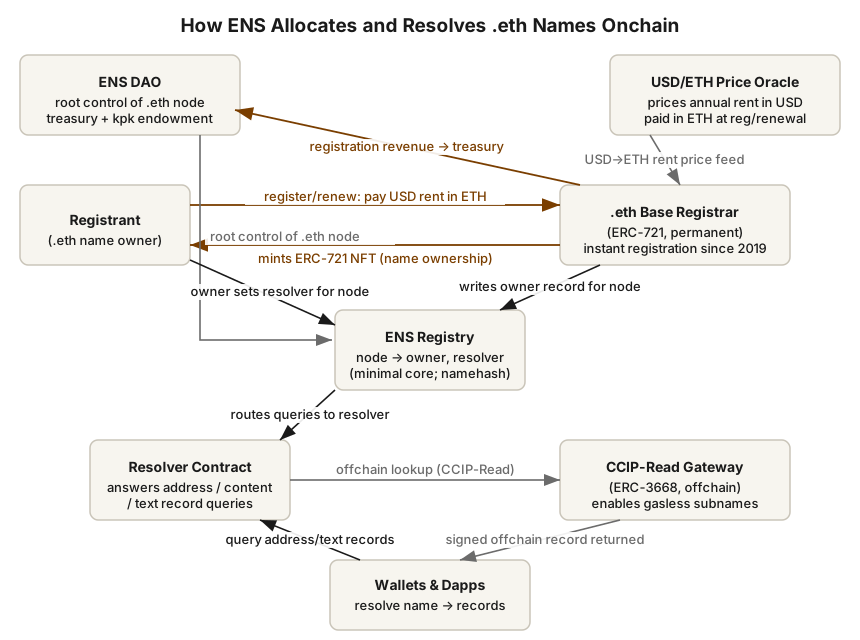 Open full-size diagram
Summary
The Ethereum Name Service (ENS) maps human-readable names like alice.eth to machine identifiers — wallet addresses, content hashes, text records — the way DNS maps domains to IP addresses, but with ownership and resolution enforced by Ethereum contracts. Launched on May 4, 2017 by Nick Johnson (then at the Ethereum Foundation, with launch help from Alex Van de Sande), ENS is one of the longest-running mechanism-design experiments on Ethereum: it has cycled through a sealed-bid Vickrey auction with locked deposits (2017–2019), a permanent registrar with USD-denominated annual rent (2019–), and full handover to a token-governed DAO with a ratified constitution and a DeFi-managed endowment (2021–). Over 2 million .eth names have been registered cumulatively, with roughly 1.3 million active names and ~638k owners per the official site as of 2026.
Design (Mechanism)
Architecture. ENS separates three concerns: a minimal registry (who owns a node, which resolver it uses), resolvers (contracts that answer queries for addresses/records), and registrars (contracts that own a TLD like .eth and set allocation rules). Names are hashed hierarchically ("namehash"), so any owner can issue subdomains, and reverse records let addresses claim a primary name.
Phase 1 — interim registrar (2017–2019). Allocation of .eth names used a sealed-bid Vickrey auction (EIP-162): a minimum 0.01 ETH bid opened a 3-day bidding window in which bids were blinded commit-reveal (observers could not see amounts or even which name was being bid on), followed by a 2-day reveal. The highest revealed bidder won but paid only the second-highest price, with the winning amount locked in a deed contract — refundable if the name was later released. This was explicitly an anti-squatting design: capital lockup rather than payment.
Phase 2 — permanent registrar (2019–). At 00:00 UTC on May 4, 2019, ENS migrated to the permanent registrar: instant registration replaced auctions, names became standard ERC-721 NFTs (base registrar at 0x57f1...eA85), and pricing changed from locked deposits to recurring rent — $5/year for names of 5+ characters, with steep premiums ($160/yr and $640/yr) for 4- and 3-character names, priced in USD via oracle and paid in ETH. Expired names re-enter the market through a decaying Dutch-auction premium. Short names (3–6 chars) reserved at launch were sold via auction in 2019.
Phase 3 — DAO and endowment (2021–). In November 2021 ENS airdropped 25M ENS tokens to 137k historical name holders (weighted by holding duration), ratified a constitution by tokenholder vote (97% approval), and transferred root control and registration revenue to the ENS DAO. The DAO later built an endowment managed by karpatkey/kpk to make protocol development self-sustaining independent of registration volume. Resolution has also expanded offchain via CCIP-Read (ERC-3668), enabling gasless subnames (e.g., Coinbase's cb.id) and, in the ENSv2 roadmap, migration of the registry to a dedicated L2 ("Namechain").
Outcome
Major success and de facto standard. ENS names resolve in most major wallets, dapps, and even some browsers; .eth became a social identity primitive (the "name.eth" Twitter-handle era of 2021–2022). Registrations passed 2M cumulative names, with ~1.3M active as of 2026 — churn reflecting the rent model working as designed (unrenewed speculative names expire back to the market). Registration revenue funded a DAO treasury large enough to spin up a durable endowment (kpk reported ~$2.9M of net DeFi results generated for the endowment by H1 2025). The 2021 airdrop is regarded as one of the fairest large retroactive distributions, and the DAO constitution (fees are an incentive mechanism, not profit maximization; ENS must remain a public good) has held through multiple governance terms. ENSv2/Namechain represents a rare case of a mature protocol voluntarily re-architecting for cheaper issuance rather than defending L1 rent.
Why it worked
- Minimal registry, swappable everything else. The registry/resolver/registrar split let ENS replace its entire allocation mechanism twice (auction → rent; L1 → CCIP-Read/L2 subnames) without breaking resolution for existing names.
- Mechanism matched the threat model. Sealed-bid Vickrey auctions blunted frontrunning and sniping during scarce initial allocation; recurring USD-denominated rent then handled long-run squatting better than one-time sales, continuously recycling abandoned names.
- Credible neutrality before monetization. Years as an EF-incubated public good, then a retroactive airdrop to actual users and a constitution constraining fee policy, gave ENS legitimacy no commercial naming competitor matched.
- NFT-standard ownership made names composable with the entire wallet/marketplace stack for free.
Limitations and criticisms
ENS's design carries real, unresolved weaknesses. The interim Vickrey auction was operationally painful (multi-day commit-reveal UX, lost deposits from failed reveals, and early registrar bugs forced a relaunch of some auctions in 2017), and commit-reveal registration still adds friction today. Rent pricing by character count is crude — a $5/yr price admits mass speculative squatting of desirable 5+ character names, and expiry churn shows a large share of 2021–22 registrations were speculation. Governance participation is low relative to token distribution, and DAO drama (e.g., disputes over director conduct and provider streams) shows token voting is a blunt instrument. Finally, resolution off Ethereum depends on wallets honoring CCIP-Read gateways, reintroducing trusted intermediaries at the edges.
Lessons
- Allocation and holding costs are separate levers. Auctions solve initial-scarcity pricing; recurring rent solves long-run squatting. ENS is the canonical demonstration that you may need both, sequentially.
- Keep the core registry dumb. A minimal ownership registry with pluggable resolvers/registrars let ENS swap mechanisms twice in production — design for mechanism replacement, not mechanism permanence.
- Retroactive airdrops to real users buy durable legitimacy. Weighting by holding duration (not count farming) and pairing tokens with a ratified constitution converted users into a governing constituency rather than mercenary claimants.
- Denominate public-good fees in fiat, not the volatile native asset. Oracle-priced USD rent kept naming affordable across ETH price cycles and made revenue plannable enough to fund an endowment.
- An endowment converts protocol revenue into independence. Sizing a treasury to survive revenue droughts is what lets a fee-charging public good credibly refuse profit maximization.
Redesign (EDITORIAL — hypothesis, not fact)
This section is editorial speculation. A redesigned ENS might replace flat character-count rent with Harberger-style self-assessed pricing on a bounded band: owners declare a valuation within protocol-set floors/ceilings, pay rent proportional to it, and face forced-sale offers above it — pricing squatted premium names to their holders honestly while the ceiling protects ordinary users' identity from hostile takeover. Demand-responsive rent (a per-name multiplier that rises with renewal-time contention, like EIP-1559 for names) could achieve much of this with less confiscation risk. On governance, registration revenue could stream partly to a resolver/client incentive pool, paying wallets that perform verified onchain (or proof-backed CCIP) resolution — attacking the trusted-gateway problem at the edge. Launching today, the registry would live on an L2 from day one with L1 checkpointing for resolution security, which is roughly the bet ENSv2 is now making in reverse.
Sources
- ENS Docs — Mainnet contract deployments — primary (docs)
- EIP-162: Initial ENS Hash Registrar (Vickrey auction spec) — primary (docs)
- ENS official website (stats, X handle) — primary (docs)
- ENS Docs — The ENS Token (airdrop and DAO launch) — primary (docs)
- ENS DAO Constitution — primary (governance)
- kpk H1 2025 review of the ENS Endowment (DAO forum) — primary (governance)
- ENS V2 announcement (Namechain / L2 plans) — primary (docs)
- EthHub — Ethereum Name Service overview (history of interim and permanent registrars) (analysis)
Related experiments
Last verified: 2026-07-27 · Spot an error? Suggest a correction