Farcaster Frames
An Open Graph extension that turns Farcaster social posts into interactive, transactable mini-applications rendered inline in the feed.
▶ Run interactive simulation animated mechanism with editable parameters
How it works onchain
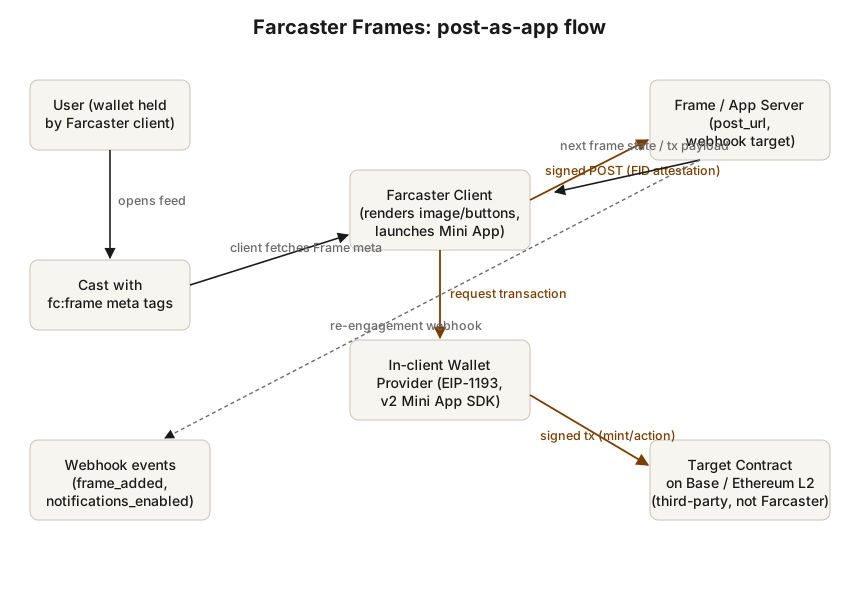 Open full-size diagram
Summary
Farcaster Frames are an extension of the Open Graph (OGP) metadata standard that transform ordinary social posts ("casts") on the Farcaster protocol into interactive, in-feed mini-applications. Launched with little fanfare by Farcaster co-founders Dan Romero and Varun Srinivasan (of Merkle Manufactory) on January 26, 2024, Frames let users mint NFTs, buy goods, play games, vote in polls, and sign onchain transactions without ever leaving the social client. The feature became Farcaster's defining growth engine: daily active users grew roughly 10x in two weeks (from under 2,000 to nearly 20,000 by early February 2024, later peaking near 73,000–100,000 by mid-2024). Frames are historically significant as one of the first widely-adopted attempts to collapse the distance between a social feed and onchain action — making "the post" itself the app surface. In late 2024 the standard was substantially rebuilt as "Frames v2," subsequently rebranded to "Mini Apps," extending the primitive into full-screen apps with wallet access and notifications.
Design (Mechanism)
Frames v1 (January 2024). A Frame is a webpage that adds fc:frame meta tags to its HTML <head>, extending Open Graph. Core tags include fc:frame (declares the page a Frame), fc:frame:image (the rendered image), fc:frame:button:1..4 (up to four labeled buttons), fc:frame:post_url (the callback endpoint), and fc:frame:input:text (optional text input). When a Farcaster client renders a cast containing a Frame URL, it displays the image and buttons inline. Clicking a button triggers a signed POST request from the client to the post_url, containing the button index, any text input, and a cryptographically signed message attesting to the acting user's Farcaster ID (FID). The server responds with a new HTML document defining the next Frame state, enabling multi-step interactions — all without wallet connection or app install for basic flows. Onchain actions (e.g., NFT mints) were bootstrapped by handing transaction data back to the client's wallet.
Frames v2 / Mini Apps (announced November 2024). Authored by Varun Srinivasan (varunsrin) as a Farcaster Improvement Proposal (Discussion #205, FIP Stage 4 / Finalized), v2 replaced the stateless image-and-button model with full-screen web applications that render inside an embedded browser in the Farcaster client. Key mechanism changes:
- Embed + launch: a compact feed embed (3:2 image plus button) opens the app URL in an in-app browser.
- JavaScript SDK: the app communicates with the host client to request actions (save the frame, open URLs, request transactions).
- Context injection: the app receives the user's identity, wallet addresses, and launch context.
- Wallet integration: an EIP-1193 Ethereum provider enables direct transaction requests and signatures against arbitrary contracts (primarily on Base and other Ethereum L2s).
- Domain association: a
/.well-known/farcaster.jsonmanifest with JSON Farcaster Signatures binds an app to its domain. - Notifications: a webhook system (
frame_added,frame_removed,notifications_enabled/disabled) lets apps re-engage users.
Versioning is semantic to preserve backward compatibility. The v2 release schedule ran v0.0.0 (Nov 27, 2024) through a stable v1.0.0 in early 2025, with a rebrand to "Mini Apps" carrying no breaking API changes.
Outcome
Status: partial_success. As a distribution and engagement primitive, Frames was an unambiguous short-term hit. Farcaster went from under 2,000 daily actives in late January 2024 to ~20,000 within two weeks, with daily casts reportedly rising from ~200,000 to ~2 million during the initial surge, and DAUs later peaking around 73,000–100,000 by mid-2024. The mechanism spawned an ecosystem of NFT-mint frames, games, and commerce experiments, and inspired the cross-ecosystem "Open Frames" standard for portability beyond Farcaster.
However, the longer arc is mixed. Third-party analysis reports DAUs declining to roughly 40,000–60,000 by late 2025, with a significantly smaller count of genuinely engaged "Power Badge" users and concerns about bot inflation. The primitive endured and evolved (Frames v2 / Mini Apps), but did not sustain the explosive trajectory of its debut. In a decisive corporate development, in early 2026 the infrastructure firm Neynar acquired Farcaster's protocol and products; co-founders Dan Romero and Varun Srinivasan departed to join stablecoin startup Tempo (announced Feb 9, 2026), and Merkle Manufactory announced plans to return roughly $180M to investors, with the protocol continuing under new leadership.
Why it worked
- Zero-friction distribution. Frames lived where attention already was — the feed — removing the click-out, wallet-connect, and app-install steps that kill onchain conversion. Romero framed this as "links are freedom" on Farcaster, contrasting with X's algorithmic penalty on outbound links.
- Signed attribution for free. Because Farcaster clients already manage user keys, every Frame interaction arrived with a verified FID signature, giving developers Sybil-resistant identity without building auth.
- Composable, permissionless surface. Any webpage could become a Frame with a few meta tags, so developers shipped experiments in hours, producing a fast Cambrian explosion of use cases (mints, polls, games, commerce).
- Right moment for Base. Cheap L2 transactions on Base made in-feed minting economically viable at consumer scale.
Where the design broke
- Novelty-driven, not retention-driven. Much early usage was speculative/airdrop-farming and mint hype; engagement cooled once novelty and incentive expectations faded, and DAUs contracted.
- v1 was too constrained. The stateless image/button model limited real app experiences, forcing a full v2 rewrite that fragmented developer effort and reset expectations.
- Bot and metric-quality concerns. Reported DAUs were criticized as inflated, undermining the growth narrative.
- Platform, not protocol-scale, network effects. Frames' value was tightly coupled to Farcaster's own reach; it never achieved the ubiquitous cross-platform adoption of the OG standard it extended, despite Open Frames efforts.
- Ownership discontinuity. The 2026 Neynar acquisition moved the protocol and its products to a new steward, with the original founders moving to a separate venture — leaving continuity of the Mini Apps roadmap dependent on the new organization rather than the team that designed it.
Lessons
- Meeting users in-context beats building destinations. The single biggest unlock was removing the click-out; onchain mechanisms convert far better when embedded in existing attention surfaces than when they require a separate app.
- Identity you inherit is a moat. Piggybacking on the client's existing key management to deliver signed, Sybil-resistant interactions gave developers a capability that would have been prohibitively hard to build independently.
- Permissionless simplicity drives the first wave; depth requires a rebuild. A trivially adoptable v1 spec maximized experimentation, but serving durable applications forced a heavier v2 — plan for that migration cost up front.
- Explosive launch metrics can mask weak retention. Incentive- and novelty-driven surges are poor predictors of durable engagement; measure cohort retention and quality-of-user, not just peak DAU.
Redesign (EDITORIAL — hypothesis, not fact)
The following is the researcher's editorial hypothesis, not established fact.
Frames' core insight — the post as the app surface — was correct; its underperformance was primarily a retention-and-portability problem. A redesign would attack both:
Ship v2-grade capability from day one, spec'd for portability. Rather than launching a constrained v1 and rewriting a year later, define a single client-agnostic app-embed standard (converging with Open Frames) so any social client could host it. This preserves the fast-experimentation advantage while avoiding the ecosystem fragmentation of a v1→v2 migration.
Make retention a first-class primitive. Bake in opt-in, permissioned notification and "saved app" surfaces from launch (v2 eventually added these), and expose standardized retention analytics so builders optimize for returning cohorts rather than one-shot mints.
Decouple value capture from a single platform. Because Frames' fortunes were tied to Farcaster's own DAU curve, a redesign would prioritize an interoperability layer that lets Frames run identically across multiple clients and even non-crypto surfaces, so the primitive's network effects are not hostage to one host app's growth.
Bias incentives toward utility over farming. Since early volume skewed toward speculative/airdrop behavior, incentive design (e.g., rewarding sustained interaction or verified real usage rather than raw interaction counts) could have produced a cleaner, less bot-inflated growth signal and more durable applications.
Sources
- FIP: Frames v2 — farcasterxyz/protocol Discussion #205 — primary (governance)
- Farcaster Mini Apps (Frames) Specification — primary (docs)
- Farcaster Docs — primary (docs)
- Farcaster's Dan Romero Explains How 'Frames' Did What X (Twitter) Doesn't (retrospective)
- Daily active users on Farcaster surge to all-time high, driven by Frames launch (news)
- Farcaster founder teases Frames v2 ahead of full launch in 2025 (news)
- Farcaster founders join stablecoin startup Tempo after Neynar acquires social protocol (news)
- Farcaster in 2025: The Protocol Paradox (analysis)
Related experiments
Last verified: 2026-07-26 · Spot an error? Suggest a correction