Foundation
Invite-only Ethereum art marketplace whose reserve-price auctions with 24-hour countdowns and 15-minute anti-snipe extensions defined the 1/1 crypto-art meta of 2021, before shutting down in 2026 after a failed acquisition.
▶ Run interactive simulation animated mechanism with editable parameters
How it works onchain
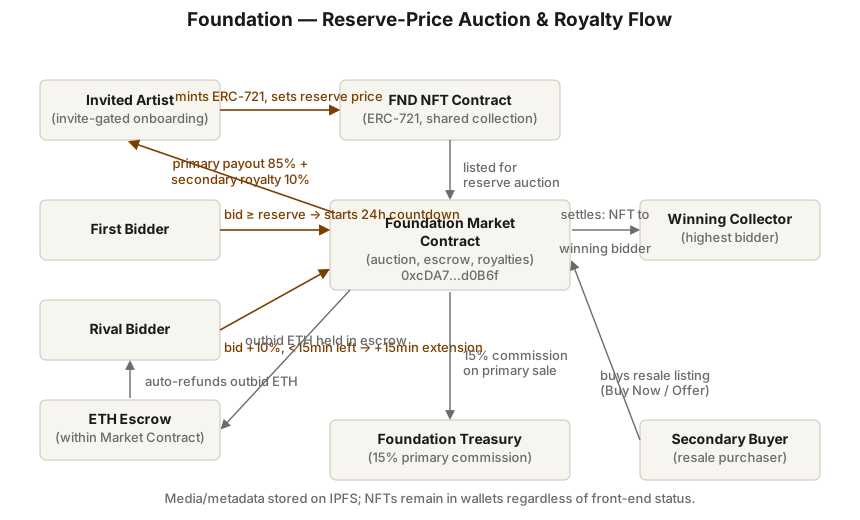 Open full-size diagram
Summary
Foundation (foundation.app) was an Ethereum NFT marketplace for 1/1 digital art that launched in February 2021, at the opening of the NFT bull market, after first announcing itself in mid-2020. Founded by Kayvon Tehranian (CEO) with co-founder and head of design Matthew Vernon, it positioned itself as the tasteful, curated alternative to open marketplaces: creators could only mint after being invited by an existing artist (later supplemented by a "Community Upvote" mechanism), which produced scarcity of supply and a strong gallery-like brand. Its signature mechanism was the reserve-price auction — a 24-hour countdown triggered by the first qualifying bid, with 15-minute anti-snipe extensions — which became the default price-discovery format for crypto art in 2021. Foundation hosted several era-defining sales, including the Nyan Cat meme (300 ETH, February 2021) and Edward Snowden's "Stay Free" (2,224 ETH, roughly $5M, benefiting the Freedom of the Press Foundation). Over its life the platform processed roughly $230 million in primary sales. As NFT volumes collapsed post-2022, Foundation launched the social NFT app Rodeo (2024, on Base), which shut down in early 2026 for lack of scale. An acquisition by digital-art display company Blackdove, announced in early 2025 with ownership handover in early 2026, was abandoned after post-handover due diligence; in April 2026 Tehranian announced the marketplace would go permanently offline, with IPFS pinning maintained through April 2027.
Design (Mechanism)
- Invite-gated supply. Creators could not simply sign up; they needed an invite from an already-onboarded artist. Each new artist received a limited number of invites, making curation itself a social graph. A "Community Upvote" pathway later let the community admit new artists. Collecting/bidding was permissionless.
- Reserve-price auctions. Artists minted an ERC-721 (Foundation's shared FND contract, 0x3B3ee1931Dc30C1957379FAc9aba94D1C48a5405) and set a reserve price. The auction had no fixed start: the first bid meeting the reserve triggered a 24-hour countdown. Each subsequent bid had to be at least 10% higher; bids in the final 15 minutes extended the auction by 15 minutes (anti-sniping). Settlement was fully onchain via the Foundation Market contract (0xcDA72070E455bb31C7690a170224Ce43623d0B6f); escrowed ETH from outbid bidders was automatically returned.
- Fees and royalties. Foundation took a 15% commission on primary sales; creators received a 10% royalty on secondary sales, enforced at the marketplace-contract level. Buy Now listings, Offers, and private sales were added later alongside auctions.
- Verified, open-source contracts. Foundation published and verified its NFT and market contracts on Etherscan, and later shipped creator-owned collection contracts, editions/drops tooling, and curated "Worlds" (creator-run galleries with curator fees).
- Provenance-first storage. Media and metadata were stored on IPFS; NFTs remained in creators'/collectors' wallets, which meant assets survived the platform's death even though the front end did not.
Outcome
Foundation was one of the defining venues of the 2021 crypto-art boom: the Nyan Cat and Snowden auctions were mainstream news events, and artists such as Jen Stark, James Jean, and Reuben Wu held landmark sales there. Cumulative primary sales reached approximately $230 million. But its revenues tracked the NFT art cycle: sector-wide monthly trading volume fell from about $2.9 billion at the 2021 peak to roughly $23.8 million by early 2025, and Foundation's high-touch 1/1 model had no hedge. The team's pivot, Rodeo (a social minting app launched 2024 on Base), "did not reach the size needed for long-term survival" and went read-only in February 2026, shutting fully by March 10, 2026. The Blackdove acquisition — announced in early 2025, with operational handover in early 2026 — was reversed when Blackdove paused the deal after post-handover due diligence and opted to build its own marketplace. In April 2026 Tehranian announced Foundation could not be brought back online; the official site now states the platform is offline indefinitely (notice dated April 27, 2026), with the IPFS gateway maintained through April 27, 2027. Because contracts were onchain and media on IPFS, the NFTs themselves persist. Outcome: technically successful, commercially unsuccessful.
Why it worked
- Curation as mechanism, not moderation. Making invites a scarce resource held by artists turned quality control into a peer-propagated social graph, giving Foundation a premium brand that open marketplaces couldn't replicate.
- Auction design fit the asset. Reserve + trigger-on-first-bid + anti-snipe extensions maximized price discovery for illiquid 1/1s and manufactured 24-hour event windows that artists could promote — auctions became performances.
- Credible neutrality of settlement. Verified, open-source contracts, onchain escrow, and enforced royalties gave artists confidence during a period rife with rug-pulls and opaque platforms.
- Cultural timing. Launching weeks before the Beeple/Christie's moment let Foundation capture the meme-and-art zeitgeist (Nyan Cat, Snowden) and headline-driven distribution for free.
Why it failed or underperformed
- Single-cycle revenue model. A 15% cut of primary 1/1 art sales is a leveraged bet on one asset class in one market regime; when 1/1 art volume evaporated after 2022, there was no durable second product.
- Curation caps scale. The invite gate that created the brand also capped supply and throughput, so Foundation could never compete on volume with OpenSea/Blur, nor on fees once royalty enforcement collapsed marketplace pricing power sector-wide.
- Pivot came late and subscale. Rodeo launched in 2024, deep into the bear market, and never reached sustainable size.
- Exit risk realized. Selling to Blackdove with handover before full due diligence left the platform stranded when the acquirer walked; infrastructure was already spun down and could not be economically restarted.
- Front-end dependency. Despite onchain assets, discovery, provenance display, and market access lived in a centralized web app whose disappearance stranded listings (users had to delist NFTs from the market contract during a brief site revival).
Lessons
- Onchain settlement outlives the company. Because NFTs, escrow logic, and IPFS-addressed media were credibly decentralized, Foundation's death did not destroy collectors' assets — a concrete validation of "protocols persist, platforms die." But UX, discovery, and provenance context did die with the front end.
- Scarcity-based curation is a brand engine and a growth ceiling simultaneously. Invite gating produced premium price realization per item and prevented the platform from ever diversifying into volume businesses.
- Auction mechanics matter: the 24h-triggered countdown with anti-snipe extensions proved a genuinely good design for illiquid 1/1s and was widely copied; mechanism quality alone, however, doesn't create a moat once competitors can fork verified open-source contracts.
- Acquisitions of onchain platforms need escrowed operational continuity. Transferring operations before due diligence completes exposes users to abrupt shutdown; wind-down commitments (IPFS pinning windows, delisting periods) should be contractual, not goodwill.
- Fee-take businesses on cyclical cultural assets need counter-cyclical products — subscriptions, infra, or custody — or they are effectively short volatility on culture.
Redesign (EDITORIAL — hypothesis, not fact)
This section is editorial speculation, not fact. A redesigned Foundation would decentralize exactly the layer that killed it: the front end. Ship the market as an immutable, feeless-or-minimal-fee protocol (as it largely was), but move curation onchain — invites as transferable-but-slashable curation tokens, "Worlds" as curator-staked registries earning a share of fees, so the tastemaker graph persists independently of any company. Fund operations with a protocol-level primary fee split (e.g., 5% protocol / 10% curator) streamed to an endowment (real-yield treasury) sized to cover indexing and IPFS pinning in perpetuity, making wind-down impossible rather than promised. Finally, escrow provenance metadata (exhibition history, auction records) onchain or on Arweave at sale time, so the historical record — Foundation's real product — survives any acquirer's cold feet.
Sources
- Foundation: Market contract (Etherscan) — primary (contract)
- Foundation (FND) NFT contract (Etherscan) — primary (contract)
- Foundation's smart contracts are verified and open source (Foundation blog) — primary (docs)
- Foundation is offline (official shutdown notice, foundation.app) — primary (archive)
- Foundation Help Center: bidding, reserve auctions, fees — primary (docs)
- Foundation Shuts Down NFT Marketplace After Failed Sale (Cointelegraph, April 2026) (news)
- Foundation NFT Marketplace Shuts Down Permanently After Failed Sale (The Defiant) (news)
- Foundation, a Prominent NFT Platform of the 2021 Boom, Shuts Down After Failed Sale (ARTnews) (news)
- What Is Foundation NFT: Invite-Only Marketplace (Phemex Academy) (analysis)
Related experiments
Last verified: 2026-07-27 · Spot an error? Suggest a correction