Olympus Pro
OlympusDAO's 'bonds-as-a-service' marketplace that let other protocols sell discounted vested tokens for LP tokens, converting rented liquidity-mining liquidity into protocol-owned liquidity — for a 3.3% fee to the Olympus treasury.
▶ Run interactive simulation animated mechanism with editable parameters
How it works onchain
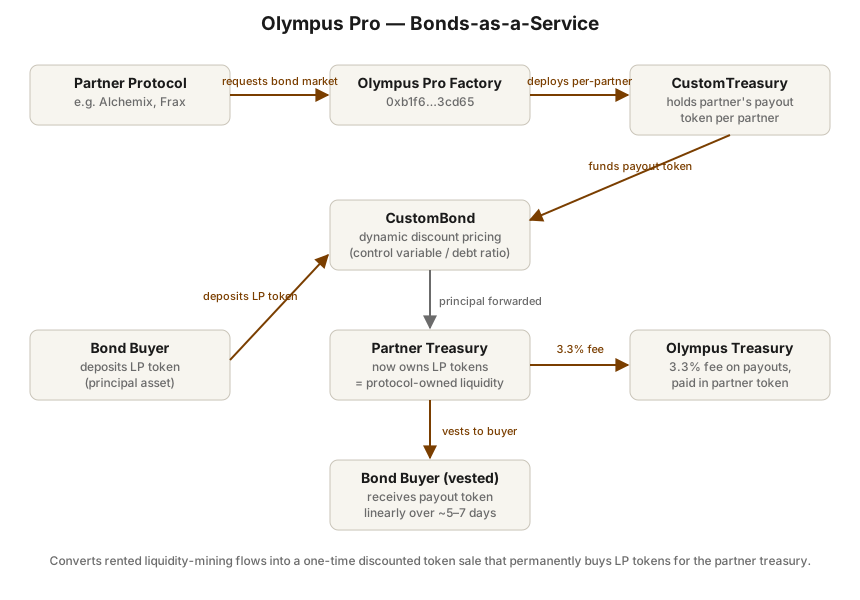 Open full-size diagram
Summary
Olympus Pro was OlympusDAO's attempt to productize the mechanism that made Olympus (OHM) famous: bonding. Announced September 17, 2021, at the height of the "protocol-owned liquidity" (POL) narrative, it offered "bonds-as-a-service" to other DeFi protocols. Instead of renting liquidity through perpetual liquidity-mining emissions, a partner protocol could sell its own token at a discount, vested over days, in exchange for LP tokens — permanently acquiring the liquidity as a treasury asset. Olympus supplied audited contracts (a factory deploying per-partner custom treasury and bond contracts), a shared marketplace front end, and advisory support, taking a flat 3.3% fee on bond payouts. It onboarded roughly 40 partners (Alchemix, Frax, PoolTogether, BarnBridge, Abracadabra, Keep3r, and others) across multiple chains and bonded tens of millions of dollars of liquidity before the 2022 bear market gutted demand. In mid-2022 Olympus governance voted (OIP-104) to spin the unit out as an independent, permissionless venture, Bond Protocol, with Olympus retaining a majority stake.
Design (Mechanism)
The core primitive is a discounted, vested token sale priced against a quote asset:
- Custom treasury + custom bond contracts. An on-chain factory (Olympus Pro Factory, Ethereum:
0xb1f69dec...cd65) deployed aCustomTreasuryandCustomBondpair per partner. The partner funded the treasury with its payout token; users deposited the principal asset — typically an LP token of the partner's own pair (e.g., ALCX/ETH SLP) — and received the payout token vested linearly (commonly ~5–7 days). - Dynamic discount pricing. Bond price adjusted with a control variable and debt ratio (the same mechanism as Olympus's own bonds): heavy demand raised the price (shrinking the discount), lulls let the discount widen until arbitrageurs stepped in. This approximated a continuous Dutch-auction against the market price.
- Fee capture. Olympus's treasury took a flat 3.3% fee on bond payouts (i.e., paid in the partner's token), making Olympus a passive index-holder of its partners' tokens and giving OHM holders a revenue stream unrelated to OHM's own rebase mechanics.
- Emissions substitution logic. The pitch was accounting-based: liquidity mining is a perpetual expense that rents mercenary liquidity; a bond converts the same emissions into a purchase of a permanent, fee-earning treasury asset (the LP position), while vesting dampens instant dump pressure versus naked farming.
- Cohort go-to-market. Partners launched in curated cohorts (Cohort 1 in October 2021, then Cohort 2, Fantom cohorts, etc.) across Ethereum, Polygon, Fantom, Avalanche, and Arbitrum, all surfaced in one marketplace UI.
Outcome
Strong initial traction during the POL mania: early cohorts captured ~$9.35M in liquidity within weeks, and by 2022 aggregate figures cited ~40 partners, over $45M in liquidity bonded, and over $2M in fee revenue to the Olympus treasury; Keep3r alone bonded over $20M across seven bonds. But volume tracked the broader OHM/POL narrative, which collapsed with the 2022 bear market and the implosion of OHM forks. In July 2022, governance proposal OIP-104 ("Deploy Permissionless OP as Bond Protocol") passed: the team spun out as Bond Protocol, an independent, permissionless bond marketplace with Olympus holding a majority equity stake (at least 60% at formation per the proposal), and Olympus became a customer of its own former product. Bond Protocol raised a $2.5M seed round led by Chapter One and IDEO, rebuilt the system as permissionless, tokenized, modular bond markets, and later (2024–2025) the team pivoted again toward Axis, a modular auction protocol. Olympus Pro as a product therefore no longer exists under that name; its mechanism survives in successors. Outcome status: partial_success — real revenue and genuine adoption, but demand proved narrative-cyclical and the business was divested rather than scaled.
Why it worked
- It monetized a proven in-house mechanism. Olympus had already run the largest bonding program in DeFi for its own treasury; selling the picks-and-shovels version to other DAOs was a natural, low-marginal-cost extension with instant credibility.
- It solved a real, widely felt pain. In 2021 nearly every DeFi protocol was bleeding emissions to mercenary liquidity farmers. "Own your liquidity instead of renting it" was a crisp, CFO-legible value proposition.
- Aligned fee design. Taking the 3.3% fee in the partner's token gave Olympus an ongoing stake in each partner's token, tying treasury outcomes to partner performance and diversifying the Olympus treasury.
- Cohort curation plus a shared marketplace concentrated bond-buyer attention, giving small protocols demand they could not have bootstrapped alone.
Where the design broke
- Demand was a bull-market phenomenon. Bond discounts are financed by token emissions; when token prices fell 80–95% in 2022, selling more tokens at a discount became unattractive, and buyer appetite for vested altcoins evaporated.
- Brand contagion from OHM. As OHM's price collapsed and "(3,3)" forks imploded, association with Olympus became a liability for a B2B product — one motivation cited for the spin-out and rename.
- Curated, high-touch model didn't scale. Manual onboarding, per-partner contract deployment, and a flat fee were outcompeted by the permissionless, modular redesign (Bond Protocol) the team itself concluded was necessary.
- POL's own economics were questioned. Buying your own LP tokens with discounted native tokens is still dilution; several analyses argued protocols often paid more per unit of durable liquidity than well-tuned incentives would have cost, especially once options-based alternatives appeared.
Lessons
- A treasury mechanism is not automatically a business. Bonding worked brilliantly for Olympus's own reflexive flywheel; as a service, its demand was tied to a market regime (cheap native-token capital) that did not persist.
- Fees taken in customers' tokens are pro-cyclical. Revenue denominated in partner tokens compounds upside in a bull market and collapses doubly in a bear — fee-asset choice is a balance-sheet decision, not a detail.
- Permissionless beats curated for infrastructure. The spin-out's first move was removing the manual cohort process; if your service's core is a smart contract, gatekeeping is a temporary go-to-market tactic, not a moat.
- Spinning out non-core products via governance can be a clean exit. OIP-104 preserved upside for OHM holders (majority equity) while freeing both sides — a rare example of a DAO divesting a business unit deliberately rather than letting it rot.
- "Own vs. rent liquidity" is a framing, not a free lunch. The real cost comparison is discount + vesting risk premium vs. ongoing emissions; teams that skipped that math often overpaid for permanence.
Redesign (EDITORIAL — hypothesis, not fact)
This section is editorial hypothesis, not established fact. A redesigned Olympus Pro would decouple its revenue from partner-token beta: charge fees in the principal asset (the LP token or its stable/ETH leg) rather than the payout token, or offer a menu. Pricing should be an explicit gradual Dutch auction with transparent parameters rather than an opaque control variable, reducing the mispricing that opaque, per-partner discount curves produced (several bond programs ended up priced away from fair value). To address the core cyclicality problem, bonds could be reframed as one instrument on a general "treasury capital-markets" platform — alongside options-based liquidity incentives (à la later designs that vest upside rather than sell spot at a discount) and range-bound POL for concentrated-liquidity AMMs, letting partners choose renting, owning, or optioning per market regime. Finally, embedding measurable liquidity-quality covenants (depth targets, retention curves) into bond programs would let issuers evaluate cost-per-unit-of-durable-liquidity, converting the marketing narrative into an auditable metric. The team's actual trajectory (permissionless Bond Protocol, then modular auctions at Axis) suggests they converged on parts of this hypothesis independently.
Sources
- Introducing Olympus Pro (OlympusDAO, Sept 17, 2021) — primary (docs)
- Olympus Pro Factory contract (Etherscan, verified) — primary (contract)
- Olympus Pro — Introducing Cohort 2 Launch Partners — primary (docs)
- Olympus Pro Recap: January 2022 — primary (docs)
- OIP-104: Deploy Permissionless OP as Bond Protocol (Olympus governance forum) — primary (governance)
- Introducing Bond Protocol (successor announcement, July 2022) — primary (docs)
- Bond Protocol: Announcing our $2.5M Seed Round — primary (news)
- OlympusDAO's Vote to Split Olympus Pro and Rename as Bond Protocol Approved (TokenInsight) (news)
- Bond Protocol — Decentralized Finance (IQ.wiki, metrics summary) (analysis)
- Axis | Modular Auction Protocol (successor team's later pivot) (analysis)
Related experiments
Last verified: 2026-07-26 · Spot an error? Suggest a correction