Giveth
Long-running crypto philanthropy platform that pioneered 'liquid pledging' traceable donations in 2017 and later wrapped zero-fee giving in a token economy (GIVbacks, GIVpower) that rewards donors with governance power.
▶ Run interactive simulation animated mechanism with editable parameters
How it works onchain
 Open full-size diagram
Summary
Giveth is one of the oldest continuously operating experiments in onchain philanthropy. Founded in 2016 by Griff Green and Jordi Baylina — both central figures in the response to The DAO hack — it set out to build "the Future of Giving": donations that are transparent, traceable, borderless, and eventually self-sustaining. The project has gone through two distinct mechanism eras. The first (2017–2021) was the "liquid pledging" era: an Ethereum smart-contract system (later branded Giveth TRACE) in which donations were delegated through a hierarchy of Communities (DACs) → Campaigns → Milestones, with donors retaining the right to see, and to some extent veto, where their pledge went before it was finally spent. The second era began with the relaunched giveth.io donation app and the GIVeconomy (launched December 24, 2021): a 1-billion-supply GIV token that pays donors back for giving (GIVbacks), streams governance power over five years (GIVstream), and lets stakers curate which projects gain visibility and higher reward rates (GIVpower). The platform charges zero fees and, as of mid-2026, reports roughly $7.2M in cumulative donations across ~8,300 projects from ~29,000 donors.
Design (Mechanism)
Era 1 — Liquid pledging (Giveth TRACE). Baylina's LiquidPledging contracts (open-sourced on GitHub) implemented delegated, traceable giving: donors pledged funds to Delegates/DACs, who forwarded pledges to Campaigns, which paid out only against concrete Milestones. Until a pledge was committed, donors could recall or redirect it. This produced an onchain audit trail from donor to outcome — a mechanism the team coined "liquid pledging," conceptually adjacent to liquid democracy but for money.
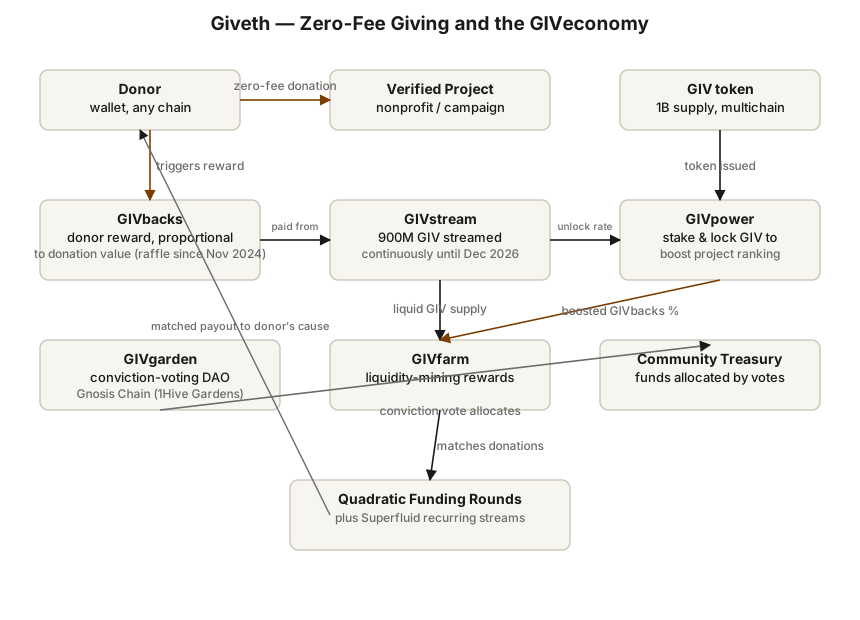
Era 2 — GIVeconomy. Launched December 24, 2021 with a GIVdrop to a curated "Trusted Seed" of crypto philanthropists, builders, and Blockchain4Good communities. Components:
- GIV token: 1B minted; 100M liquid at genesis, 900M streamed via GIVstream until December 23, 2026 — recipients' balances unlock continuously, so long-term participants gain governance weight as the economy grows.
- GIVbacks: donors to verified projects receive GIV proportional to donation value — a decentralized analogue of the tax-deductible donation that converts donors into governors. In November 2024 (Round 77) it was converted into a raffle-based system (each eligible donation is a chance to win up to 500,000 GIV) to stretch the rewards budget.
- GIVpower: stake-and-lock GIV to "boost" projects, raising their ranking and their donors' GIVbacks percentage — a token-curated registry of charitable projects, in effect.
- GIVgarden: conviction-voting DAO governance (1Hive Gardens stack on Gnosis Chain) allocating treasury funds to community proposals; GIVfarm provided liquidity-mining rewards.
- Quadratic funding rounds and Superfluid-based recurring donation streams were added later on the main app.
Deployments span Ethereum mainnet (GIV: 0x900dB999074d9277c5DA2A43F252D74366230DA0), Gnosis Chain (0x4f4F9b8D5B4d0Dc10506e5551B0513B61fD59e75), Optimism, Polygon zkEVM, and Solana.
Outcome
Ongoing after nearly a decade — a rarity in this category. The liquid-pledging DApp proved technically workable but too complex for mainstream nonprofits; the simpler giveth.io app superseded it and TRACE was wound down after community discussion (forum: "The future of Giveth TRACE," 2022). The GIVeconomy launched into the top of the 2021 cycle: GIV hit an all-time high near $1.02, then fell roughly 99.9% from peak. Cumulative donation volume (~$7.2M) is meaningful for crypto-native philanthropy but small against traditional giving, and the GIVbacks program's shift to a raffle model signals rewards-budget pressure. Giveth remains a hub of the regen/public-goods ecosystem (Gitcoin, Commons Stack, General Magic adjacency) and continues shipping (QF rounds, Causes, recurring donations). Verdict: an institutional success and mechanism pioneer; a token economy that underperformed.
Why it worked
- Credible, mission-driven founders with DAO-hack-response reputations attracted a durable volunteer/contributor community that survived multiple bear markets without VC dependence.
- Zero-fee, borderless donations are a genuinely better rail for many use cases (international, unbanked, censorship-prone causes) than card-based platforms taking 3–8%.
- GIVbacks reframed donating as governance acquisition, giving donors a non-cynical reason to return, and the GIVstream tied token power to long-term participation rather than mercenary capital.
- Verification + GIVpower curation created a workable spam/fraud filter for an open project registry.
Limitations and criticisms
- Liquid pledging was over-engineered for its users: nonprofits found the DAC/Campaign/Milestone flow confusing; the team itself ultimately replaced it with a conventional donate button plus offchain verification.
- Token-subsidized giving is reflexive: GIVbacks value depends on GIV price, which depends on demand for governance over a donations platform with no revenue (zero fees). As price fell ~99.9% from ATH, the donor rebate weakened, and the program had to be converted to a raffle.
- Circularity risk: rewarding donations with tokens invites wash-donating to farm rewards, forcing heavy manual verification overhead.
- Modest scale: ~$7.2M lifetime volume shows crypto philanthropy remains niche; the "nonprofits become DAOs with regenerative economies" vision has not materially arrived.
Lessons
- Traceability is not the binding constraint in charity — trust and simplicity are. Donors mostly did not want to actively steer pledges; they wanted a credible verified badge and a one-click flow.
- Donation rebates paid in a native governance token are a subsidy, not an economy; without an exogenous revenue or sink, the mechanism decays with token price and must be rationed (as GIVbacks' raffle pivot showed).
- Streaming governance power over years (GIVstream) is an underrated alternative to cliff-vesting airdrops: it filtered for long-horizon participants and dampened immediate dump pressure, even if it could not fight a bear market.
- Longevity in public-goods projects correlates with community ownership and low burn, not token performance — Giveth outlived many better-funded rivals.
- Stake-to-curate (GIVpower) works as an anti-spam ranking device but concentrates visibility toward projects with wealthy backers unless quadratic or reputation weighting is added.
Redesign (EDITORIAL — hypothesis, not fact)
This section is editorial speculation, not a description of Giveth's actual plans. A redesigned Giveth would give the token a real cash-flow anchor: keep donations zero-fee but route donated principal through yield-bearing strategies (its own "GIVfi" direction points here), with yield split between the cause, a GIVbacks budget, and protocol reserves — making donor rewards sustainable rather than emissions-funded. GIVbacks would pay in a non-transferable reputation asset redeemable for matching-pool influence (quadratic-funding credits) instead of a tradable token, eliminating wash-donation farming and reflexive price dependence. Liquid pledging deserves revival at the institutional layer: large grantmakers and QF matching pools, not retail donors, are the actors who actually want revocable, milestone-gated delegation. Finally, project verification could be decentralized via staked attestations (slash on fraud) rather than a core-team review queue, cutting the platform's largest operational bottleneck.
Sources
- About Giveth — Giveth Docs — primary (docs)
- GIVeconomy — Giveth Docs — primary (docs)
- GIVbacks — Giveth Docs — primary (docs)
- GIVdrop — Giveth Docs — primary (docs)
- Giveth/liquidpledging (contract source) — primary (contract)
- GIV Token — Etherscan — primary (contract)
- Welcome to the GIVeconomy (launch announcement, Giveth Medium) — primary (retrospective)
- Two Flavours of Giveth — Which One to Choose? (Giveth Medium) — primary (retrospective)
- The future of Giveth TRACE (governance forum) — primary (governance)
- Round 1 GIVbacks distribution (governance forum) — primary (governance)
- Giveth (GIV) — CoinGecko (analysis)
- Interview with Griff Green, Co-Founder Giveth — Global Philanthropic (news)
Related experiments
Last verified: 2026-07-26 · Spot an error? Suggest a correction