Hivemapper
A Solana-based DePIN that pays dashcam-equipped drivers in HONEY tokens to crowdsource a fresh, street-level global map sold to enterprises via burn-based map credits.
▶ Run interactive simulation animated mechanism with editable parameters
How it works onchain
 Open full-size diagram
Summary
Hivemapper is one of the flagship "DePIN" (decentralized physical infrastructure network) experiments: a crowdsourced alternative to Google Street View built by paying ordinary drivers in crypto. Contributors mount a purpose-built 4K dashcam (originally the "Hivemapper Dashcam," later the upgraded "Bee") in their car and passively record street-level imagery as they drive. Imagery is processed into map features, and contributors earn HONEY, an SPL token on Solana. The company behind it, Hivemapper Inc., was founded by Ariel Seidman (previously Director of Product Management for Yahoo Maps/Search and co-founder of Gigwalk) with co-founder/CTO Evan Moss; it began as a drone/aerial mapping startup years before pivoting to the token-incentivized dashcam network. The crypto network launched on Solana in early November 2022, after an $18M raise led by Multicoin Capital in April 2022. By 2025 the network claimed roughly a third of the world's road network mapped (21M+ unique km), enterprise deals including Lyft and Volkswagen's ADMT autonomous-driving unit, a commercial brand ("Bee Maps," introduced September 2024), and a further $32M round led by Pantera in October 2025 — while the HONEY token itself suffered heavy inflation-driven price decline.
Design (Mechanism)
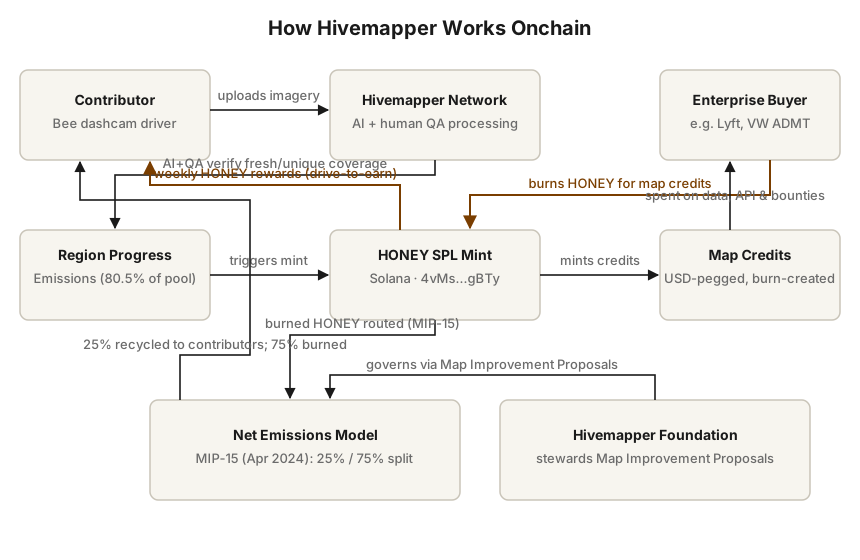
- Supply side — drive-to-earn. Contributors buy a Hivemapper/Bee dashcam (hardware sold by the company; a sensor-buy-in similar to Helium hotspots). Driving generates imagery uploaded to the network; AI plus a human "map consumer" QA layer (AI Trainers reviewing imagery) turn it into map data. Rewards favor fresh and unique coverage: emissions are split across reward types, with the large majority (per docs, 80.5% of the minted rewards pool) allocated to Map Coverage and divided among regions by a "Region Progress" score, so mapping an unmapped road pays more than re-driving a saturated one.
- Token. HONEY is a plain SPL token (mint
4vMsoUT2BWatFweudnQM1xedRLfJgJ7hswhcpz4xgBTy), max supply 10B: 40% to contributors, 20% investors, 20% employees, 15% Hivemapper Inc., 5% the Hivemapper Foundation. At network launch (November 3, 2022) the network began minting the 4B contributor allocation, with weekly issuance indexed to "Global Map Progress" — emissions scale with how much of the world remains unmapped, rather than a fixed halving schedule. - Demand side — burn-based map credits. Enterprises don't hold volatile tokens: they buy USD-pegged map credits, created by burning HONEY, and spend credits on imagery/APIs or on bounties that direct future collection. This is a burn-and-mint-equilibrium (BME) design in the Helium/Factom lineage: usage burns supply, contribution mints it.
- Net emissions. Governance proposal MIP-15 (April 2024) refined this into a "Net Emissions Model": of HONEY burned for consumption, 25% is recycled to contributors as Map Consumption Rewards (capped at 500K HONEY weekly) and 75% is permanently burned — tying contributor income partially to real demand instead of pure inflation.
- Governance. Parameter changes flow through Map Improvement Proposals (MIPs) stewarded by the Hivemapper Foundation.
Outcome
Ongoing, and one of the few DePINs with verifiable physical output. The network mapped its claimed ~33–35% of the global road network (21M+ unique km) within roughly two-plus years of launch — coverage Street View took far longer to assemble — across markets from Tokyo to Lagos. Commercially, Hivemapper launched Bee Maps as its enterprise-facing brand (September 2024), shipped the improved Bee dashcam (unveiled February 2024), and landed marquee customers: Lyft announced use of its community-built maps, and Volkswagen's ADMT unit selected it for real-time mapping data for autonomous vehicles (July 2025). Investor conviction continued: $32M led by Pantera in October 2025 to scale device deployment. The token, however, tracked the classic DePIN pattern: circulating supply grew past 5.5B and analyses attributed a ~91% annual price decline to emissions outpacing burn; enterprise deals had not yet translated into token demand at matching scale. Verdict: the map is a success; the token economy remains demand-starved — hence "ongoing" rather than a settled outcome.
Why it worked
- Real cost advantage. Street-level mapping is brutally expensive for fleets (Google's approach); paying marginal rewards to drivers already on the road collapses the cost of coverage and, crucially, of refresh frequency — the dimension where incumbents are weakest.
- Hardware-gated contribution quality. Requiring a purpose-built camera (rather than arbitrary phone uploads) standardized data quality and raised Sybil costs, while dashcams have standalone consumer utility.
- Progress-indexed, freshness-weighted emissions steered contributors toward unmapped/stale roads instead of farming dense cities, making token spend map roughly onto map value.
- USD-pegged credits insulated enterprise buyers from token volatility — a necessary bridge for non-crypto customers like automotive firms.
Limitations and criticisms
- Burn has lagged mint. Contributor emissions have run far ahead of consumption burns; with rewards immediately sellable, structural sell pressure has produced severe token depreciation, shrinking real contributor income and forcing repeated tokenomic patches (MIP-15's net-emissions cap).
- Demand is enterprise-slow. Automotive and logistics sales cycles run years long while the token market reprices weekly, so even large deals like Volkswagen's take time to translate into measurable on-chain demand.
- Coverage is a supply metric, not the product. "% of roads driven once" doesn't guarantee the freshness, QA, and API polish paying customers need — which has pushed the company toward a conventional B2B data business (Bee Maps) with the token network as a procurement layer, raising centralization questions (company-controlled hardware, processing pipeline, and pricing).
Lessons
- Burn-and-mint equilibria are asymmetric in practice: supply-side incentives activate in weeks, demand-side burn takes enterprise-sales years, and the token price bears the gap. Emissions should be throttled to demand from day one, not patched later.
- Hardware-gated contribution is a strong Sybil defense and quality filter for physical data networks — the cost is slower onboarding and dependence on the company's supply chain.
- Denominating consumption in USD-pegged credits is effectively mandatory for selling blockchain-produced data to non-crypto enterprises.
- A DePIN can succeed as infrastructure while its token underperforms; evaluating these systems requires separating network output (km mapped, customers) from token performance.
Redesign (EDITORIAL — hypothesis, not fact)
This section is editorial hypothesis, not a factual claim about Hivemapper's plans. A redesign would hard-couple emissions to trailing consumption: contributor rewards each epoch equal a multiple (say 2–4x, decaying toward 1x) of the prior epoch's credit burn, with a small bootstrap floor for genuinely unmapped regions — eliminating the open-ended inflation phase. Coverage bounties could be auction-based: buyers post USD-credit bounties on specific road segments and freshness SLAs, and drivers claim them, making price discovery per-kilometer explicit instead of formula-driven. Vesting a portion of drive rewards until the covered segment is consumed by a paying customer would align contributors with demand rather than raw supply. Finally, publishing verifiable proofs of imagery provenance (device attestation on-chain) would let third parties build competing processing pipelines on the same raw data, reducing the single-company chokepoint between the token network and enterprise revenue.
Sources
- What Is HONEY? — Hivemapper Docs — primary (docs)
- HONEY token mint on Solana Explorer — primary (contract)
- Earning HONEY / Global Map Progress — Hivemapper Docs — primary (docs)
- HONEY — Hivemapper Foundation — primary (docs)
- Hivemapper official site (stats, Lyft announcement, X link) — primary (docs)
- A Decentralized Google Maps? Solana-Based Hivemapper Raises $18M — Decrypt (news)
- Hivemapper raises $32M, launches new subscription for Bee dashcams — Blockworks (news)
- Hivemapper Introduces Bee Maps — Businesswire (company release) — primary (news)
- Case Study: Hivemapper decentralizes mapping — Solana Foundation (analysis)
- Hivemapper reveals new Bee dashcam — TechCrunch (news)
- How Hivemapper Became Solana's DePIN Darling with Founder Ariel Seidman — Coinage (retrospective)
Related experiments
Last verified: 2026-07-27 · Spot an error? Suggest a correction