io.net
Solana-based DePIN that aggregates idle GPUs into rentable clusters for AI workloads, paying suppliers in emitted IO tokens — known both for rapid scale and for a 2024 incident in which roughly 1.8 million spoofed GPU devices were detected, followed by a leadership change days before token launch.
▶ Run interactive simulation animated mechanism with editable parameters
How it works onchain
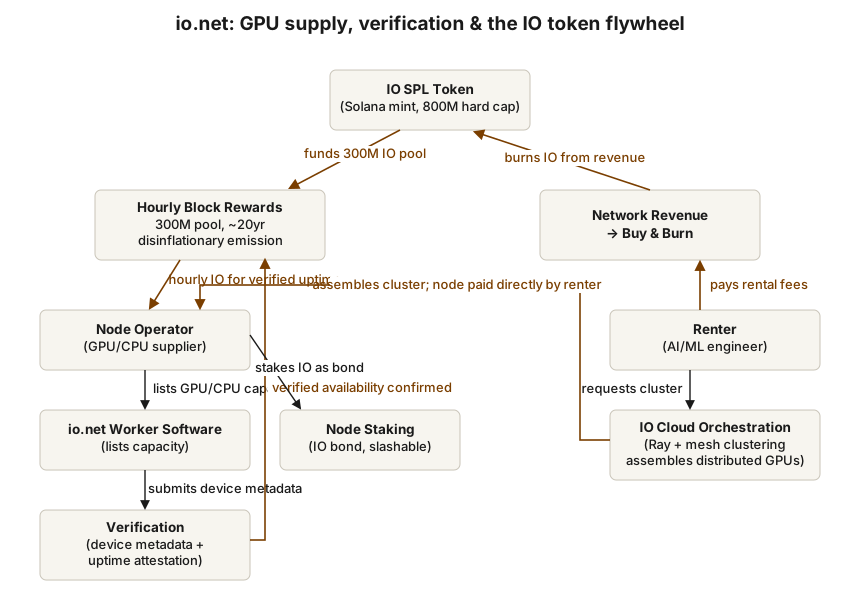 Open full-size diagram
Summary
io.net is a decentralized physical infrastructure network (DePIN) on Solana that aggregates underutilized GPUs — from independent data centers, crypto-mining farms, and consumer machines — into on-demand clusters that AI/ML teams can rent, positioned as a cheaper, permissionless alternative to hyperscaler cloud GPU rental. The network launched in beta in November 2023, raised a $30M Series A led by Hack VC in March 2024 (with Multicoin Capital, Solana Ventures, OKX Ventures and others), and launched its IO token via Binance Launchpool on June 11, 2024. It is one of the most-watched experiments in token-incentivized compute supply — and a cautionary tale about incentive-driven supply inflation: in April 2024 roughly 1.8 million fake "GPUs" attempted to spoof the network for rewards, triggering a public credibility crisis, and founder-CEO Ahmad Shadid resigned two days before the token launch. The project continued under successive CEOs (co-founder Tory Green, then Gaurav Sharma from April 2025) and reported growing revenue ($5.7M in Q1 2025, up 82.6% quarter-on-quarter).
Design (Mechanism)
Supply side (workers). Anyone with qualifying hardware runs the io.net worker software and lists GPU/CPU capacity. Suppliers earn (a) direct payments from renters and (b) hourly block rewards in IO tokens for verified availability/uptime. Node operators stake IO as a bond, aligning them against misbehavior and churn.
Demand side (clusters). Renters (AI/ML engineers) spin up clusters of distributed GPUs through IO Cloud; io.net's orchestration layer (built around open frameworks such as Ray, plus mesh networking) knits geographically scattered devices into usable training/inference clusters, with pricing that competes on cost against centralized clouds. Later products layered on the same supply: IO Worker (supplier management) and IO Intelligence (inference/API layer).
Token design. IO is an SPL token on Solana (mint: BZLbGTNCSFfoth2GYDtwr7e4imWzpR5jqcUuGEwr646K). Supply is hard-capped at 800M: 500M at genesis and 300M emitted as supplier/staker rewards, distributed hourly over ~20 years on a disinflationary schedule. The design pairs emissions with a sink: the project uses network revenue to buy and burn IO, so token value is nominally tied to real compute demand rather than pure speculation.
Verification problem. The core mechanism-design challenge of any compute DePIN is proving that advertised hardware is real, unique, and actually available. io.net relied on device metadata, proof-of-work-style checks and uptime attestation — the weakness of which was exposed in April 2024, after which the team hardened device verification.
Outcome
Rapid, incentive-fueled supply growth: the network claimed hundreds of thousands of connected GPUs within months of beta. On April 28, 2024, a "GPU metadata attack" — spoofed devices chasing expected airdrop/emission rewards, about 1.8M fake GPUs by the team's postmortem — caused displayed active connections to collapse (reported at the time as falling from ~600,000 to as few as 10), and critics including Martin Shkreli argued the headline supply numbers had reflected unverified device counts rather than active hardware all along. Amid these allegations, founder Ahmad Shadid resigned as CEO on June 9–11, 2024, two days before the token launch; co-founder/COO Tory Green took over. The IO token launched June 11, 2024 on Binance and other major exchanges. Post-crisis, the network pivoted messaging toward verified GPUs and real revenue: reported Q4 2024 revenue of $3.1M rising to $5.7M in Q1 2025, with thousands of verified GPUs and tens of thousands of CPUs across 130+ countries. In April 2025 Gaurav Sharma (ex-CTO) became CEO — the third in about two years — with Green chairing a new io.net Foundation. As of 2026 the project is operating and shipping (e.g., IO Intelligence), but IO trades far below its 2024 launch levels, and the token's value accrual remains modest relative to emissions. Verdict: ongoing — a real business with real revenue, but the token-incentive experiment's durability is unproven.
Why it worked
- Genuine demand-side tailwind: the 2023–2025 GPU shortage made "aggregate idle GPUs" one of the few DePIN pitches with obvious, paying customers, letting io.net show actual revenue rather than only emissions-subsidized activity.
- Emissions solved cold-start: hourly IO rewards bootstrapped hardware supply far faster than any sales team could — a textbook DePIN flywheel.
- Hard cap + revenue burn gave the token a cleaner value story than inflationary predecessors.
- Orchestration over open tooling (Ray) meant renters got familiar workflows, not a bespoke crypto stack.
Limitations and criticisms
- Sybil-vulnerable supply metrics: rewarding reported capacity rather than verified, consumed capacity invited mass spoofing; ~1.8M fake GPUs and the resulting metrics collapse permanently damaged trust in DePIN headline numbers.
- Vanity metrics as marketing: the gap between "connected" and "verified/rentable" GPUs was the crisis's root — the incentive design and marketing both leaned on the flattering number.
- Leadership turnover: three CEOs in two years, including a CEO transition 48 hours before the token generation event, added visible instability to the governance layer that enterprise buyers evaluate alongside the network's technical uptime.
- Token underperformance: emissions to suppliers outpaced burn from early revenue, so IO price bled despite business growth — supplier earnings denominated in a falling token weaken the flywheel.
Lessons
- Reward verified consumption, not self-reported capacity. Any DePIN paying for advertised supply will be Sybil-farmed; proof-of-real-work must precede emissions, not follow a crisis.
- Publish the conservative metric. The distance between "connected devices" and "verified, rentable devices" is where credibility dies; the strictest number should be the headline number.
- Emissions must be smaller than the sink at maturity. A revenue burn only supports the token if realistic revenue can plausibly offset the emission curve; otherwise suppliers are paid in dilution.
- Key-person risk is protocol risk. A pre-TGE leadership transition repriced the entire token launch; key-person exposure belongs in tokenholder risk models.
Redesign (EDITORIAL — hypothesis, not fact)
This section is editorial speculation, not a factual claim about io.net. A redesigned io.net would gate all emissions behind cryptographic or economic proof of delivered compute: rewards only for completed, attested jobs (sampled re-execution, TEE attestation, or optimistic verification with slashed stakes), with zero payment for idle "availability" beyond a small, stake-collateralized standby fee. Headline stats would be computed on-chain from paid job receipts, making the marketing number unfalsifiable by construction. Emissions would be dynamically throttled to a multiple of trailing protocol revenue (e.g., emissions ≤ 3× quarterly burn), so dilution tracks real demand. Finally, supplier rewards could be split between liquid IO and revenue-share claims on future job fees, so suppliers hold a direct claim on demand growth rather than pure token beta.
Sources
- io.net official X post announcing the $IO Solana token address — primary (docs)
- io.net official site — primary (docs)
- The Block — io.net CEO claims network was attacked in detailed postmortem (news)
- The Block — Io.net CEO Ahmad Shadid steps down days before token launch (news)
- Binance — Introducing IO.NET (IO) on Binance Launchpool (news)
- Chainwire — Tory Green appointed Chair of io.net Foundation; Gaurav Sharma appointed CEO (Apr 2025) (news)
- CoinGecko Learn — What Is io.net? (analysis)
- io.net blog — 2025 Year in Review — primary (docs)
Related experiments
Last verified: 2026-07-27 · Spot an error? Suggest a correction