HydraDX Omnipool
A Polkadot-native AMM that pools every asset into a single shared pool routed through a synthetic hub token (LRNA), instead of pairwise liquidity pools.
▶ Run interactive simulation animated mechanism with editable parameters
How it works onchain
 Open full-size diagram
Summary
The Omnipool is HydraDX's (now rebranded Hydration) flagship AMM design: instead of the standard model where every trading pair needs its own liquidity pool, every listed asset is deposited into a single shared pool and routed against a synthetic hub token, LRNA. Liquidity providers deposit only one asset at a time (no need to pair it with ETH, USDC, or anything else), and traders effectively swap "through" LRNA even though the interface shows a direct asset-to-asset trade. The Omnipool launched on Polkadot on January 6, 2023, and has since become the core liquidity layer for the Hydration parachain, later expanded with stablepools, isolated pools, lending/borrowing, and the HOLLAR stablecoin.
Design (Mechanism)
Traditional AMMs (Uniswap-style) require a separate pool for every pair (ETH/USDC, DOT/USDC, etc.), which fragments liquidity and forces new assets to bootstrap their own pools from scratch. HydraDX's Omnipool instead uses a hub-and-spoke model:
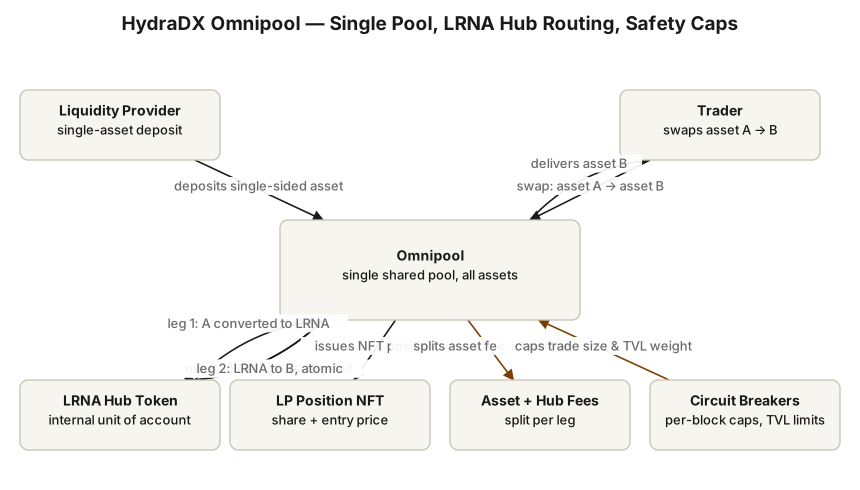
- Every asset added to the protocol is paired internally against LRNA, a non-transferable-by-default hub asset that exists purely as unit of account inside the pool's accounting.
- When a liquidity provider deposits an asset, the protocol mints a corresponding amount of LRNA against it, and the LP receives a position represented as an NFT recording their share and entry price — not a standard fungible LP token.
- A trade between any two assets (say DOT and USDC) is executed as two internal legs against LRNA in a single atomic transaction, so users experience it as one swap even though the pool is conceptually routing through the hub token.
- Fees are split into an asset fee (charged on the non-hub leg) and a protocol/hub fee (charged on LRNA flows), and an "Imbalance" mechanism was added to dampen LRNA price volatility caused by LRNA being sold back into the pool.
- Because every asset shares the same pool, adding safety limits was critical: the design layers in weight/TVL caps per asset, circuit breakers, and per-block trade-size limits to bound how much any single asset's price can move or how much an attacker could drain in one block.
The pitch is capital efficiency and better onboarding economics: new tokens can be listed with single-sided liquidity (no need to source a matching pair), and traders get access to deep, non-fragmented liquidity across all listed assets from one pool.
Outcome
The Omnipool has been running continuously since January 2023 and is still HydraDX/Hydration's core AMM more than three years later, having survived a live security scare in its first few months. In March 2023, a whitehat reported a potential Omnipool price-manipulation vector; the team paused new liquidity additions and shipped mitigations (oracle-based limits, circuit breakers, per-block caps) before any funds were lost. The protocol underwent a further security review as part of a Code4rena public audit contest in February 2024. The project has since rebranded from HydraDX to Hydration and expanded the product suite around the Omnipool (stablepools, isolated pools, money market, HOLLAR stablecoin), with the team publishing "Two Years of Omnipool" retrospectives. Exact current TVL, trading volume, and asset count were not independently confirmed in this research pass — outcome is marked ongoing rather than a definitive success/failure verdict.
Why it worked
- Single-pool design meaningfully lowers the bar for listing new assets: a project doesn't need to bootstrap a paired pool with deep liquidity on the other side, it just needs single-sided depth.
- The hub-asset routing genuinely can reduce liquidity fragmentation compared to pairwise pools, which is a real structural inefficiency in constant-product AMMs.
- The team responded to an early whitehat-reported vulnerability by pausing proactively rather than after an exploit, preserving trust and avoiding a loss event that could have killed the protocol in its first quarter.
- Being a native Polkadot parachain (rather than a smart contract on a general-purpose chain) let the team build safety limits (circuit breakers, per-block caps) directly into the runtime/consensus layer rather than bolting them onto contract logic after the fact.
Limitations and criticisms
- Pooling every asset together concentrates risk: a single mispriced or manipulated asset can, in principle, drain value from the entire shared pool rather than just one pair, which is why the design needed extensive circuit breakers and caps bolted on after a near-miss in 2023.
- The hub-asset (LRNA) accounting adds real conceptual and implementation complexity relative to a standard xy=k pool, which raises the audit surface and the chance of subtle mispricing bugs — reflected in the need for a dedicated public Code4rena contest.
- Being Polkadot-native (rather than deploying to Ethereum/L2s where most DeFi liquidity and users are) has structurally capped the addressable market and made cross-ecosystem comparisons to Uniswap/Curve-scale volumes unfavorable.
- Public, verifiable metrics on current TVL/volume relative to peers were not found in this pass, making it hard to independently assess whether the design's efficiency claims have translated into durable market share.
Lessons
- A shared-liquidity, hub-routed AMM can reduce fragmentation and ease new-asset bootstrapping, but it also concentrates tail risk across all assets in the pool rather than isolating it per pair — safety mechanisms (caps, circuit breakers, oracles) aren't optional add-ons, they're load-bearing parts of the design.
- Responding to a whitehat report by pausing proactively, before funds are at risk, is a strong signal for trust-building in early-stage DeFi protocols and is worth treating as a first-class design requirement, not an afterthought.
- Building AMM logic at the base-layer/runtime level (native parachain pallet) rather than as a smart contract changes the tradeoffs around upgradeability, auditability, and safety-limit enforcement — worth weighing deliberately against smart-contract deployment on an established ecosystem.
- Novel hub-asset accounting (LRNA-style) introduces complexity that is easy to underestimate; teams pursuing similar designs should budget for extended, adversarial audit processes (e.g., public contest audits) beyond a single private review.
Redesign (EDITORIAL — hypothesis, not fact)
One open question is whether a hybrid model — several "Omnipool-style" hub-routed clusters segmented by risk tier (e.g., blue-chip assets in one shared pool, long-tail/experimental assets in a separate, more tightly capped pool) — could preserve most of the capital-efficiency benefit of single-sided listing while reducing the blast radius of a single mispriced or manipulated long-tail asset. This is a hypothesis only: it would trade away some of the "one deep pool for everything" simplicity that is the Omnipool's core selling point, and it's unverified whether segmentation would meaningfully reduce systemic risk versus just adding operational complexity, since the existing per-asset caps and circuit breakers may already achieve a similar effect within the single-pool design.
Sources
- Omnipool | Hydration Docs — primary (docs)
- HydraDX Omnipool (part 1) — Hydration's Newsletter — primary (blog)
- Two Years of Omnipool — Hydration's Newsletter — primary (blog)
- State of the Art Security | HydraDX Docs — primary (docs)
- HydraDX-node omnipool pallet source (Code4rena audit repo) — primary (code)
- Hydration: DeFi Hub on Polkadot — Polkadot Support (article)
Related experiments
Last verified: 2026-07-27 · Spot an error? Suggest a correction