Hypercerts
A Protocol Labs-incubated standard for tokenized 'impact certificates' — fractionalizable ERC-1155 claims over defined scopes of impactful work, designed to enable retrospective funding markets for public goods.
▶ Run interactive simulation animated mechanism with editable parameters
How it works onchain
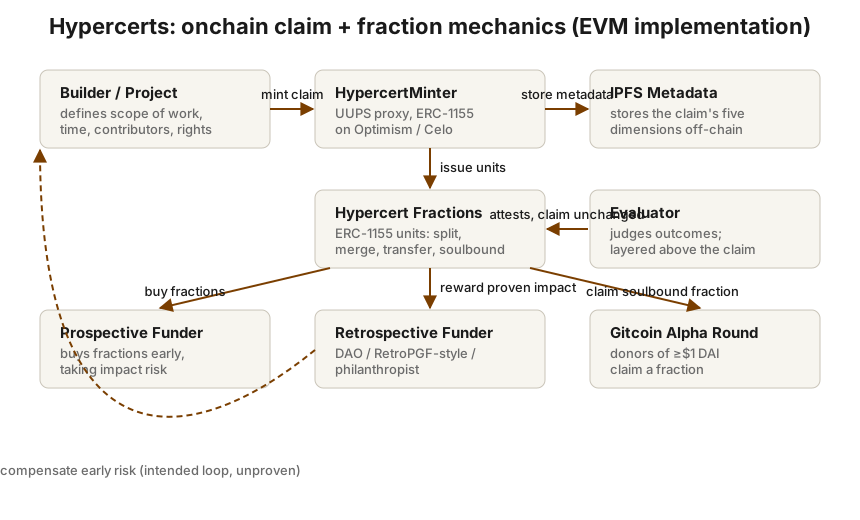 Open full-size diagram
Summary
Hypercerts are a data-layer primitive for impact funding: standardized, fractionalizable certificates that claim credit for a defined piece of impactful work (a scope of work, a time frame, a set of contributors, and a bundle of rights). The concept was introduced publicly by Protocol Labs in August 2022 — with Holke Brammer authoring the announcement and later directing the spun-out Hypercerts Foundation — as "a generalized form of carbon credits" applicable to any impact vector: open-source software, biodiversity, AI safety, community programs. The original implementation launched on Optimism in early 2023 as ERC-1155 semi-fungible tokens with IPFS metadata, debuting alongside Gitcoin's Alpha Rounds, where donors could claim soulbound hypercert fractions. The deeper ambition was to bootstrap retrospective funding markets in the spirit of Optimism's RetroPGF: prospective funders buy fractions of a hypercert early (taking impact risk), retrospective funders reward proven impact later, and the certificate is the interoperable unit of account connecting them. By 2025–2026 the project had reoriented: the current hypercerts.org describes hypercerts as "living digital records of impactful work built on the AT Protocol," de-emphasizing the token-market framing in favor of portable record/evaluate/fund infrastructure stewarded by the Hypercerts Foundation with contributors including Ma Earth, GainForest, and Protocol Labs.
Design (Mechanism)
An EVM hypercert is a claim with structured dimensions: scope of work, time of work, contributor set, scope and time of impact, and rights conferred to owners. Mechanically:
- Semi-fungible fractions. Each hypercert is minted via the HypercertMinter (UUPS proxy at 0x822F17A9...D1d07 on Optimism) as an ERC-1155 claim divided into units; fractions can be split, merged, transferred, or configured as soulbound. Metadata lives on IPFS.
- Non-overlapping claims. The framework's norm is that claims over the same work should not overlap — the intent is that each unit of impact is claimed exactly once, so funders can account for what they funded without double counting.
- Retrospective funding markets (intended loop). Builders mint hypercerts for work; prospective funders buy fractions to finance the work; evaluators attest to outcomes; retrospective funders (DAOs, RetroPGF-style programs, philanthropists) later purchase or reward fractions of proven-impact certificates, compensating early risk-takers. The certificate is deliberately mechanism-agnostic: an "interoperable data layer" any funding mechanism (quadratic funding, retro rounds, grants) can write to and read from.
- Evaluation as a separate layer. Hypercerts assert a claim, not its truth; third-party evaluations/attestations are layered on top, keeping the claim primitive neutral.
- AT Protocol reimplementation (current). The present architecture replaces token-centric claims with AT Protocol records: projects publish structured work records to personal data servers, evaluators add evidence and trust-signal labels, and funders allocate against shared, portable records — identity and data remain user-owned rather than app-locked.
Outcome
The EVM protocol shipped and saw real, if niche, adoption. The Optimism HypercertMinter shows on the order of ~25,000 holders (Optimistic Etherscan), much of it driven by the Gitcoin Alpha Round claim campaign (soulbound fractions for donors of ≥$1 DAI, minting <$1 on Optimism). Deployments followed on Celo and testnets; ecosystem experiments included Gitcoin/GreenPill impact-certificate pilots, Zuzalu-adjacent retro rounds, and regen projects via Ma Earth and GainForest. However, liquid secondary markets for impact — the load-bearing hypothesis of retrospective funding — did not materially emerge; activity stayed concentrated in commemorative claims and small pilot rounds. Rather than abandoning the idea, the Foundation rebuilt it as AT Protocol infrastructure (announced via docs and the ATProto community, live as the primary product by 2026), betting that rich, portable impact records plus social-context evaluation matter more than tokenized tradability. The project remains active and funded; the tokenized-market thesis remains unproven.
Why it worked
- Clear conceptual contribution. The five-dimension claim schema (work scope, time, contributors, impact scope, rights) gave the vague notion of "impact certificates" (Christiano-era idea, Optimism's RetroPGF) its first credible interoperable standard.
- Strong institutional backing. Protocol Labs incubation, a dedicated foundation, and immediate distribution through Gitcoin's Alpha Rounds delivered tens of thousands of holders at launch — rare for a public-goods primitive.
- Cheap, sensible engineering. ERC-1155 fractions + IPFS metadata on Optimism kept minting under $1, making mass claims viable.
- Honest layering. Separating claims from evaluations avoided baking any single truth oracle into the primitive.
Limitations and criticisms
- No demand-side market. Retrospective funding requires reliable retro buyers; outside Optimism's own RetroPGF (which never adopted hypercerts as its unit), there was no dependable payer of last resort, so prospective fraction-buying never became a rational investment at scale.
- Soulbound commemoratives dominated. The largest usage (Gitcoin claims) was non-transferable memorabilia — good for awareness, but exercising none of the market mechanism.
- Evaluation gap. Without mature, trusted impact evaluation, certificates struggled to price impact; a market needs something to trade on, and credible evaluation was the missing input.
- Primitive-before-ecosystem. The token standard preceded the funding networks it needed, and the 2025 AT Protocol pivot is an implicit acknowledgment that the bottleneck was shared records and trust context, not tokenization.
Lessons
- A funding primitive is only as strong as its buyer of last resort. Impact certificate markets need committed retrospective funders before speculation on impact can be rational; standards alone don't conjure demand.
- Evaluation is the hard part. Claims are cheap to tokenize; credible, comparable judgments of impact are the scarce input, and they determine whether prices mean anything.
- Distribution through an existing funding platform works. Piggybacking on Gitcoin rounds produced more real users in weeks than most public-goods protocols get in years — but conflating "claimed a badge" with "participates in an impact market" flatters the metrics.
- Be willing to re-platform. Migrating from ERC-1155 tokens to AT Protocol records shows the team treated blockchain as one possible substrate for the actual goal (portable impact accounting), not the goal itself.
Redesign (EDITORIAL — hypothesis, not fact)
The mechanism's missing piece was a committed retro-buyer. A redesign could invert the launch order: first sign one or more retrospective funders into a binding, escrowed commitment ("$X will purchase the top-evaluated hypercerts in domain Y in 12 months, per pre-published evaluation criteria"), then open prospective fraction sales against that commitment. This converts impact investing from pure altruism into an underwritable position with a known exit, which is what carbon markets — the stated analogy — actually have via compliance demand. Second, bind evaluation economically: require evaluators to stake on their attestations, slashed against later audit (Kleros/UMA-style), so certificate prices encode accountable judgment rather than vibes. Third, keep the current hybrid instinct but formalize it: AT Protocol records as the rich, mutable evidence layer, with a minimal onchain settlement token minted only when a record enters a funded round — tokenizing at the moment of market entry rather than at the moment of claim, so supply of tradable certificates never outruns demand.
Sources
- Hypercerts: A new primitive for public goods funding (Protocol Labs blog, Aug 2022) — primary (docs)
- Hypercerts official site (AT Protocol-based, current) — primary (docs)
- Hypercerts FAQ (legacy docs — ERC-1155 implementation, Optimism) — primary (docs)
- Hypercerts GitHub (protocol monorepo, deployment addresses) — primary (contract)
- HypercertMinter token tracker on Optimistic Etherscan — primary (contract)
- Hypercerts for public goods funding (Gitcoin blog, Mar 2023) (news)
- GreenPill Hypercerts Experiment — Impact Certificates in Practice (Gitcoin case study) (analysis)
- Hypercerts ATProto implementation (ATProtocol community forum) (analysis)
- Current Hypercerts documentation (AT Protocol architecture) — primary (docs)
Related experiments
Last verified: 2026-07-26 · Spot an error? Suggest a correction