SEKOIA by Virtuals
An autonomous 'AI venture capitalist' agent on Virtuals Protocol (Base) that evaluated pitches from other AI-agent teams and invested in their tokens, backed by Canonical's Anand Iyer, before its token collapsed >99.9% and its websites went dark.
▶ Run interactive simulation animated mechanism with editable parameters
How it works onchain
 Open full-size diagram
Summary
SEKOIA (billed as "Strategic Ecosystem Knowledge and Opportunity Investment Agent") was an attempt to run a venture capital fund as an autonomous AI agent inside the Virtuals Protocol ecosystem on Base. Launched as a tokenized agent in late October 2024, it evaluated pitches from teams building other AI agents, deployed capital into their tokens at or near launch, and split the acquired positions between co-investors and its own treasury. Its human sponsor was Anand Iyer, managing partner of the crypto VC firm Canonical, who publicly stated on November 19, 2024 that what began as an experiment had become a full commitment. The name was a nod to Sequoia Capital. SEKOIA rode the winter 2024–25 "AI agent" mania to an all-time-high token price of about $0.086 on January 15, 2025 (roughly $85M fully diluted on a 1B supply), then bled out with the rest of the sector. By July 2026 the token traded around $0.00008 (~$82K market cap, an all-time low set July 10, 2026), and both domains historically associated with the project (sekoia.website, sekoia.vc) no longer resolved.
Design (Mechanism)
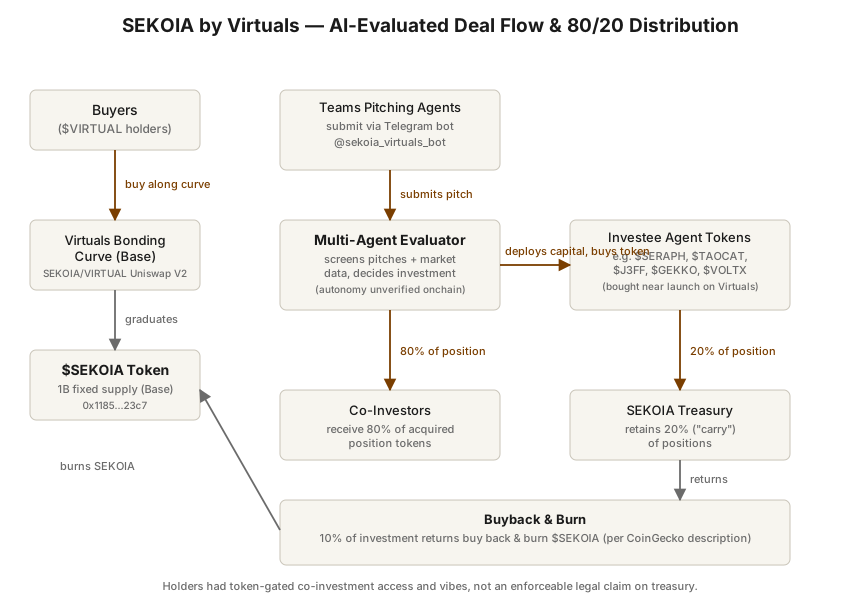
- Agent tokenization via Virtuals. SEKOIA launched as a standard Virtuals Protocol agent token (1B fixed supply, ERC-20 at 0x1185cb...23c7 on Base), bootstrapped through Virtuals' bonding-curve launchpad and graduating to a SEKOIA/VIRTUAL Uniswap V2 pool. The token was the fund's coordination and access asset, not an equity claim.
- AI-evaluated deal flow. Teams building agents on Virtuals submitted pitches to SEKOIA (intake ran through a Telegram bot, @sekoia_virtuals_bot). A multi-agent system analyzed pitches and market data and decided whether to invest, with the stated pitch that software could screen "thousands of projects daily" and enter very early — often immediately after a token's launch on Virtuals.
- 80/20 distribution split. Per contemporaneous community documentation of the mechanism, 80% of tokens acquired in an investment were distributed back to the investors who supplied capital, with 20% retained by the SEKOIA treasury — a carried-interest analogue enforced by convention rather than a court.
- Buyback-and-burn. CoinGecko's project description records a deflationary loop in which 10% of investment returns were used to buy and burn SEKOIA from the market, tying fund performance to token scarcity.
- Holder access. Token holders were promised first access to co-invest through the fund, plus community/governance participation — token-gated LP status rather than legal LP status.
Outcome
SEKOIA did actually invest. Early 2025 community documentation lists five initial positions — $SERAPH, $TAOCAT, $J3FF, $GEKKO and $VOLTX — with a claimed 76x paper gain on $GEKKO ($25K → ~$1.9M at the time of the January 2025 thread) and a treasury then valued around $780K (these figures come from a community thread, not audited reporting; treat as indicative). The token peaked mid-January 2025 alongside the broader Virtuals agent bubble, then collapsed with it: from ~$85M FDV to under $100K by mid-2026, a >99.9% drawdown, hitting its all-time low in July 2026. The project's GitHub organization contains only five forked repositories (AgentGPT, agentic, and ERC-20 tutorials) with no original public code. Iyer's personal site no longer mentions SEKOIA, the websites are offline, and no wind-down statement, final report, or treasury distribution was found. Unknown / not found: any formal shutdown announcement or final disposition of the treasury.
Why it worked
- Credible human sponsor. A named, reputable VC (Anand Iyer, ex-Pear VC, founder of Canonical) publicly staking his reputation distinguished SEKOIA from anonymous agent tokens and drove serious attention.
- Perfect narrative timing. "An AI that does VC for AIs" was the purest possible expression of the winter 2024–25 agent-economy thesis, launched on the hottest launchpad (Virtuals) at its peak.
- Real mechanism, real trades. Unlike most agent tokens, SEKOIA had a legible fund structure (intake → evaluation → investment → 80/20 split → burn) and demonstrably executed investments with visible early wins, which fed a reflexive loop into its own token.
Where the design broke
- Portfolio and token were both long the same bubble. SEKOIA's assets were early-stage Virtuals agent tokens; when the agent sector deflated in 2025, its portfolio, deal flow, and its own token collapsed simultaneously. There was no diversification and no downside mechanism.
- The "AI VC" was thin. The public technical footprint was five forked repos; how much genuine autonomous evaluation occurred versus human curation branded as an agent was never verifiable on-chain.
- No enforceable claim. Holders had access and vibes, not rights. The 80/20 split, buyback-and-burn, and treasury handling depended entirely on the operator continuing to care; when attention moved on, the structure evaporated with no accountability event.
- No wind-down mechanism existed. With no dead-man's-switch or automatic treasury distribution built in, the project could go dark with no postmortem or final disposition of funds — the failure mode of most agent-era projects that lacked such a mechanism, and corrosive to the credibility the named sponsor initially lent.
Lessons
- A tokenized fund whose portfolio, fee asset, and investor base are all exposed to the same narrative is a single trade, not a fund; the structure amplifies both directions of reflexivity.
- "Autonomous agent" claims need on-chain or open-source verifiability; otherwise an AI fund is just a discretionary fund with marketing, and it inherits none of the trust advantages of code.
- Access-token "LP" structures without enforceable claims on treasury or carry work only while the operator's reputation is on the line — and reputational collateral drains quickly when the operator can simply stop mentioning the project.
- Early paper multiples on illiquid, freshly launched tokens (e.g., a claimed 76x on $GEKKO) are not returns; distribution mechanics and exit liquidity determine whether investors ever realize them.
Redesign (EDITORIAL — hypothesis, not fact)
This section is editorial hypothesis, not a description of what SEKOIA did. A more durable version would (1) put the fund's capital in an on-chain vault (e.g., a Safe with published policy or an ERC-4626 wrapper) so treasury, positions, and the 80/20 waterfall are contract-enforced rather than promised; (2) publish the evaluation pipeline — model prompts, scoring rubrics, and signed decisions — so the "AI" claim is auditable, with a human-override log; (3) stagger realization: force programmatic partial exits into stables on multiple-based triggers, converting paper marks into distributable returns and dampening the all-long-one-narrative failure mode; (4) pre-commit to a dead-man's-switch wind-down — if the operator fails to post signed activity for N months, the treasury auto-distributes pro-rata to holders. That converts sponsor reputation from the only guarantee into a bootstrapping device for a mechanism that can outlive attention.
Sources
- SEKOIA token tracker (Base) — primary (contract)
- SEKOIA agent page — Virtuals Protocol app — primary (docs)
- sekoia-virtuals GitHub organization (links sekoia.website and @sekoia_virtuals) — primary (docs)
- AiCoin: Virtuals ecosystem overview reporting Anand Iyer's Nov 19, 2024 commitment post to SEKOIA (news)
- Community explainer thread on SEKOIA mechanism and early portfolio (Michael, Jan 2025) (analysis)
- CoinGecko: sekoia by Virtuals price, ATH/ATL, links (analysis)
- CoinMarketCap: sekoia by Virtuals (analysis)
- RootData: sekoia by Virtuals — on-chain venture capital agent (analysis)
Related experiments
Last verified: 2026-07-26 · Spot an error? Suggest a correction