Legion
A MiCA-compliant 'ICO underwriter' that replaces first-come-first-served token-sale scrambles with a reputation-based Legion Score, curating a small fraction of applicants and allocating sale access to verified, non-bot participants.
▶ Run interactive simulation animated mechanism with editable parameters
How it works onchain
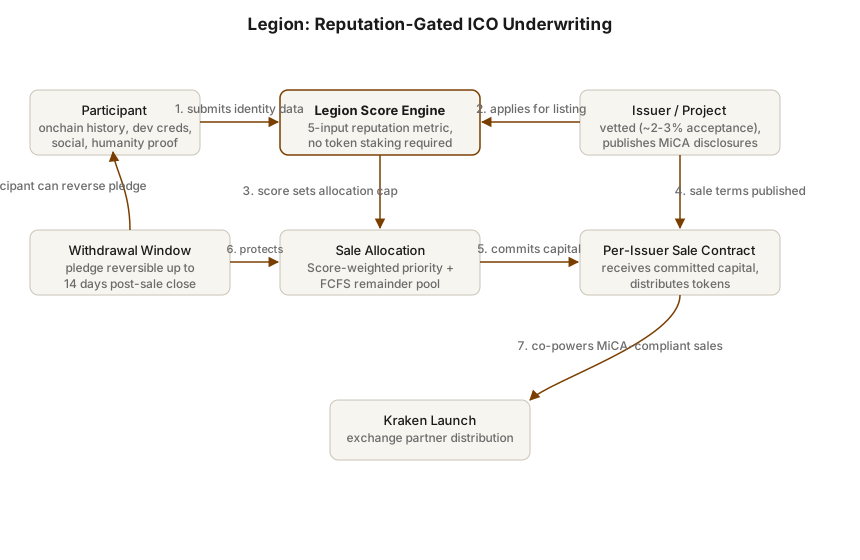 Open full-size diagram
Summary
Legion (legion.cc) is a crypto fundraising platform that rebrands itself as an "ICO underwriter" rather than a launchpad. Founded by Fabrizio Giabardo (ex-Delphi Digital) and Matt O'Connor (ex-Bridgewater Associates, former Stacks Foundation tokenomics researcher and Status ICO token-economics lead), Legion raised a $5 million seed round announced August 2025, led by VanEck and Brevan Howard Digital, with participation from Coinbase Ventures, Crypto.com Ventures, Kraken, Cyber Fund, Blockchain Builders, and GSR. The platform's core pitch is applying "IPO-type rigor" to token sales: heavy issuer vetting (Legion says it accepts only 2-3% of projects it reviews), MiCA-aligned disclosure requirements in the EU, and a reputation-based allocation system — the "Legion Score" — that replaces the gas-war, bot-dominated free-for-all typical of earlier ICO/IDO launchpads. By mid-2025 Legion said it had facilitated 30+ sales, over $450M in committed capital, and 350,000+ verified users, with notable sales including Fuel Network, Yield Basis, Enclave, Makina, Giza, Skate, Corn, Intuition, Resolv, and Pulse. In 2025 Kraken partnered with Legion to power MiCA-compliant token sales on "Kraken Launch."
Design (Mechanism)
Legion's central mechanism is the Legion Score, a reputation metric computed from five inputs: onchain activity history, developer credentials, social presence, "value-add" contributions to the ecosystem, and Proof of Humanity verification. Unlike many launchpads, Legion does not require staking a native token or completing social-media "quest" tasks to qualify for allocation — the Score itself is the gate. Higher-scored, verified participants receive priority access and larger allocation caps in a given sale; some sales split allocation between Score-weighted access and a first-come-first-served remainder pool.
On the issuer side, Legion positions itself as a curator/underwriter: it screens incoming projects and claims to accept only a small single-digit percentage of applicants, publishing disclosures (whitepapers, risk factors, material-change updates) modeled loosely on securities-offering norms. This is explicitly framed to satisfy the EU's Markets in Crypto-Assets (MiCA) regulation, which requires token issuers offering to EU residents to publish a compliant whitepaper and subjects listed tokens to market-abuse rules.
A consumer-protection feature is a withdrawal right: participants can pull back a pledge from the moment they commit until 14 calendar days after the sale window closes, unless tokens have already been distributed to their wallet or the token has listed before that window elapses — intended to reduce the "locked in with no recourse" problem that plagued earlier ICOs.
Outcome
Legion is an active, ongoing platform as of mid-2026, not a single one-off "experiment" with a terminal outcome — it is infrastructure that other token sales run through. Its traction signals (30+ completed sales, $450M+ committed capital, 350k+ verified users per Legion's own reporting, a $5M institutional-backed seed round, and a partnership with Kraken to power "Kraken Launch") indicate it has found meaningful adoption among both crypto-native issuers (Fuel, Resolv, Intuition) and larger exchanges. No security incident or exploit against Legion itself has been found in available sources as of this research.
Why it worked
- Timing with regulation, not against it. MiCA created a concrete compliance requirement (whitepaper + disclosures) that most legacy launchpads were unprepared for; Legion built directly to that spec, giving it a credible pitch to institutional issuers and to an exchange like Kraken looking for a compliant sale rails partner.
- Solving a real, well-known failure mode. Gas-war/bot-dominated ICOs and IDOs were a widely recognized problem across the 2017-2021 cycle; a reputation-gated allocation model directly targets that complaint without requiring costly token staking from retail users.
- Credible-neutral capital and distribution partners. Backing from VanEck, Brevan Howard Digital, and exchange venture arms (Coinbase, Crypto.com, Kraken) both funded the company and created natural distribution/listing partnerships for the projects it underwrites.
Limitations and criticisms
- Reliance on self-reported metrics. Headline numbers ($450M+ committed, 350k+ users, 30+ sales) come from Legion's own marketing; independent, sale-by-sale verification of committed vs. actually-settled capital, and of realized investor returns, was not found in available sources.
- Curation is still centralized judgment. "Top 2-3% of projects" is Legion's own subjective vetting process; unlike fully algorithmic or market-based mechanisms, this reintroduces a trusted-gatekeeper risk (conflicts of interest, favoritism, missed red flags) that decentralized allocation mechanisms are partly designed to avoid.
Lessons
- Reputation-based sale access (onchain history + social + humanity proofs) is a plausible alternative to staking-gated or pure-FCFS allocation for reducing bot dominance, but it shifts trust onto the scoring methodology itself, which is opaque to outside observers.
- Positioning a launchpad as an "underwriter" that curates deal flow and enforces disclosure is a strategy to court institutional capital and regulated exchange partners (Kraken), at the cost of the permissionless, anyone-can-list ethos of earlier ICO platforms.
- A withdrawal-rights window (14 days post-sale) is a low-cost consumer-protection primitive that other token-sale platforms could adopt to reduce "trapped capital" complaints.
- Founder domain expertise in tokenomics and prior ICO cycles (O'Connor's Status ICO and Stacks background) appears to correlate with credible institutional fundraising, though this is inference from a single case, not a proven causal pattern.
Redesign (EDITORIAL)
EDITORIAL — hypothesis, not fact. A fully trust-minimized version of Legion's model might replace the discretionary "top 2-3%" issuer-curation step with a bonded-listing mechanism: any project can post a slashable stake to list a sale, with the stake forfeited to burned/insurance-fund if the project is later proven fraudulent or materially misrepresented (verifiable via an onchain dispute/oracle process), rather than relying purely on Legion's internal review team. Similarly, the Legion Score's weighting formula could be published and made independently auditable (or computed by a decentralized oracle network) rather than remaining a black-box internal metric, which would let researchers and regulators verify that the score isn't systematically favoring well-connected wallets. Neither change has been implemented or proposed by Legion as of this research; both are speculative design directions consistent with the platform's stated compliance-first philosophy.
Sources
- Legion — Merit-Based, Crypto Fundraising Platform (official site) — primary (official)
- Crypto startup Legion raises $5 million to bring back ICOs—without the scams — Fortune — primary (news)
- VanEck and Brevan Howard Digital lead $5 million round into startup Legion looking to revamp ICOs — The Block (news)
- Kraken works with Legion to roll out MiCA-compliant token sales — Cryptopolitan (news)
- Legion Launchpad Review 2026: Is Reputation-Based Access Worth It? — CryptoSlate (analysis)
- How to participate in the Legion token sale — INCRYPTED (analysis)
Related experiments
Last verified: 2026-07-27 · Spot an error? Suggest a correction