Limitless Exchange
Base-native prediction market that pivoted from AMM-style daily price markets to a Polymarket-fork CTF/CLOB architecture, becoming the largest prediction market on Base with a points-to-token (LMTS) flywheel.
▶ Run interactive simulation animated mechanism with editable parameters
How it works onchain
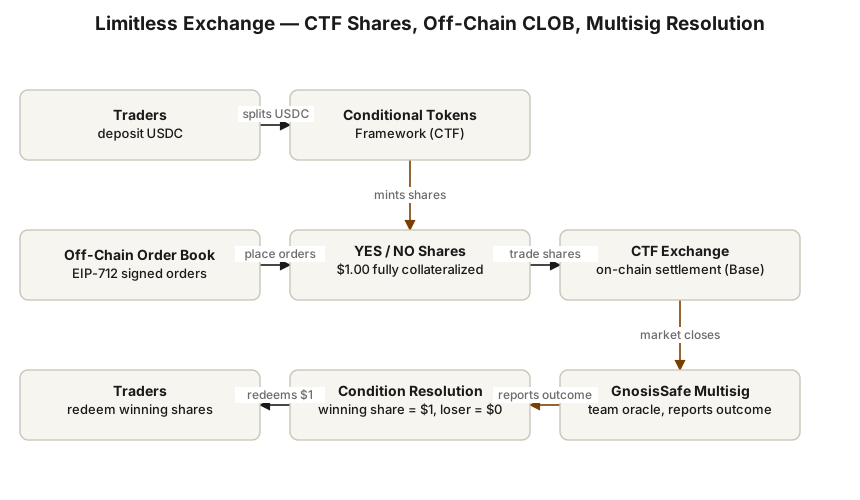 Open full-size diagram
Summary
Limitless Exchange is a prediction market on Base, the Coinbase-incubated Ethereum L2. Founded in late 2023 by CJ Hetherington (previously co-founder of the web3 metaverse project Atlantis World) with co-founders reported as Roman Mogylnyi, Dima Horshkov, and Rev Miller, it launched publicly in 2024 with a mobile-first focus on very short-duration markets — hourly and daily questions about crypto price action ("Will BTC be above $100k this week?") — rather than the long-dated political markets that defined Polymarket. It later generalized into a full Polymarket-style venue: fully collateralized YES/NO outcome shares traded on a central limit order book (CLOB), with sports, esports, finance, politics, and pop-culture categories.
The project raised a reported ~$3M pre-seed led by 1confirmation, a $4M strategic round in July 2025 that brought in Arthur Hayes (via Maelstrom) as investor and advisor, and a $10M seed round announced October 20, 2025 led by 1confirmation with Coinbase Ventures, DCG, Collider, and others. Its LMTS token generated on October 22, 2025 (1B supply, ~24.37% to ecosystem incentives/airdrops) after seasons of points farming. By 2025 it was the largest prediction market on Base with roughly $500M cumulative volume; by 2026 the team and press cited around $2B in monthly volume and "$3B+ traded," placing it behind Kalshi and Polymarket in the category. It remains live and growing; outcome is ongoing.
Design (Mechanism)
- Fully collateralized binary shares. Every YES + NO pair is backed by $1.00 of USDC held in Gnosis's Conditional Tokens Framework (CTF) — the same primitive Polymarket uses. Shares trade between $0.01 and $0.99; winning shares redeem for $1.00, losers go to zero. Minting/splitting, merging, and redemption all happen against a shared CTF contract on Base (0xC9c9...6e18).
- CLOB execution, forked from Polymarket. Limitless openly forked the Polymarket CTF Exchange contracts (the GitHub repo is literally titled "Polymarket CTF Exchange for Limitless"). Orders are signed off-chain with EIP-712 against the venue's exchange contract as
verifyingContractand settled on-chain — a hybrid off-chain-orderbook/on-chain-settlement model. Multiple exchange versions (V1–V3) plus parallel "NegRisk" exchanges support multi-outcome (categorical) markets with share conversion between outcomes. - Centralized multisig resolution. Unlike Polymarket's UMA optimistic-oracle path, Limitless uses a GnosisSafe multisig as the oracle: the team's safe calls
prepareConditionand reports outcomes directly on the CTF. This enables the "instant resolution" UX that hourly price markets require, at the cost of trust in the operator. - Short-duration market focus. The signature product is nonstop hourly/daily crypto price markets that resolve quickly — closer in spirit to binary options than to election forecasting — marketed as leverage-like upside "without liquidation risk."
- Incentive flywheel. Limitless Points seasons, order-book LP rewards for quoting inside the spread, and a 24.37% ecosystem allocation of LMTS (Season 1 airdrop unlocked fully at TGE) drove volume farming; LMTS staking ("earn yield on LMTS") was added post-TGE. In June 2026 it launched its first permissionless market type using a deliberately templated, finance-scoped approach to market creation rather than fully open curation.
Outcome
Ongoing and, so far, a category winner on its chain. Limitless grew from ~$9.7M volume in its early daily-markets phase to ~$500M cumulative by late 2025, then to reported ~$2B/month during the 2025–26 prediction-market boom, making it the largest prediction market on Base. It raised ~$17M+ across rounds, shipped its LMTS token in October 2025, and attracted Arthur Hayes as advisor. Founder CJ Hetherington became a prominent public voice in the sector — notably in October 2025 alleging (his claim, disputed by the exchange) that Binance asks projects to reserve ~9% of token supply for listing-related programs. Long-run durability is untested: volumes are heavily incentive-driven (points seasons ran through at least May 2026), and LMTS faces ongoing unlock overhang (e.g., ~85M tokens on April 22, 2026).
Why it worked
- Fork the winner, differentiate on tempo. Reusing Polymarket's audited CTF/CLOB stack meant Limitless spent zero innovation budget on settlement plumbing and all of it on product: hourly/daily crypto price markets with instant resolution — a niche Polymarket underserved and one that matches crypto traders' dopamine cycle.
- Right chain, right patron. Being Base-native gave it cheap fees, Coinbase-adjacent distribution, and a lane where it did not compete head-on with Polymarket (Polygon) or Kalshi (regulated US) — it became "the" prediction market of its ecosystem.
- Aggressive but legible incentives. Points seasons, LP rewards for tight quoting, and a large airdrop allocation bootstrapped both sides of the order book before the token existed.
- Timing. It scaled into the 2024–25 prediction-market supercycle (US election, Polymarket/Kalshi mainstreaming) with a differentiated product already live.
Limitations and criticisms
Resolution trust is centralized: a team multisig reporting outcomes is a step back from the optimistic-oracle decentralization Polymarket pioneered, making the operator a single point of failure for every market. Hourly price markets are economically close to binary options/gambling. Volume quality is uncertain — much of it was farmed against points seasons and LMTS emissions, and the token carries a heavy unlock schedule against a 25% team / 25% investor allocation. Finally, it remains a fast follower in a market where Polymarket and Kalshi command distribution and brand; its own CEO argues no platform will dominate the category, an assessment that also applies to Limitless itself.
Lessons
- In mechanism-heavy verticals, forking settled infrastructure (CTF + CLOB) and competing on market selection, chain, and UX is a viable and capital-efficient wedge.
- Resolution latency is a product axis: decentralized oracles (UMA) trade speed for trust; a multisig oracle trades trust for the instant settlement that short-duration markets require. Pick per market type, and be honest about the trust model.
- Short-duration, high-frequency markets generate volume far faster than long-dated event markets — but that volume is closer to options flow than to forecasting, with the retention profile that implies.
- Points-to-token flywheels can bootstrap an order book, but cumulative-volume milestones earned under emissions are weak evidence of organic demand; the test is retention after seasons end.
- Ecosystem-native positioning (the biggest X on chain Y) is a real moat when the L2's patron (Coinbase/Base) is motivated to showcase you.
Redesign (EDITORIAL — hypothesis, not fact)
This section is editorial hypothesis, not reporting. The most fragile element is the GnosisSafe oracle. A redesign could keep instant resolution for price markets by resolving them from on-chain/oracle price feeds (e.g., Chainlink or a TWAP attested at expiry) with the multisig only as a fallback, while routing subjective markets through an optimistic oracle with a bonded dispute window — tiering trust by market type instead of applying maximum trust everywhere. Second, incentive design could shift from volume-farmed points (which reward wash-like churn) toward maker-quality rewards: pay for time-at-best-quote, depth within the spread, and realized fill quality, decaying rewards for self-crossing flow. Third, given the binary-options character of hourly markets, a sustainable version likely needs proactive market-integrity tooling (position limits near resolution, oracle-price freeze windows). Finally, LMTS would be healthier with utility tied to resolution security — e.g., staked LMTS backing a dispute/insurance pool — rather than generic staking yield layered on an emissions token.
Sources
- Limitless Exchange documentation — primary (docs)
- Limitless CTF Exchange (Polymarket CTF Exchange fork) — GitHub — primary (contract)
- Limitless subgraphs (contract addresses, simple + negrisk markets) — primary (contract)
- Limitless seed round announcement ($10M led by 1confirmation) — primary (governance)
- Limitless early positioning on Base (April 2024) — primary (archive)
- Limitless Exchange — IQ.wiki (analysis)
- Limitless CEO: no prediction market platform will dominate — The Block (news)
- Limitless (LMTS) token launch Oct 22, 2025: airdrop and tokenomics — BingX Learn (news)
- How Limitless built a real-time prediction market feed on Base — Envio case study (analysis)
Related experiments
Last verified: 2026-07-27 · Spot an error? Suggest a correction