USDD
TRON's dollar stablecoin that launched in May 2022 as a Terra-style algorithmic coin backed by the TRON DAO Reserve, depegged repeatedly, and was relaunched in January 2025 as a MakerDAO-style overcollateralized CDP system with a Peg Stability Module.
▶ Run interactive simulation animated mechanism with editable parameters
How it works onchain
 Open full-size diagram
Summary
USDD ("Decentralized USD") is TRON's flagship dollar stablecoin and one of the clearest natural experiments in stablecoin mechanism migration: the same brand has lived under two entirely different designs. Version 1 launched on May 5, 2022 — days before Terra's UST collapsed — as an explicitly Terra-inspired algorithmic stablecoin, minted by burning TRX and backstopped by a whitelisted consortium called the TRON DAO Reserve (TDR). After depegging in June 2022 and again in late 2022, and after persistent questions about how its "over-collateralization" was counted, the project was rebuilt from scratch. USDD 2.0, launched on TRON on January 25, 2025, abandoned the algorithmic model entirely in favor of a MakerDAO-fork architecture: overcollateralized CDP vaults, community liquidation auctions, a Peg Stability Module (PSM) for 1:1 swaps against USDT/USDC, and a savings token (sUSDD). It later expanded natively to Ethereum in October 2025. The v2 system has held its peg with system collateralization reported between roughly 103% and 199% (averaging ~112%), though it remains a mid-sized stablecoin (collateral peaking around $620M in 2025) in a market dominated by USDT and USDC — including on TRON itself.
Design (Mechanism)
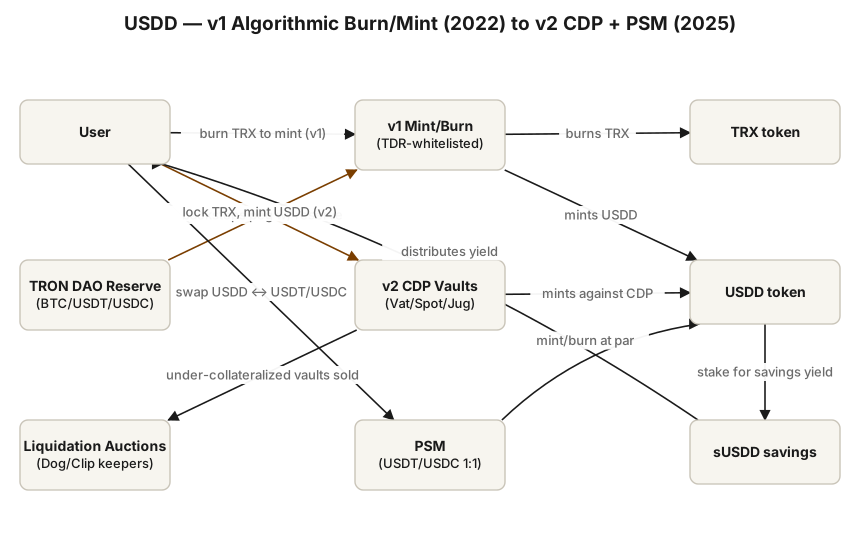
v1 (2022–2024), algorithmic + reserve: USDD was minted by burning TRX (and burned to release TRX), the same seigniorage arbitrage loop as Terra's UST/LUNA — CoinDesk noted at launch that the whitepaper closely mirrored Terra's. Crucially, mint/burn was not permissionless: only TDR members (institutions such as market makers and exchanges, coordinated by Justin Sun) could perform the arbitrage. USDD offered promotional yields around 30% APY at launch to bootstrap demand. After UST's collapse, TDR pivoted the narrative in June 2022, declaring USDD "the first over-collateralized decentralized stablecoin" with a reserve basket of TRX, BTC, USDT and USDC and a published collateral ratio target above 130% (at times claimed above 200–300%). Critics noted the ratio counted burned TRX and TDR-controlled assets, and that the reserve was governed by a small permissioned multisig rather than an autonomous protocol — economically closer to a discretionary currency board than a trustless mechanism.
v2 (2025–), overcollateralized CDP: USDD 2.0 is a Maker/DAI-style system, visible directly in its core contract names (Vat, Dog, Clip, Spot, Jug, OSM, PSM). Users open vaults, lock collateral (TRX and other approved assets), and mint USDD against it; positions falling below the liquidation ratio are auctioned by keepers. A PSM allows zero-slippage 1:1 swaps between USDD and USDT on TRON (plus USDT/USDC on Ethereum), anchoring the peg via arbitrage. sUSDD distributes a savings yield with a dynamic APY pricing mechanism, and a "Smart Allocator" deploys idle protocol capital for yield. Deployed token contracts: TXDk8mbtRbXeYuMNS83CfKPaYYT8XWv9Hz (TRON) and 0x4f8e5de400de08b164e7421b3ee387f461becd1a (Ethereum); the legacy v1 TRC-20 (TPYmHEhy5n8TCEfYGqW2rPxsghSfzghPDn) was migrated via SUN.io's PSM swap.
Outcome
v1 reached roughly $700M+ supply in 2022 but broke peg to ~$0.97 on June 14, 2022 amid the TRX selloff and broader deleveraging; TDR injected roughly $700M in USDC and pushed the stated collateral ratio above 300% to restore parity. USDD traded persistently below $1 (around $0.97–0.98) again after FTX's collapse in November–December 2022, hitting its lowest level since June. It never regained credibility as an algorithmic design. The January 2025 relaunch as an overcollateralized CDP system has, per Messari's one-year review, maintained the peg with collateralization consistently above 100% (103–199%, avg ~112%) and grown collateral to a ~$620M peak — a functioning but modest protocol relative to TRON's ~$60B+ of USDT. Net assessment: v1 failed as designed; v2 is a working pivot — hence partial_success overall.
Why it worked
- The backstop was real money. Unlike Terra, TDR held billions in outside assets (BTC, USDT, USDC) and used them aggressively; the June 2022 depeg was capped at ~3 cents and recovered within about a week.
- Small relative size. USDD's supply (~$700M) was tiny versus UST's ~$18B and versus TDR's reserves, so a discretionary bailout was affordable.
- The v2 pivot adopted a battle-tested design. Forking MakerDAO's CDP/PSM architecture rather than inventing novel mechanisms gave USDD 2.0 credible, legible solvency properties, and the PSM has kept the peg tight since relaunch.
- Distribution advantages. TRON's massive stablecoin-payments user base and affiliated venues (HTX, Poloniex, SUN.io, JustLend) provided listings, liquidity, and yield programs.
Where the design broke
- v1's algorithmic design was structurally unsound — the same reflexive TRX-burn loop as UST, launched literally days before UST demonstrated the failure mode. The peg survived on discretionary reserve intervention, not the mechanism.
- Opacity and insider control. Whitelisted-only mint/burn, a multisig reserve, and collateral accounting that counted burned TRX drew sustained criticism; "decentralized USD" was largely a brand claim in v1.
- Trust discount. A permissioned reserve and the 2022 depegs left a lasting credibility gap; even the technically sound v2 has struggled to grow beyond a niche against USDT on its own home chain.
- Yield-led demand is mercenary. 30% APY bootstrapping in v1 (and high sUSDD promotional yields in v2) attracts capital that leaves when subsidies fall.
Lessons
- Algorithmic seigniorage pegs backed by an endogenous, reflexive asset (TRX, LUNA) fail under correlated stress; USDD survived 2022 only because a discretionary treasury absorbed the loss — the mechanism itself did not hold.
- A "collateral ratio" is only as good as its accounting: counting burned or insider-controlled assets as backing invites exactly the scrutiny it is meant to deflect. Verifiable, permissionless redeemability (PSM/CDP) is worth more than a big headline number.
- Brands can survive mechanism failure if the operator eats the loss and migrates to a proven design — but the trust discount persists; USDD 2.0's peg has held for over a year yet adoption remains a fraction of centralized rivals.
- Forking a battle-tested architecture (MakerDAO) is a legitimate and often superior strategy to novel mechanism design when the goal is credibility rather than innovation.
Redesign (EDITORIAL — hypothesis, not fact)
This section is editorial hypothesis, not established fact. If redesigning USDD from the start in 2022, the strongest move would have been to skip the algorithmic phase entirely: launch as an overcollateralized CDP with a PSM (i.e., ship v2 first), accepting slower growth for durable solvency. Given TRON's real comparative advantage — the world's largest USDT settlement network — a more differentiated design might be a "payments-native" stablecoin: PSM-first issuance against USDT with hard on-chain proof-of-reserve, revenue from allocator yield shared with transactional users (fee rebates) rather than with mercenary depositors, and a legally separate, transparent reserve entity to break the single-figurehead trust discount. Governance minimization (Reflexer-style) would also counter the perception of insider control that dogged v1. The open question is whether any TRON-native stablecoin can escape USDT's gravity on its own chain; a redesign that complements USDT rails (as a yield/collateral layer) rather than competing with them head-on seems the more viable path.
Sources
- USDD official documentation (v2 mechanism, deployment addresses) — primary (docs)
- USDD legacy documentation and whitepaper (v1) — primary (docs)
- TRON DAO and Other Blockchain Leaders Jointly Roll out USDD (launch press release) — primary (news)
- USDD Upgrades into the First Over-Collateralized Decentralized Stablecoin (TRON DAO blog, June 2022) — primary (governance)
- 'Revolution' Promised by Tron's Justin Sun Looks Like Clone of Terra's Algorithmic Stablecoin (CoinDesk, May 2022) (analysis)
- Tron's USDD stablecoin falls to $0.97 as it loses dollar peg (CryptoSlate, June 2022) (news)
- TRON's claims of USDD over-collateralization may have hidden worms (CryptoSlate) (analysis)
- Tron's USDD Stablecoin Falls to Under 97 Cents, Lowest Level Since June (CoinDesk, Dec 2022) (news)
- USDD 2.0 — New Horizons (official Medium) — primary (retrospective)
- USDD 2.0: From Tron to Ethereum and Beyond (official Medium, Oct 2025) — primary (retrospective)
- USDD One Year After 2.0: Yield, Peg Stability, and Multichain Execution (Messari) (analysis)
Related experiments
Last verified: 2026-07-26 · Spot an error? Suggest a correction