Morpho
A lending network that evolved from a peer-to-peer rate optimizer atop Aave/Compound into Morpho Blue, an immutable singleton of permissionless isolated markets with risk management externalized to curated ERC-4626 vaults.
▶ Run interactive simulation animated mechanism with editable parameters
How it works onchain
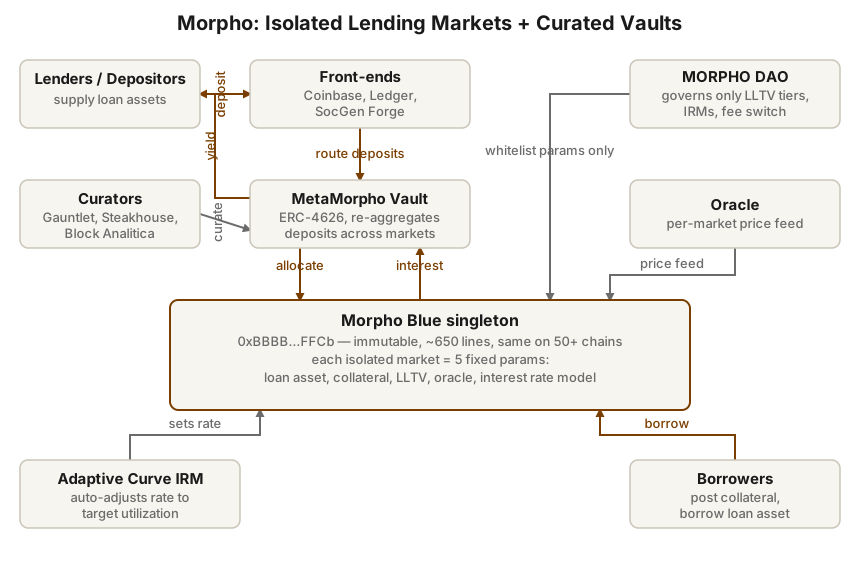 Open full-size diagram
Summary
Morpho is one of DeFi's clearest examples of a protocol that succeeded by progressively removing itself from the risk business. Founded in Paris in 2021 by students Paul Frambot, Mathis Gontier Delaunay, Merlin Egalité, and Julien Thomas, it launched in June 2022 as the "Morpho Optimizer" — a peer-to-peer matching layer sitting on top of Aave and Compound that narrowed the spread between lenders and borrowers while inheriting the underlying pools' liquidity and liquidation machinery. In October 2023 the team published Morpho Blue: a tiny, immutable, governance-minimized singleton contract in which anyone can permissionlessly create an isolated lending market from five fixed parameters. Risk management was pushed up a layer into MetaMorpho (Morpho Vaults), curated ERC-4626 vaults that allocate deposits across Blue markets. The unbundled design became the backend for Coinbase's crypto-backed loans and dozens of other distribution partners, growing deposits from roughly $5B to $13B+ during 2025 and attracting a $175M round led by a16z crypto, Paradigm, and Ribbit in June 2026.
Design (Mechanism)
Phase 1 — Optimizer (2022): Morpho V0 wrapped Aave and Compound. When a lender and borrower could be matched peer-to-peer, both received a rate strictly between the pool's supply and borrow APYs; unmatched liquidity fell back to the underlying pool. Users were never worse off than using the pool directly — a Pareto-improvement wedge that bootstrapped ~$1B+ in deposits without new trust assumptions beyond Morpho's own contracts.
Phase 2 — Morpho Blue (2023–24): A deliberately minimal lending primitive (~650 lines, no upgradability) deployed as a singleton at 0xBBBB…FFCb, later replicated at the same address across 50+ EVM chains. Each market is defined by exactly five immutable parameters: loan asset, collateral asset, liquidation LTV (LLTV), oracle address, and interest rate model. Market creation is permissionless; governance (the MORPHO token DAO) can only whitelist new LLTV tiers and IRMs and toggle a capped fee switch — it cannot alter or pause existing markets. The default Adaptive Curve IRM adjusts rates autonomously toward a target utilization, removing rate governance entirely. Isolation ring-fences bad debt: an oracle failure in one market cannot contaminate others.
Phase 3 — Vaults and curators: Because raw isolated markets fragment liquidity and demand sophistication, MetaMorpho vaults (ERC-4626) re-aggregate deposits. Third-party curators (Gauntlet, Steakhouse, Block Analitica, etc.) set market allowlists, supply caps, and rebalancing policy, competing on risk-adjusted yield. The protocol thus separates three roles that Aave-style pools bundle: the immutable settlement primitive, risk curation, and distribution (front-ends like Coinbase, Crypto.com, Ledger, Societe Generale Forge embedding Morpho-powered loans and earn products). Morpho V2 (2025–26) extends this with intent-based, fixed-rate/fixed-term loans aimed at institutional credit.
Outcome
Major success and ongoing. The Optimizer proved product-market fit; Blue became the growth engine. Public recaps report deposits growing from ~$5B to ~$13B during 2025, active loans around $4.5B, users from 67K to 1.4M+, and Coinbase's Morpho-powered loan product holding $1.6B+ in collateral by April 2026 — arguably the largest CeFi-DeFi lending integration to date. Morpho became the largest DeFi protocol on Base and consolidated its corporate structure under the nonprofit Morpho Association, with the MORPHO token governing the (deliberately narrow) DAO surface. The most notable incident was not a protocol failure: on April 10, 2025, a front-end/Bundler3 configuration error exposed ~$2.6M of one user's approvals; white-hat MEV operator c0ffeebabe.eth intercepted the transaction and returned funds, and Morpho reverted the update the same day. Curator-layer stress in late 2025 (vaults exposed to risky collateral across the industry) showed where the model concentrates residual risk, but the core contracts have not been exploited.
Why it worked
- Pareto-improvement onboarding: the Optimizer gave users strictly better rates with fallback to Aave/Compound, so early adoption required no leap of faith.
- Credible neutrality via immutability: Blue's unupgradeable, governance-minimized singleton let institutions (Coinbase, SocGen Forge) integrate without exposure to DAO parameter risk — the rules at deposit time are the rules at withdrawal time.
- Unbundling risk from settlement: externalizing risk to competing curators turned risk management into a market instead of a governance bottleneck, while ERC-4626 vaults preserved a simple passive-lender UX.
- B2B distribution strategy: powering other brands' loan products scaled deposits far beyond what a first-party app could reach.
Limitations and criticisms
The architecture relocates rather than eliminates risk: depositors underwrite curator judgment and oracle choices, and 2025's industry-wide curated-vault losses (at Morpho and rivals) showed the model has no protocol-level accountability mechanism constraining curator allocation into toxic collateral. Liquidity fragmentation across thousands of isolated markets depends entirely on the vault layer to re-aggregate, so passive depositors' actual protection rests on curator diligence they can't easily audit. The April 2025 incident demonstrated that periphery contracts and front-ends remain the soft underbelly of an "immutable" core — immutability at the settlement layer doesn't extend to the surrounding tooling users actually touch. MORPHO token value accrual also remains thin by design, since governance intentionally controls little, which raises a fair question about what the token is ultimately for.
Lessons
- Strictly-dominant upgrades ("same risk, better rate") are among the most effective cold-start mechanisms in DeFi.
- Making the base layer immutable and pushing all discretionary risk decisions to a competitive curator market converts governance risk into legible, priced counterparty choice — the AMM-ification of lending.
- Minimal, frozen primitives are what regulated distributors will actually integrate; credible neutrality is a BD strategy, not just an ideology.
- Externalized risk management needs externalized accountability: curator incentives, disclosure, and slashing-like mechanisms lag the primitive itself.
- Even with a perfect core, approvals, bundlers, and front-ends define real user risk.
Redesign (EDITORIAL — hypothesis, not fact)
EDITORIAL. The obvious upgrade target is the curator layer: require curators to post first-loss capital (a junior tranche) proportional to vault TVL and risk parameters, so vault depositors hold a senior claim and curator incentives shift from yield-chasing to underwriting. Standardized, onchain-attested curator disclosures (oracle choices, LLTV distribution, concentration limits) would let aggregators price curator risk the way rating agencies price credit. Second, the periphery deserves the same rigor as the core — immutable, formally verified bundler/adapter sets with allowance-scoped approvals would have prevented the April 2025 incident class. Finally, a native cross-market liquidity backstop (protocol-owned senior pool that bids in liquidations across all markets) could dampen isolated-market illiquidity spirals without reintroducing pooled contagion.
Sources
- Morpho Docs — Contract Addresses — primary (docs)
- Morpho Blue Whitepaper (Gontier Delaunay, Frambot et al.) — primary (docs)
- Morpho Blue and how it enables our vision for DeFi lending — primary (retrospective)
- Morpho App Incident: April 10, 2025 — primary (retrospective)
- The Morpho Effect: 2025 (annual recap) — primary (retrospective)
- Morpho 2026 (strategy post) — primary (retrospective)
- a16z crypto — The open credit network: Investing in Morpho part III (analysis)
- Fortune — Morpho raises $175 million led by a16z crypto, Paradigm, Ribbit (news)
- Cointelegraph — White hat intercepts $2.6M Morpho App frontend exploit (news)
- Wikipedia — Morpho Labs (history, founding, milestones) (archive)
Related experiments
Last verified: 2026-07-27 · Spot an error? Suggest a correction