MyShell
A consumer AI-agent creation platform that funded open-source voice/agent models with crypto capital and launched the SHELL token on BNB Chain and Ethereum via a Binance HODLer Airdrop in February 2025.
▶ Run interactive simulation animated mechanism with editable parameters
How it works onchain
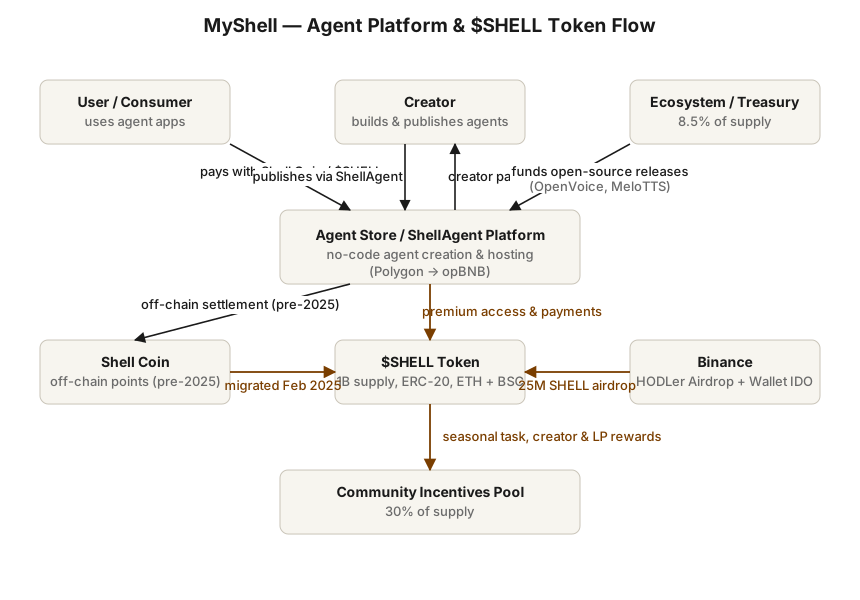 Open full-size diagram
Summary
MyShell is a consumer-facing platform for building, sharing, and monetizing AI agents ("Shells") without code, positioned as a "decentralized AI consumer layer." Founded in 2023 in Hong Kong by Ethan Sun (Oxford mathematics and CS; previously Auto3D and AI unicorn Aibee), Rick Lin, and Charles Qin, it launched its product in May 2023, initially on Polygon before migrating to opBNB (BNB Chain's OP Stack L2). It raised a $5.6M seed at a $57M valuation led by INCE Capital (October 2023) and an $11M Pre-Series A led by Dragonfly (March 2024, total raised $16.6M), with angels including Balaji Srinivasan and Illia Polosukhin. MyShell differentiated itself by releasing genuinely popular open-source AI models — OpenVoice (instant voice cloning, 15,000+ GitHub stars at the time of the Dragonfly round), MeloTTS (multilingual text-to-speech), and the ShellAgent framework — funded by crypto capital. The SHELL token (1B supply, deployed at the same address on Ethereum and BSC) launched in February 2025 as Binance's 10th HODLer Airdrops project, listing on February 27, 2025. As of July 2026 the platform continues operating (with a consumer pivot toward MyShell Art image generation), but SHELL trades roughly 97% below its February 2025 all-time high of ~$0.73.
Design (Mechanism)
- Agent creation and app store. Creators build AI agents via no-code templates or the open-source ShellAgent framework (workflow-based agent composition), then publish them to an agent store where consumers use them. Early flagship use cases ranged from language tutors and productivity bots to AI companions.
- Dual currency: Shell Coin then $SHELL. Before the token, MyShell ran on "Shell Coin," an off-chain settlement/points currency used to pay for agent usage and reward early adopters — an explicit points-before-token design. $SHELL (capped 1B supply) later became the on-chain asset for premium access, creator support/payments, and ecosystem incentives.
- Token allocation. Per official docs: Community Incentives 30%, Private Sale 29%, Team 12%, Ecosystem/Treasury 8.5%, Binance HODLer 5%, Liquidity 5%, IDO 4%, Advisors 3%, Marketing 2.5%, Binance Wallet Airdrop 1%. Community tokens reward seasonal tasks, agent creation, and liquidity provision.
- Exchange-orchestrated launch. Distribution leaned heavily on Binance rails: a Binance Wallet IDO and airdrop, then a HODLer Airdrop (25M SHELL credited to BNB Simple Earn subscribers) with same-day spot listing across six pairs.
- Open source as moat and funding flywheel. Crypto funding subsidized public-goods model releases (OpenVoice, MeloTTS); the models drove developer mindshare and platform traffic, which the token was meant to capture.
Outcome
Product traction was real by web3-consumer standards: 400,000 users and 30,000+ creators by October 2023 (The Block); company materials later claimed millions of users and tens of thousands of agents. OpenVoice and MeloTTS became widely used open-source projects independent of the crypto angle. The token event was initially successful — SHELL hit an all-time high of ~$0.7256 on February 13, 2025 and pumped ~40-45% on the Binance listing announcement — but then followed the trajectory of most 2025 AI-agent tokens: a grinding decline to an all-time low of ~$0.0192 on July 18, 2026 (roughly -97% from ATH), with modest daily volume ($5M). The company remains active, emphasizing consumer AI imaging (MyShell Art) and the ShellAgent framework; the token's role in day-to-day product usage appears secondary. outcome_status: ongoing — the business persists; the token has so far been commercially unsuccessful.
Why it worked
- Real product before token. Two years of consumer product iteration and an off-chain points economy preceded the TGE, so the token launched onto an existing user base rather than a promise.
- Open-source releases bought legitimacy. OpenVoice and MeloTTS gave MyShell credibility with AI developers that most "AI x crypto" projects lacked, and functioned as zero-CAC marketing.
- Tier-1 distribution. Binance Wallet IDO + HODLer Airdrop + immediate listing delivered instant liquidity and reach few consumer apps achieve.
- Strong capitalization. $16.6M from Dragonfly, INCE, Delphi, OKX Ventures and prominent angels funded GPU-heavy consumer AI development through the bear market.
Limitations and criticisms
- Weak token-product coupling. The product runs fine on off-chain Shell Coin and standard payments; $SHELL utility (premium access, creator payments, incentives) was largely substitutable, so token demand has tracked speculation more than usage.
- Heavy supply overhang. 29% private sale plus 12% team against a launch float concentrated in airdrop recipients created persistent sell pressure as vesting unlocked into a fading AI-agent narrative.
- Narrative beta. SHELL launched at the top of the early-2025 AI-agent token mania; when the sector deflated, even fundamentally stronger projects fell ~90%+.
- Airdrop-farmer churn. Exchange airdrop distribution rewards holders of BNB, not users of MyShell; recipients had little reason to become customers.
Lessons
- An off-chain points currency (Shell Coin) is an effective staging mechanism, but if the product works without the token, the eventual token inherits no organic demand — utility must be designed in before TGE, not retrofitted.
- Open-source model releases are one of the few proven growth loops in AI x crypto, but the value they create (developer adoption) does not automatically accrue to a token.
- Exchange-orchestrated launches (Launchpool/HODLer-style) maximize day-one distribution and price, and near-guarantee that the listing is the all-time-high region; teams should plan treasury and vesting policy for that path-dependence.
- Consumer traction measured in signups is not tokenizable; only flows that must settle in the token (fees, staking for placement, revenue share) are.
Redesign (EDITORIAL — hypothesis, not fact)
This section is editorial hypothesis, not a factual claim about MyShell's plans. A redesigned MyShell token would make $SHELL the mandatory settlement asset for agent inference credits, with creator revenue paid in $SHELL and a burn-or-buyback on platform take-rate, so token demand scales mechanically with usage. Agent creators could stake $SHELL for store ranking and slash-able quality bonds, converting the marketplace's curation problem into token sink. The 29% private-sale allocation would shrink in favor of usage-mined emissions vesting against verified inference volume (not tasks), and the launch would avoid holder-airdrops to non-users in favor of retroactive distribution weighted by historical Shell Coin spend. Finally, open-source releases (OpenVoice-class models) could carry an on-chain attribution registry that routes a small share of platform fees to model contributors — turning the public-goods flywheel into a durable reason for AI developers to hold the token.
Sources
- MyShell Docs — $SHELL Basics (supply, allocation, contract) — primary (docs)
- MyShell official website (product, X handle) — primary (docs)
- opBNB-based AI platform MyShell raises funds at $57 million valuation (The Block, Oct 2023) (news)
- MyShell Raises $11 Million for its Decentralized AI Consumer Layer (Chainwire, Mar 2024) (news)
- MyShell, Blockchain Platform For Building 'AI Girlfriends' and Productivity Apps, Raises $11M (CoinDesk) (news)
- MyShell (SHELL) New Listing on Binance, Feb 27 2025 (CoinCarp event record) (news)
- SHELL token tracker on BscScan — primary (contract)
- MyShell price page (ATH/ATL data) — CoinMarketCap (analysis)
- Ethan Sun — IQ.wiki profile (analysis)
Related experiments
Last verified: 2026-07-26 · Spot an error? Suggest a correction