PancakeSwap
A Uniswap-derived automated market maker on BNB Chain that became the largest DEX by volume outside Ethereum by routing a fixed slice of every swap fee into CAKE token buyback-and-burn alongside LP rewards and a protocol treasury.
▶ Run interactive simulation animated mechanism with editable parameters
How it works onchain
 Open full-size diagram
Summary
PancakeSwap is an automated market maker (AMM) decentralized exchange launched in September 2020 by a pseudonymous team (publicly known only by "Chef" nicknames) as a fork of Uniswap V2, deployed on Binance Smart Chain (now BNB Chain) to exploit its low gas fees at a time when Ethereum gas costs were pricing out small-value DeFi users. It combined a standard constant-product AMM with an aggressive yield-farming layer (the "MasterChef" emissions contract distributing its native token CAKE) and, from the outset, a fee split that routes part of every trade into buying back and burning CAKE. It has since expanded to nine-plus chains, shipped its own Uniswap V3-style concentrated-liquidity engine, and become the largest non-Ethereum-native DEX by cumulative volume, while iterating its tokenomics multiple times (most recently "Tokenomics 3.0" in April 2025) to keep CAKE supply net deflationary.
Design (Mechanism)
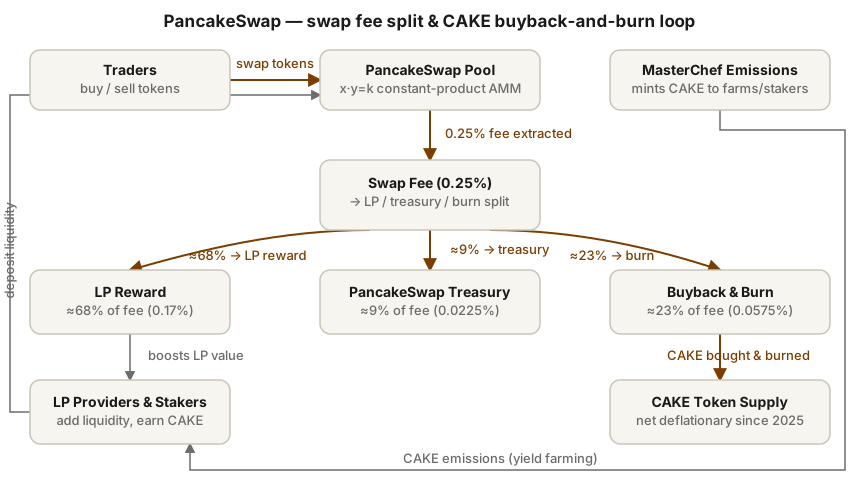
Core swap engine. PancakeSwap V2 pools use the same x*y=k constant-product formula as Uniswap V2, charging a flat 0.25% fee on every swap. Per official documentation that fee is split three ways: 0.17% (68% of the fee) is returned to the pool as an LP reward, 0.0225% (9%) is sent to the PancakeSwap Treasury, and 0.0575% (23%) funds CAKE buyback-and-burn. PancakeSwap V3, a concentrated-liquidity engine modeled on Uniswap V3, offers four fee tiers (0.01%, 0.05%, 0.25%, 1%) and splits each tier's revenue differently: the two low tiers (0.01%/0.05%, aimed at stable/correlated pairs) send roughly 66-67% to LPs, 15% to CAKE burn, and 18-19% to treasury, while the two higher tiers (0.25%/1%) mirror V2's roughly 68% LP / 23% burn / 9% treasury split. In both versions, burn and treasury cuts are taken at the protocol level rather than left entirely with LPs, meaning every swap is simultaneously a liquidity-reward event, a token-supply-reduction event, and a treasury-funding event.
Emissions and buyback loop. CAKE is minted continuously to reward liquidity providers and stakers via a MasterChef-style farming contract, then partially offset by (a) the swap-fee burn described above and (b) periodic manual/automated burns funded from treasury revenue (IFO token-sale proceeds, lottery revenue, NFT marketplace fees, and lending-market interest have all been routed toward burns at various points). The protocol publishes a running "CAKE Tokenomics" target — the stated goal since Tokenomics 3.0 (April 2025) is a net annual deflation rate, achieved by cutting daily CAKE emissions roughly in half (from ~40,000/day toward ~22,250/day) while retiring the prior vote-escrow (veCAKE) governance-weighting model. In January 2026, governance further lowered CAKE's hard supply cap from 450M to 400M tokens.
Ancillary products feeding the same fee/burn loop include Syrup Pools (single-asset staking), an NFT marketplace, a lottery, Initial Farm/Fair Offerings (IFOs) for new token launches, Perpetuals (a leveraged trading product), and a Prediction market — each contributes a slice of its own revenue toward CAKE burns rather than operating as an isolated fee silo.
Outcome
PancakeSwap became the dominant DEX on BNB Chain (reported 83% BNB Chain DEX market share in 2025) and one of the highest-volume DEXs industry-wide, later expanding to Ethereum, Arbitrum, Base, Aptos, zkSync, Polygon zkEVM, Linea, and opBNB. As of May 2025 self-reported figures cited $1.82B TVL, $30.92B total historical volume, ~$1.03B average daily volume, and roughly 37.8M CAKE ($72.5M) burned. The protocol has sustained multiple tokenomics overhauls (notably Tokenomics 3.0 in 2025) explicitly to correct earlier over-emission and keep the CAKE supply net-shrinking, reporting 28 consecutive months of supply reduction as of its 2025 recap.
Why it worked
Launching on BNB Chain during 2020's "DeFi Summer" gas-fee crunch let PancakeSwap absorb Ethereum-priced-out retail traders and yield farmers essentially overnight, while forking Uniswap's audited AMM math minimized core-contract risk. Routing a fixed, protocol-enforced share of every trade into CAKE burn — rather than leaving buybacks discretionary — gave the token a continuous, mechanically verifiable deflationary counterweight to its farming emissions, which helped offset the typical farm-token death spiral that hit many 2020-era "food-coin" forks. Diversifying revenue across swap fees, IFOs, NFTs, lottery, and perpetuals gave the treasury multiple independent inputs to fund burns even when swap volume alone softened.
Limitations and criticisms
The pseudonymous, "Chef"-branded team structure means founder identity, governance authority, and long-run accountability for treasury and emission-parameter decisions cannot be independently verified from public sources. The CAKE emissions schedule required repeated ad hoc governance corrections (Tokenomics 1.0 → 3.0, plus the 2026 supply-cap cut) to stay net deflationary, indicating the original emission curve was not self-sustaining without discretionary intervention. The V3 fee-tier split table shows burn/treasury share is materially larger on low-fee, stable-pair tiers (up to 33% combined) than on higher tiers (32%), a design choice whose rationale is not detailed in public documentation. As with any AMM, LPs remain exposed to impermanent loss, and V3 concentrated positions require active range management that is not accessible to less sophisticated users.
Lessons
- A fixed, contract-enforced fee split (LP / treasury / burn) is more credible and auditable than a discretionary buyback promise, because every trade mechanically executes the split rather than relying on a team decision.
- Emissions-heavy liquidity-mining designs tend to require multiple governance-driven tokenomics rewrites over a multi-year horizon; treating the first emission schedule as final is a common early mistake that PancakeSwap iteratively corrected.
- Diversifying protocol revenue sources (swap fees, token-sale fees, marketplace fees, lottery, perps) reduces a treasury's dependence on swap volume alone to fund ongoing token-supply management.
Redesign (EDITORIAL — hypothesis, not fact)
A cleaner design might decouple "supply management" from "governance discretion" entirely: instead of periodically re-legislating emission rates and burn percentages (Tokenomics 1.0/2.0/3.0, supply-cap cuts), encode a monotonic, pre-committed emissions-decay curve at token-generation time (as e.g. Bitcoin's halving schedule does) so market participants can price future dilution without waiting on governance votes. Separately, the tier-dependent burn/treasury split (higher combined take on stable-pair tiers, lower on volatile-pair tiers) could be published with an explicit rationale — e.g., because stable-pair volume is higher and more price-inelastic, a larger fixed-percentage take there raises more absolute revenue without meaningfully deterring trading — so the split reads as a deliberate revenue-optimization choice rather than an opaque legacy parameter.
Sources
- PancakeSwap Documentation — Token Swaps / Exchange Fees — primary (docs)
- PancakeSwap Documentation — Swap FAQ (V3 fee-tier distribution table) — primary (docs)
- PancakeSwap Documentation — CAKE Tokenomics — primary (docs)
- CAKE Token contract on BscScan — primary (contract)
- PancakeSwap Developer Docs — V3 FAQ — primary (docs)
- PancakeSwap Blog — March 2024: PancakeSwap's CAKE Burn — primary (blog)
- DefiLlama — PancakeSwap TVL, Fees, Revenue & Volume (analysis)
- AMBCrypto — PancakeSwap tightens CAKE supply ceiling following tokenomics overhaul (analysis)
Related experiments
Last verified: 2026-07-28 · Spot an error? Suggest a correction