Raydium
A Solana-native AMM that routed its pooled liquidity into Serum's central-limit order book and now splits every trading fee three ways — LPs, an on-chain RAY buyback, and a protocol treasury.
▶ Run interactive simulation animated mechanism with editable parameters
How it works onchain
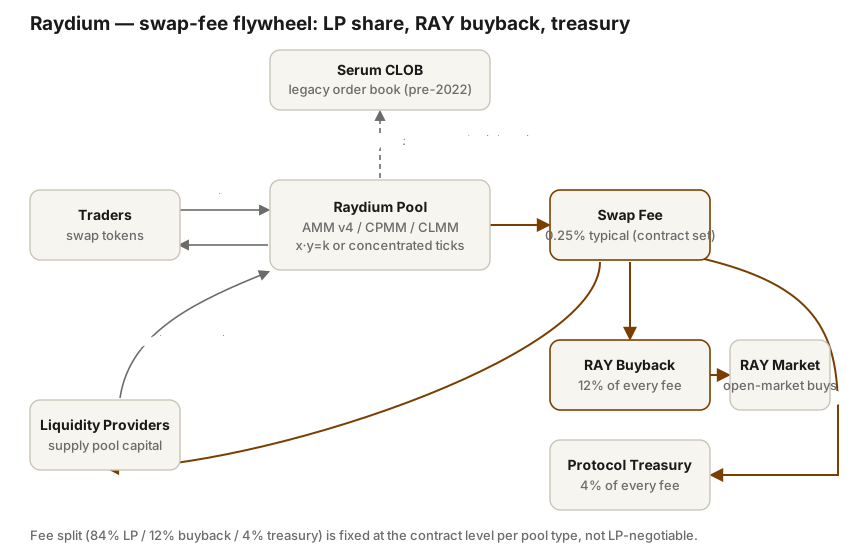 Open full-size diagram
Summary
Raydium is an automated market maker (AMM) and liquidity provider built on Solana, launched in February 2021 by a pseudonymous team known only as AlphaRay, XRay, and GammaRay. Its original differentiator was a "hybrid" design: instead of isolating pooled liquidity inside its own contracts the way Uniswap does, Raydium routed idle liquidity from its constant-product pools onto Serum's on-chain central-limit order book (CLOB), so that a single deposit of capital could be accessed by both AMM swappers and order-book traders simultaneously. Since Serum's effective wind-down after the FTX collapse, Raydium has evolved into a multi-pool-type exchange — legacy AMM v4 pools, a newer capital-efficient CPMM (constant-product, order-book-free) design, and a concentrated-liquidity market maker (CLMM) with per-pool fee tiers — plus LaunchLab, a bonding-curve token-launch product. It is consistently ranked among the highest-volume DEXs on Solana and one of the highest fee-generating DeFi protocols across all chains.
Design (Mechanism)
Pool types. Raydium runs three parallel liquidity primitives on Solana:
- AMM v4 — the original x*y=k constant-product pools, historically integrated with Serum's order book so LP capital also seeded on-chain limit orders.
- CPMM (CP-Swap) — a simplified constant-product pool without order-book integration, with configurable fee tiers, used heavily for newly launched tokens.
- CLMM — concentrated-liquidity pools (Uniswap V3-style discretized tick ranges) offering multiple fee tiers (roughly 0.01%, 0.02%, 0.04%, 0.05%, 0.25%, 1%, and 2%, selected per pool by volatility/use case).
Fee split. Every swap pays a trade fee set by the pool (0.25% is the common default for AMM v4/CPMM pools; CLMM pools choose among the tiers above). Per Raydium's own protocol-fee documentation, that trade fee is then divided three ways: 84% to liquidity providers, 12% routed to RAY buybacks, and 4% to a protocol treasury (in CPMM/CLMM contract terms, a "protocol fee rate" of 12% and a "fund fee rate" of 4%, both expressed as fractions of the trade fee — not of the swap notional). This split is fixed at the contract level per pool type rather than being adjustable by LPs.
RAY buybacks. The 12% buyback slice is accumulated in protocol-controlled fee accounts and periodically used to purchase RAY on the open market, mechanically converting a portion of trading volume into continuous demand for the token. Per third-party reporting (Blockworks, citing on-chain data), by late August 2025 Raydium had cumulatively spent roughly $196M buying back about 71M RAY — on the order of a quarter of circulating supply — since the mechanism went live. Bought-back RAY is not documented publicly by Atlas as being burned versus retained/redistributed; treat the exact disposition as unconfirmed pending direct on-chain verification.
LaunchLab. A newer bonding-curve launch product lets new tokens bootstrap liquidity through an automated price curve before "graduating" into a standard CPMM pool, echoing the pump.fun launch-then-migrate pattern, and is covered by its own fee schedule layered on top of the CPMM fee reference.
Outcome
Raydium remains a live, actively used protocol more than five years after launch, and by trading volume and fee generation is routinely one of the largest DEXs on Solana and among the highest fee-generating DeFi applications on any chain during periods of high Solana memecoin/token-launch activity. The RAY buyback program has run continuously since its introduction and — per third-party analytics cited above — has repurchased a meaningful fraction of RAY's circulating supply, giving the protocol a visible, auditable link between trading activity and token demand. The pivot away from Serum order-book dependency (after Serum's post-FTX decline) and toward CPMM/CLMM/LaunchLab shows the protocol adapting its core mechanism multiple times rather than freezing at v1.
Why it worked
Three design choices compounded: (1) being first to deploy a full AMM on Solana gave Raydium default integration and liquidity-sourcing status as the ecosystem's baseline swap venue; (2) tying a fixed, non-discretionary percentage of every trade's fee directly to RAY purchases created a mechanical, volume-linked buy pressure that didn't depend on treasury discretion or governance votes to execute; (3) diversifying pool types (AMM v4 → CPMM → CLMM → LaunchLab) let the protocol keep capturing fee volume across very different trading regimes — deep stable/majors liquidity, long-tail volatile pairs, and high-velocity new-token launches — rather than being tied to one AMM curve shape.
Limitations and criticisms
The fee split is fixed by contract per pool type, not market-set: LPs cannot bid for a larger share of the fee even where their capital is scarcer or riskier, so the 84/12/4 split is a governance-style constant rather than an LP-competitive price. The buyback mechanism converts trading fees into RAY purchases regardless of RAY's price level, meaning the program buys mechanically at both cheap and expensive prices rather than opportunistically. Routing part of every trade fee to a treasury and a token-buyback line also means LPs earn structurally less than 100% of the quoted trade fee (84% of 0.25% ≈ 0.21%, not 0.25%), which is a smaller LP-facing yield than fee-tier headline numbers might suggest to a casual pool depositor. Founders remain pseudonymous, which the Atlas records as a transparency characteristic of the design rather than a judgment of the team.
Lessons
- A protocol-level, contract-enforced fee split (LP / buyback / treasury) removes governance discretion from token-support mechanics — the buyback happens by code on every trade, not by a periodic vote.
- Diversifying pool architectures (AMM v4, CPMM, CLMM) inside one protocol lets a single fee-flywheel capture volume across very different trading profiles (majors, long-tail, and rapid token launches) instead of betting on one curve shape.
- Dependence on an external component (the Serum order book) for a core value proposition is a single point of failure at the ecosystem level — when Serum's usage declined, Raydium had to functionally replace that layer with its own CPMM design.
Redesign (EDITORIAL)
Hypothesis, not fact: a variable buyback rate — e.g., scaling the 12% buyback share up when RAY trades below a rolling on-chain fee-derived valuation floor and down when it trades above it — could make the buyback demand more price-sensitive rather than mechanically constant, potentially improving capital efficiency of the treasury-controlled portion of fees without removing the model's core transparency (the rule would still be enforced by contract, just parameterized by an oracle instead of a flat constant).
Sources
- Protocol fees | Raydium Docs — primary (docs)
- RAY Buybacks | Raydium Docs — primary (docs)
- LaunchLab & CPMM fee reference | Raydium Docs — primary (docs)
- About Raydium | Raydium Docs — primary (docs)
- Raydium Token Holder Report Q3 2025 (Blockworks) (analysis)
- Raydium TVL, Fees, Revenue & Volume (DefiLlama) (analysis)
- Raydium (RAY): Inside Solana's First Automated Market Maker (LBank) (analysis)
Related experiments
Last verified: 2026-07-28 · Spot an error? Suggest a correction