Tessera
Tessera (formerly Fractional.art) let groups collectively own NFTs by locking them in vaults and issuing tradable ownership tokens with a reserve-price/buyout mechanism, before shutting down in 2023 for lack of a viable business model.
▶ Run interactive simulation animated mechanism with editable parameters
How it works onchain
 Open full-size diagram
Summary
Tessera — launched in July 2021 as Fractional.art by Andy Chorlian (a former MakerDAO smart-contract engineer) and Nejc Krajnik — was the canonical NFT fractionalization protocol on Ethereum. It let an NFT owner lock a token in a non-custodial vault and mint fungible "fractions" (ERC-20s in v1; ERC-1155 "Raes" in the Tessera-era v2), giving many people tradable, partial ownership of a single expensive NFT plus a mechanism to reassemble it via buyout. Its flagship moment was PleasrDAO's fractionalization of the original Doge meme NFT into $DOG in August–September 2021, which reached an implied valuation above $225M after a SushiSwap MISO auction. The company rebranded to Tessera in August 2022 alongside a $20M Series A led by Paradigm, but announced in May 2023 that it (and sibling art marketplace Escher) would wind down, citing a financial model that could not reach profitability. The immutable contracts outlived the company; the business did not.
Design (Mechanism)
Fractional v1 (2021):
- Vaults. An owner deposits an ERC-721 into a vault created by the
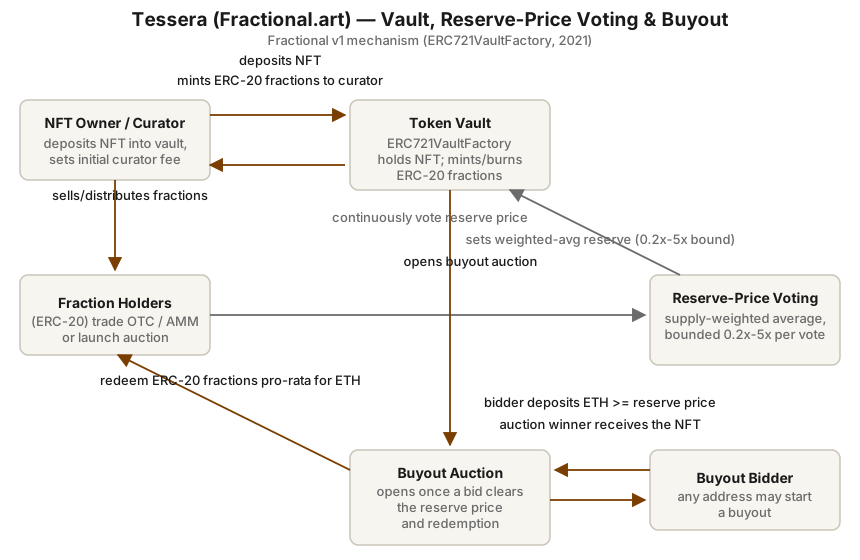
ERC721VaultFactory(0x85Aa7f78...cfC63; a separate factory,0xde7711...33a1, handled multi-NFT "index" vaults). The vault mints a fixed supply of ERC-20 fractions to the curator, who can then sell/distribute them however they like (OTC, AMM pools, launch auctions such as $DOG's MISO sale). - Reserve-price voting. Each fraction holder continuously votes on a reserve price; the vault computes a supply-weighted average. New votes were bounded (greater than 1/5x and less than 5x the current weighted average) to prevent a single holder from instantly warping the reserve.
- Buyout auction. Anyone can start a buyout by depositing ETH at or above the reserve price, triggering an auction; the winning bidder receives the NFT and fraction holders redeem their ERC-20s pro-rata for the auction proceeds. This is the "reassembly valve" that keeps fractions tethered to the value of the underlying NFT.
- A curator fee (inflationary fractions accruing to the vault curator) monetized curation, not the protocol itself.
Tessera v2 (December 2022):
- Rebuilt as a modular protocol of permissionless vaults (smart-contract wallets) with plug-in modules. Ownership shifted from ERC-20s to Raes — ERC-1155 tokens representing both ownership and governance rights over a vaulted NFT.
- Initial distribution used Last Price Dutch Auctions (all winners pay the clearing price).
- Nounlets, a Tessera experiment, fractionalized a Noun and let Rae holders elect a delegate to vote in Nouns DAO governance — an early template for collective governance of a governance asset.
Outcome
Technically and culturally, the v1 mechanism worked: roughly 70,000 users and 6,500+ NFTs were vaulted by mid-2022 (per the rebrand announcement), and $DOG became one of the highest-implied-valuation NFTs ever, with a 20% tranche raising ~$45M from ~1,796 buyers. The August 2022 Series A ($20M from Paradigm, Uniswap Labs Ventures, eGirl Capital, Yunt Capital, Focus Labs and others) marked the peak. Then the 2022–23 bear market collapsed NFT volumes; the December 2022 relaunch as tessera.co plus the Escher fine-art marketplace (March 2023) failed to generate sustainable revenue. On May 12, 2023 Chorlian announced (via @andy8052) that Tessera and Escher would cease operations over the following weeks, stating the economics "just didn't add up." Because the protocol was non-custodial and immutable, existing vaults and fractions remained accessible onchain after the frontends closed. Outcome status: technically_successful_commercially_unsuccessful.
Why it worked
- A real reassembly mechanism. Reserve-price voting plus a buyout auction gave fractions a credible claim on the underlying asset, distinguishing them from mere "exposure tokens" and anchoring price discovery.
- Weighted-average voting with bounds elegantly aggregated dispersed preferences without requiring quorums or active governance, and resisted single-holder manipulation.
- Cultural product-market fit at the top of the cycle. DAOs (PleasrDAO especially) wanted shared ownership of grail assets; $DOG made fractional ownership a memetic phenomenon and marketed the protocol for free.
- Non-custodial, permissionless design meant users never depended on the company for asset safety — which is precisely why the shutdown was orderly rather than catastrophic.
Why it failed or underperformed
- No protocol revenue. Fees accrued to vault curators, not the protocol; the company's marketplace/aggregation businesses (Tessera marketplace, Escher) had to fund development and never reached profitable scale.
- Beta-to-NFTs business. Demand for fractionalization is a leveraged bet on NFT prices; when blue-chip NFT volumes collapsed in 2022–23, fractions became illiquid tokens on illiquid assets.
- Governance-liquidity tension. Fractions dispersed ownership so widely that coordinating buyouts or asset decisions was hard, while AMM liquidity for each vault's token was thin and fragmented.
Lessons
- A mechanism can succeed while its company fails. Non-custodial protocols with no fee switch leave the operating company monetizing adjacencies (marketplaces, curation) that may never pay for protocol development.
- Fractionalization inherits, and amplifies, the liquidity of its underlying. Splitting an illiquid asset into 1B tokens does not create liquidity; it creates many holders of an illiquid claim unless paired with deep AMM incentives.
- Buyout/reassembly valves are essential. The reserve-price + auction loop is the load-bearing part of any fractional design; without it, fractions drift into unbacked meme-coin territory.
- Bounded, continuous, weighted-average voting is a reusable primitive for pricing decisions among passive token holders — cheaper and more robust than proposal-based governance for one-dimensional parameters.
- Ship the immutable thing. Because vaults were immutable and non-custodial, the shutdown stranded no assets — a benchmark for responsible wind-downs.
Redesign (EDITORIAL — hypothesis, not fact)
This section is editorial analysis — a hypothesis, not established fact. A revival would need to fix the revenue and liquidity problems, not the vault mechanics, which were sound. Plausible changes: (1) a minimal protocol fee on buyout settlements (the one moment of guaranteed value realization), so the protocol earns exactly when it delivers its core service; (2) unified liquidity — one shared AMM/coordination layer where all vault fractions trade against a common numeraire, rather than fragmented per-vault pools, possibly via an ERC-6909/1155-native CLOB or hooks-based AMM; (3) making the Nounlets pattern the headline product: fractionalizing productive governance assets (DAO seats, validator positions, revenue-bearing NFTs) whose cash flows or voting rights give fractions intrinsic yield independent of NFT-market beta; (4) explicit legal wrappers (e.g., co-ownership or series-LLC structures) for jurisdictions where fractional interests are securities, sold as a compliance feature rather than avoided. The lesson-shaped bet: fractionalization of speculative art was a bull-market toy, but collective ownership of cash-flowing or governance-bearing onchain assets remains an unsolved, valuable problem.
Sources
- Fractional docs — Token Vault (smart contract breakdown) — primary (docs)
- Introducing tessera.co, Tessera Marketplace, and the Tessera Protocol (Andy8052, official Medium) — primary (docs)
- Entering the New Phase of Collective Ownership as Tessera (Andy8052, official Medium) — primary (docs)
- Reserve Price — A Key Attribute of Fractional Vaults To Understand (official Fractional Medium) — primary (docs)
- Paradigm-Backed NFT Ownership Platform Tessera Is Shutting Down (CoinDesk) (news)
- Fractional NFT project Tessera to shut down amid tough crypto market (The Block) (news)
- Fractionalized Doge NFT valued at $225 million after SushiSwap auction (The Block) (news)
- Fractional raises $20 million to simplify joint NFT ownership, rebrands as Tessera (Fortune) (news)
- Tessera and Escher Will Cease All Operations (nft now) (news)
Related experiments
Last verified: 2026-07-26 · Spot an error? Suggest a correction