Perena
A Solana stablecoin AMM (Numéraire) that routes all swaps through a single yield-bearing hub token, USD*, instead of pairing every stablecoin with every other stablecoin.
▶ Run interactive simulation animated mechanism with editable parameters
How it works onchain
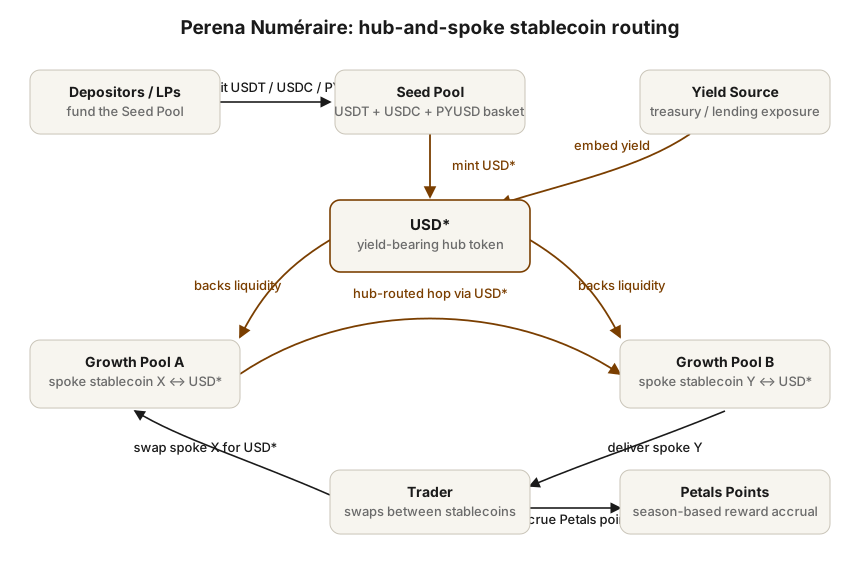 Open full-size diagram
Summary
Perena is a Solana-based stablecoin infrastructure project whose flagship product, Numéraire, is an automated market maker (AMM) built specifically for swapping between stablecoins. Instead of the conventional approach of pooling every stablecoin against every other stablecoin (an n² pairing problem), Numéraire routes all trades through a single central asset, USD*, in a "hub-and-spoke" topology. USD* is itself a claim on a "Seed Pool" of blue-chip, widely integrated stablecoins (initially USDT, USDC, and PYUSD), and it is designed to embed treasury-style yield directly into the token rather than requiring users to separately stake or lend it. Perena was founded by Anna Yuan, who previously led stablecoin efforts at the Solana Foundation, and launched Numéraire on Solana mainnet in November 2024 after raising a pre-seed round backed by investors including Binance Labs, Primitive Ventures, SevenX Ventures, and Maelstrom.
Design (Mechanism)
Numéraire's core innovation is architectural rather than purely mathematical. Traditional stableswap AMMs (Curve-style) let liquidity providers deposit into pools of correlated assets and rely on low-slippage curves near the peg; but as the number of distinct stablecoins on a chain grows, deploying a discrete pool for every pair becomes capital-inefficient and fragments liquidity. Perena's answer is a two-tier pool structure:
- Seed Pool: a base pool holding a small set of highly trusted, deeply liquid stablecoins (USDT, USDC, PYUSD at launch). Depositing into the Seed Pool mints USD*, an index/LP token representing a claim on the underlying basket.
- Growth Pools: individual pools that pair a new or smaller stablecoin against USD* rather than against every other stablecoin directly. Because USD* is already backed by the Seed Pool's liquidity, a Growth Pool effectively gives its paired stablecoin indirect access to the full depth of the hub.
To move between two "spoke" stablecoins that don't share a direct pool, a trade is routed through USD* as an intermediate hop. This is the hub-and-spoke design: liquidity that would otherwise need to be duplicated across many pairwise pools is instead concentrated once, at the hub, and shared.
On top of this topology, Numéraire uses a bounded/concentrated liquidity curve that keeps liquidity dense in a narrow band around parity (roughly $0.99–$1.01), and it is built to compose with Solana's Interest/Token-2022 extensions so that yield-bearing stablecoins can sit natively inside pools without being unwrapped. The protocol also states it incorporates MEV-resistant execution mechanics for trades. USD* itself is marketed as combining AMM utility (it can be swapped and used as the hub asset) with embedded yield sourced from the underlying basket's treasury/lending exposure, so holding USD* is intended to be productive by default rather than requiring a separate staking step. User engagement has been gamified through a points program ("Petals") accumulated across several "seasons," which Perena has stated will convert into a future claimable token allocation.
Outcome
Numéraire went live on Solana mainnet in late November 2024. Perena reports that the protocol has processed several billion dollars in cumulative swap volume across its life, but at last check total value locked sat in the single-digit millions of dollars (around $8M per DefiLlama), which is modest relative to the scale of the stablecoin markets it targets and relative to incumbent Solana stableswap venues. As of mid-2026, Perena had closed its points-accrual "Season 1" and communicated that a reward token derived from Petals would eventually be claimable, but had not published a confirmed token generation event or exchange listing. No security incidents, depegs, or protocol failures tied to Numéraire were found in public reporting. Given a live, functioning product with real (if modest) usage and no resolved token/incentive outcome yet, the project is best classified as ongoing rather than a clear success or failure.
Why it worked
The hub-and-spoke structure is a real answer to a real problem: on a chain that wants to host many stablecoins (issuer-specific, yield-bearing, regional, RWA-backed, etc.), pairwise stableswap pools scale liquidity requirements quadratically. By making every new stablecoin's liquidity a function of one relationship (to USD*) rather than many, Perena lowers the bootstrapping cost for smaller or newer stablecoin issuers who want tradability without needing to bribe or seed dozens of separate pools. Anchoring to Solana specifically — a chain with fast finality and low fees, and one where the founder had prior institutional relationships with stablecoin issuers via her Solana Foundation role — gave the design a plausible distribution channel: issuers like PYUSD had reason to want deep, cheap Solana liquidity, and Numéraire offered a single integration point rather than a fragmented one. Framing USD* as both a hub-routing asset and a yield-bearing instrument also gave depositors a reason to hold it beyond pure trading utility, which is what a hub asset needs to attract the deepest liquidity.
Limitations and criticisms
The hub-and-spoke design concentrates systemic risk in a single hub asset: any de-pegging, exploit, or bad-debt event affecting the Seed Pool's basket (USDT, USDC, PYUSD, or whatever is added later) propagates immediately to every Growth Pool and every stablecoin priced against USD*, rather than being contained to one isolated pair. This is the classic hub-and-spoke trade-off — efficiency gains in normal conditions in exchange for concentrated tail risk in stressed ones. The model also depends on continual curation of which assets are allowed into the Seed Pool; a governance or risk-management misstep in admitting a lower-quality stablecoin into the hub would carry outsized consequences precisely because everything routes through it. Growth Pool assets are, by construction, more exposed to USD*'s liquidity and health than to each other, meaning a spoke stablecoin's tradability is only as good as the hub's solvency and depth — creating a dependency that individual issuers may not fully control or see. Finally, despite meaningful cumulative volume claims, the protocol's TVL has remained comparatively small, and no independent, audited breakdown of the yield sources embedded in USD* (i.e., exactly which lending/treasury exposures back the "embedded yield" claim) was found in the public sources reviewed, which limits external verifiability of the yield mechanism's safety and durability.
Lessons
- Routing liquidity through a single hub token can turn an O(n²) stablecoin-pairing problem into an O(n) one, but it also turns n independent risk surfaces into one shared risk surface — efficiency and fragility are often the same design choice viewed from two angles.
- A hub asset needs an independent reason to be held (not just routed through) to attract deep liquidity; embedding yield directly into the token is one way to do that, but it also means the hub's safety is now coupled to whatever generates that yield.
- Founder-to-ecosystem relationships (e.g., prior standing with a chain foundation or stablecoin issuers) can be a meaningful, if non-technical, input into which liquidity-design bets get adopted early — infrastructure protocols compete on distribution as much as on mechanism.
- Cumulative volume is a weak proxy for protocol health if TVL stays low; both figures should be read together, since high volume on thin liquidity can also indicate wash trading, incentive farming, or fragile depth rather than organic demand.
- Points-based incentive programs that promise a "future token" create a long window during which user behavior is shaped by an unresolved payoff — the eventual token design (allocation, unlock schedule, listing) can retroactively validate or undermine the economic story users were sold during the points phase.
Redesign (EDITORIAL)
The following is a hypothesis about alternative designs, not a factual claim about Perena's actual plans or failures.
If concentrated hub risk is the central worry, one could keep the routing efficiency of hub-and-spoke while blunting the systemic exposure by splitting the hub into risk-tiered sub-hubs rather than one monolithic USD*: a "senior" hub restricted to the most liquid, longest-track-record stablecoins for the deepest routing, and a separate, smaller "junior" hub for newer or less-proven stablecoins, with an explicit haircut or slower settlement path between tiers. This would preserve most of the capital-efficiency benefit for well-established assets while preventing a problem in a newly-onboarded, less-vetted stablecoin from immediately contaminating routing for everything else. A complementary change would be publishing a continuously updated, on-chain-verifiable breakdown of exactly what backs USD*'s embedded yield (which lending markets, what duration, what counterparty exposure) so that the yield component is auditable in the same way the swap mechanism is, rather than being a black-box feature of the token.
Sources
- Welcome Numéraire — a new DeFi protocol for capital-efficient stablecoin markets (Solana announcement) — primary (announcement)
- The Perena Promise — primary (project blog)
- Stablecoin Trading Startup Perena Tries Its Luck on Solana (news)
- What is Perena? Unified Stablecoin Infrastructure Explained (explainer)
- Project Spotlight: Perena (explainer)
- Perena Founder Discusses Stablecoin Innovations on Solana (news)
- Perena TVL Stats & Charts (data)
Related experiments
Last verified: 2026-07-28 · Spot an error? Suggest a correction