Puffer Finance
Native liquid restaking protocol on EigenLayer that let 1–2 ETH node operators run full validators via TEE-based anti-slashing and a novel Validator Ticket market, riding the 2024 restaking boom to >$1B TVL before points-driven capital rotated out.
▶ Run interactive simulation animated mechanism with editable parameters
How it works onchain
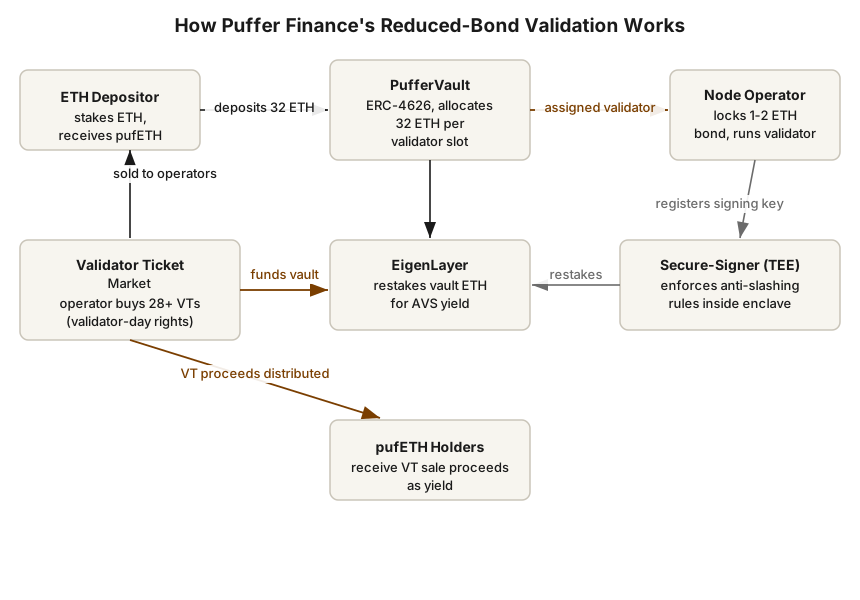 Open full-size diagram
Summary
Puffer Finance is a "native liquid restaking protocol" (nLRP) built on Ethereum and EigenLayer, founded in 2022 by Amir Forouzani (CEO, a former NASA engineer) and Jason Vranek (CTO). Its pitch combined two experiments: (1) radically lowering the capital barrier for solo-style validators — from 32 ETH down to 1–2 ETH bonds — using an Ethereum Foundation–granted TEE remote signer ("Secure-Signer") to make small operators slashing-resistant, and (2) a liquid restaking token, pufETH, that layers EigenLayer restaking yield on top of Ethereum staking yield. Deposits opened February 1, 2024 during the restaking mania; TVL passed $340M within four days and roughly $1.4B in stETH accumulated during the pre-mainnet "Crunchy Carrot" points campaign. Full mainnet went live May 8, 2024, and Puffer briefly ranked among the top three liquid restaking protocols (~$1.2B TVL). After the October 2024 PUFFER token airdrop, points capital rotated out; by 2026 core TVL had fallen to roughly $62M and the team pivoted toward institutional staking (Anchorage custody partnership, March 2026) and the UniFi based-rollup/preconfirmation stack.
Design (Mechanism)
pufETH vault. Stakers deposit ETH into the PufferVault (0xD9A442856C234a39a81a089C06451EBAa4306a72), an ERC-4626 reward-bearing token inspired by Compound's cToken design. The vault's ETH is allocated to validators run by node operators and restaked via EigenLayer; pufETH appreciates against ETH as rewards accrue.
Reduced-bond permissionless validation. Anyone can run a Puffer validator by locking a bond of pufETH (2 ETH worth, or 1 ETH for validators using Puffer's anti-slashing tooling) and receiving a 32 ETH allocation from the vault. The bond aligns incentives: bad performance or slashing burns the operator's own capital first.
Secure-Signer / anti-slashing. Puffer's original research artifact (funded by an Ethereum Foundation grant) is a remote signing tool running inside a Trusted Execution Environment (Intel SGX). Keys are generated and held inside the enclave, which enforces slashing-protection logic so an operator cannot double-sign even if their node software is compromised — the justification for the smaller 1 ETH bond.
Validator Tickets. Rather than skimming a commission from operator rewards, Puffer sells Validator Tickets (VTs): each VT entitles an operator to one validator-day. Operators must deposit at least 28 VTs at registration and then keep 100% of the PoS rewards they earn; VT sale proceeds (minus protocol fees) flow to pufETH holders. This converts staking yield into an upfront, market-priced payment — Nethermind published formal research on VT pricing — and is designed to reward high-performing operators (they keep everything they earn) while smoothing yield for stakers.
Points → token. Like its LRT rivals, growth was driven by Puffer Points plus EigenLayer points, redeemed via the PUFFER governance token airdrop (13% of supply) beginning October 14, 2024.
Outcome
Explosive start: ~$200M+ TVL in days, ~$1.4B before mainnet, peak TVL around $1.2B+ in 2024, third-largest restaking protocol behind ether.fi and Renzo. The team raised ~$24M total, including an $18M Series A (Brevan Howard Digital, Electric Capital) and a Binance Labs–backed token round at a $200M valuation. The airdrop launch was marred by a DDoS on the claims page and community complaints about small allocations; PUFFER traded down sharply from its listing high. Post-airdrop, TVL bled steadily as points mercenary capital consolidated into ether.fi and Kelp; by early 2026 Puffer's core TVL was ~$62M (DefiLlama, cited by The Defiant) — a >90% decline from peak. The protocol remains live and unexploited (an Immunefi audit competition caught a critical EigenLayer-withdrawal slashing-accounting bug pre-production), and the team has redirected effort into UniFi (a based rollup with sub-second preconfirmations via an EigenLayer AVS), a BNB Chain expansion (May 2025), and institutional products.
Why it worked
- Genuinely novel mechanism design. Validator Tickets and TEE-backed 1–2 ETH bonds were real research contributions, not fork-and-rebrand; the EF grant and Nethermind pricing research gave it credibility with Ethereum-aligned capital.
- Perfect timing. Launching deposits at the peak of EigenLayer points mania, with a double-points campaign, captured over a billion dollars in months.
- Decentralization narrative. Capping validator share and lowering the solo-operator barrier positioned Puffer as the "anti-Lido," attracting endorsement-adjacent attention from Ethereum researchers and staking-decentralization advocates.
- Security discipline. Multiple audits, an Immunefi competition that surfaced a critical bug before it mattered, and no exploit to date.
Where the design broke
- Mercenary capital, not product-market fit. Most TVL was points farming; once the airdrop landed, the yield differential versus larger LRTs didn't justify staying, and TVL fell >90%.
- Airdrop mechanics and tokenomics backlash. The claims page had no DDoS resilience, per-claim gas costs were disproportionate to small allocations, and a falling token price coincided with the exact moment retention mattered.
- The restaking thesis itself deflated. EigenLayer AVS yields never materialized at scale, so the entire LRT category consolidated; Puffer's differentiators (small-operator validation) mattered less to depositors than liquidity and integrations, where ether.fi won.
- Complexity overhead. VTs and TEE requirements add operator friction that a simple DVT or commission model avoids; the sophisticated mechanism served decentralization more than it served yield.
Lessons
- Points-driven TVL is rented, not owned: a protocol's true demand curve only becomes visible after the airdrop, and mechanisms should be stress-tested against that cliff.
- Upfront-payment markets for validator rights (VTs) are an elegant alternative to commissions — they price operator performance and smooth staker yield — but they add friction that only pays off if operators are the scarce resource; in 2024–26, depositor liquidity was the scarce resource.
- Lowering validator capital requirements via TEEs is technically credible (EF-granted, audited) but decentralization features do not by themselves retain deposits; they must be paired with best-in-class liquidity and integrations.
- Shipping the token during a category-wide narrative unwind converts a distribution event into an exit event; sequencing token generation against category momentum matters as much as the mechanism.
Redesign (EDITORIAL — hypothesis, not fact)
This section is editorial speculation. A redesigned Puffer might have (1) delayed or throttled the airdrop with vesting tied to continued deposits or validator operation, converting farmers into stakeholders rather than paying them to leave; (2) made Validator Tickets the headline product — an open, protocol-agnostic marketplace for validator-day rights usable by any staking pool — rather than an internal accounting detail of one LRT; (3) leaned into the small-operator niche with explicit revenue sharing for home stakers (e.g., subsidized VTs for geographically distributed or solo operators), making decentralization measurable and marketable to Ethereum-aligned institutions; and (4) avoided competing on restaking yield entirely once AVS yields failed to materialize at scale, instead pricing pufETH as a "clean" decentralized staking token for institutions from day one — the pivot it eventually made in 2026, two years and a billion dollars of TVL later.
Sources
- Puffer Finance official site — primary (docs)
- Validator Tickets — Puffer Finance Docs — primary (docs)
- PufferFinance/puffer-contracts (GitHub) — primary (contract)
- pufETH token contract (Etherscan) — primary (contract)
- Introduction to Puffer Finance — Liquid (Re)Staking for the Little Fish — primary (docs)
- Welcome to Puffer Mainnet! — primary (docs)
- Puffer Finance Raises $18M to Propel Ethereum's Decentralization — primary (docs)
- Nethermind Research on Validator Ticket Pricing (Puffer Finance) (analysis)
- Immunefi audit competition report — critical: slash during EigenLayer withdrawal — primary (audit)
- PUFFER Rises 157% in 14 Hours, But Users Unhappy with Airdrop Rewards (news)
- Ethereum liquid restaking protocol Puffer Finance reaches $200 million valuation in new token funding round (news)
- Puffer Teams Up With Anchorage to Bring Ethereum Restaking to Institutions (news)
- Puffer's Next Chapter: Roadmap Update and BNB Chain Expansion — primary (docs)
- Puffer Upgrades UniFi Preconf AVS to Deliver Sub-10ms Execution (news)
- Puffer Finance TVL — DefiLlama (analysis)
Related experiments
Last verified: 2026-07-27 · Spot an error? Suggest a correction