Squid Game Token
An unlicensed Netflix-themed BSC 'play-to-earn' token whose sell-restricting 'anti-dump' mechanism trapped ~40,000 buyers before the anonymous team rug-pulled roughly $3.3M on November 1, 2021, minutes after the price hit $2,861.
▶ Run interactive simulation animated mechanism with editable parameters
How it works onchain
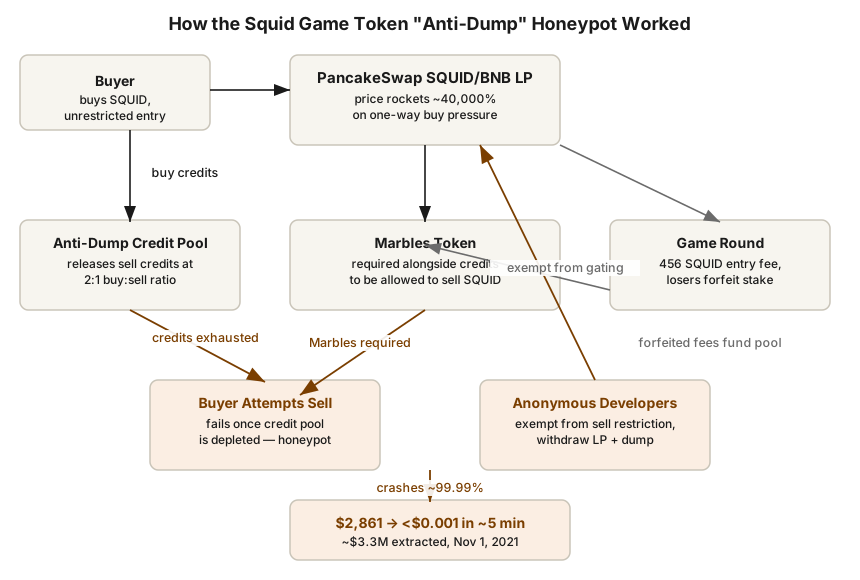 Open full-size diagram
Summary
Squid Game Token (SQUID) launched on Binance Smart Chain on October 26, 2021, riding the peak of the Netflix series' global popularity — with no license or affiliation from Netflix. Marketed via squidgame.cash as the currency of a forthcoming "play-to-earn" tournament modeled on the show's deadly games, SQUID rocketed from about $0.01 to a reported peak of $2,861.80 in under a week. On the morning of November 1, 2021, the anonymous developers drained liquidity and dumped their holdings; the price collapsed roughly 99.99% within about five minutes. Estimates put the team's take at approximately $3.3–3.4M, with around 40,000 holders affected. SQUID became the canonical example of a "rug pull" and was covered by mainstream outlets worldwide — notable because its defining scam feature, a whitepaper-documented "anti-dump" sell restriction, was publicly disclosed in advance and reported on by crypto media a full day before the collapse.
Design (Mechanism)
- Two-token gating. The system had SQUID (the tradable token) and "Marbles," a secondary token nominally earned by playing the (never-launched) online game. Per the whitepaper, holders needed Marbles to be allowed to sell SQUID — selling was conditional, not free.
- "Anti-dump" credit pool. The whitepaper described an anti-dumping mechanism releasing sell credits proportional to buys (reported as a 2:1 buy:sell ratio), so aggregate sales could never exceed roughly half of buy volume; when the credit pool was depleted, sells simply failed. In practice, ordinary buyers found they could not sell on PancakeSwap at all, which Cointelegraph and Crypto Briefing reported on October 31 — before the rug.
- Pay-to-enter game rounds. Entry to the first game round was priced at 456 SQUID (a reference to the show's 456 players); losers would forfeit their entry fee, and later rounds were to cost more. Fees were pitched as funding the reward pool, with a cut to developers.
- One-way flywheel. Because buys were unrestricted but sells were gated, every marketing wave translated almost entirely into price appreciation — a mechanically manufactured up-only chart that itself became the marketing.
- Exit. The developers exempted themselves from the sell restriction, and on November 1 sold their tokens/withdrew liquidity, crashing SQUID from ~$2,861 to under $0.001 in minutes. The website went offline; the project's Twitter account (reported handle @GoGoSquidGame, ~57k–70k followers) had been restricted by Twitter for "unusual activity" shortly before; a Telegram message claimed the team was "depressed" after alleged hacking and was abandoning the project.
Outcome
Total loss for holders. The token's presale and listing phase lasted under a week; the peak-to-zero collapse took minutes. Reported proceeds to the anonymous team were about $3.3–3.4M (some outlets cite higher figures; BscScan-based estimates cluster around $3.38M). No perpetrators were ever publicly identified, arrested, or charged, and no funds were recovered as far as public reporting shows. A "community takeover" token later reused the name on a new contract; it has no continuity with the original and rode the same branding. CoinMarketCap and CoinGecko had displayed the token with scam warnings appended only late in its run; the episode triggered lasting changes in how aggregators flag unsellable ("honeypot") tokens. outcome_status: exploited (a deliberate rug pull rather than a failed honest design).
Why it worked
(As a scam — i.e., why it attracted capital.)
- Perfectly timed cultural hijack. It free-rode on the single biggest media property of the moment; mainstream outlets (BBC, CNBC and others) covered the price surge, lending inadvertent legitimacy.
- Mechanism-as-marketing. The sell restriction produced a flawless up-only chart, which screenshot-driven FOMO amplified; the whitepaper dressed the trap in play-to-earn language familiar from Axie Infinity's 2021 boom.
- Plausible-sounding tokenomics. "Anti-dump" mechanics genuinely existed in legitimate 2021 DeFi (transfer taxes, sell cooldowns), so a gated-sell design did not immediately read as a honeypot to casual buyers.
Where the design broke
- It was a honeypot by construction. The sell-gating that manufactured the chart also guaranteed holders could not exit; only the deployer-exempt addresses could realize gains. This was not an incentive-design failure but intent.
- Every classic red flag was present. Anonymous team with fabricated-looking credentials and no verifiable identities, no Netflix license, a typo-ridden whitepaper, a weeks-old website, disabled comments on social channels, and — decisively — publicly reported inability to sell 24+ hours before the collapse.
- No enforcement backstop. Pseudonymous deployment on BSC plus mixer-based laundering meant no recourse; the low cost of forking a token contract made the scam nearly free to run.
Lessons
- A token you cannot sell has no price. Quoted AMM prices are meaningless when sell paths are gated; any "anti-dump" mechanism that restricts exits asymmetrically is a honeypot primitive, and buy-side simulation tools (now standard in honeypot checkers) exist largely because of SQUID.
- Disclosed scams still work. The trap was documented in the whitepaper and reported by crypto media before the rug; disclosure does not protect buyers when hype outruns reading. Mechanism literacy, not information availability, was the binding constraint.
- Up-only charts are a red flag, not a signal. Mechanically suppressed sell pressure produces exactly the price action that attracts retail; extreme, smooth appreciation with stable volume should trigger suspicion of restricted exits.
- IP hijacking is a scam accelerant. Unlicensed use of trending media brands imports trust the project never earned; absence of a license announcement from the rights holder is a one-search due-diligence check.
Redesign (EDITORIAL — hypothesis, not fact)
This entry is a scam, so "redesign" means: what would a legitimate version of the underlying idea look like? A licensed, elimination-tournament game token could work with symmetric transferability (no sell gating ever), entry fees escrowed in an audited, timelocked prize-pool contract that pays winners programmatically, team allocations vested onchain, and LP tokens burned or locked with a third-party locker at launch. The genuinely interesting mechanism buried here — pay-to-enter, winner-take-most tournaments with forfeited stakes funding the pot — is viable and was later executed honestly by onchain game-theory experiments (e.g., battle-royale and last-man-standing games). The honest version's rule is simple: the game may take your stake by its published rules, but the token must always be sellable. Any deviation from exit symmetry converts a game into a trap.
Sources
- Squid Game (SQUID) Token Tracker — BscScan — primary (contract)
- 'I Lost Everything': How Squid Game Token Collapsed — CoinMarketCap Academy (analysis)
- Users unable to sell Squid Game token clocking 45,000% gains — Cointelegraph (news)
- Twitter flags Squid Game token accounts as price crashes — Cointelegraph (news)
- Squid Game Token Crashes; Developers Say They've Left the Project — CoinDesk (news)
- Top1 Rugpull Token: How Squid Game was born? — Wu Blockchain (analysis)
- More Insights into the Squid Game Crash — Fairyproof (analysis)
- Squid Game Token Jumps 40,000% But Holders Can't Sell — Crypto Briefing (news)
Related experiments
Last verified: 2026-07-27 · Spot an error? Suggest a correction