Stacks (Proof of Transfer / Stacking)
A Bitcoin layer whose Proof of Transfer consensus makes miners spend BTC to win STX blocks and recycles that BTC to STX holders who lock ('Stack') their tokens, creating native BTC yield.
▶ Run interactive simulation animated mechanism with editable parameters
How it works onchain
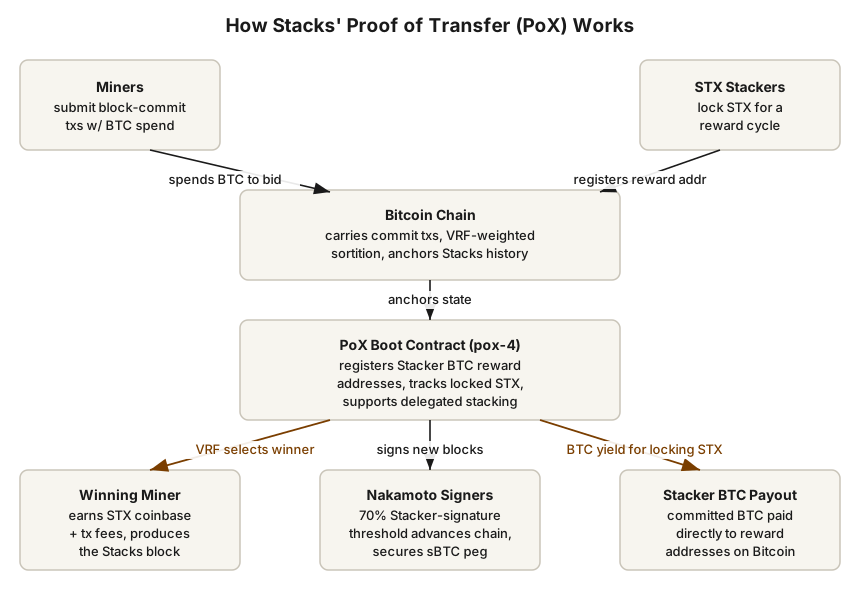 Open full-size diagram
Summary
Stacks is a Bitcoin layer-1 (self-described "Bitcoin layer") whose consensus mechanism, Proof of Transfer (PoX), is one of the most unusual economic experiments in consensus design: instead of burning electricity (PoW) or locking the chain's own token (PoS), Stacks miners spend already-mined Bitcoin for the chance to produce Stacks blocks, and that BTC is routed to STX holders who lock their tokens in a process called Stacking. The result is a chain anchored to Bitcoin's security whose native token pays yield denominated in BTC rather than in inflationary emissions of itself.
The project began as Blockstack, founded around 2013 out of Princeton's computer science department by Muneeb Ali and Ryan Shea (Y Combinator S14). Blockstack ran the first SEC-qualified Reg A+ token offering in July 2019 (~$23M), rebranded to Stacks in 2020, and launched Stacks 2.0 with PoX on mainnet on January 14, 2021. The mechanism was specified in SIP-007 ("Stacking Consensus") as an explicit improvement over the earlier proof-of-burn design of SIP-001: rather than destroying BTC, transfer it to aligned token holders.
Design (Mechanism)
- Mining by BTC spend (sortition). Would-be Stacks miners submit block-commit transactions on the Bitcoin chain, attaching BTC. A verifiable random function weighted by each miner's BTC spend selects the winner, who earns the STX coinbase and transaction fees. Miners thus convert BTC into STX at a market-discovered rate; mining is profitable when the STX reward exceeds the BTC bid.
- Stacking. STX holders lock tokens for one or more ~2-week "reward cycles" via the PoX boot contract (originally
.pox, currentlySP000000000000000000002Q6VF78.pox-4, deployed April 2024). Stackers meeting the dynamic minimum register a Bitcoin reward address; miners' committed BTC is paid directly to those addresses on the Bitcoin chain. Smaller holders delegate to pools (delegated stacking is native to the contract). - Bitcoin anchoring. Every Stacks block history is committed to Bitcoin, so reorganizing Stacks history requires contesting Bitcoin history. Clarity smart contracts can read Bitcoin state, enabling BTC-aware applications.
- Nakamoto upgrade (activated October 29, 2024). Decoupled Stacks blocks from Bitcoin blocks (block times fell from ~10 minutes to seconds), introduced "100% Bitcoin finality" (Stacks no longer forks on its own; Stacker signatures — a 70% threshold — are required to advance the chain), and changed miner selection to a median-of-recent-commitments rule (ATC-C) to neutralize a Bitcoin-miner MEV attack. Nakamoto plus the Stacker signer set became the foundation for sBTC, a BTC-backed asset launched December 16, 2024, whose peg is secured by Stackers' economic stake.
Outcome
Ongoing, and one of the longest-lived consensus experiments outside plain PoW/PoS. PoX has run continuously since January 2021, distributing BTC to Stackers every reward cycle for over five years, and STX has remained a major-cap asset with listings on top exchanges. The mechanism survived a real adversarial episode: Bitcoin mining pools with large hashrate discovered they could censor competitors' Stacks block-commits from Bitcoin blocks they mined, winning Stacks sortitions with trivial BTC spend — a Bitcoin-miner MEV attack that suppressed Stacker rewards for months. The Nakamoto upgrade's assumed-total-commitment rule substantially blunted this. Stacking matured from solo-only participation into a pool and liquid-stacking ecosystem (e.g., stacking pools and liquid stacked STX tokens), and Stackers gained a second job post-Nakamoto as the signer set backing sBTC. Weaknesses persist: the Stacks miner set has remained small (single-digit-to-low-double-digit active miners for much of its history), BTC yield fluctuates with miner competition, and STX price performance has lagged its "Bitcoin L2" narrative peaks of 2021 and early 2024.
Why it worked
- Recycling instead of burning aligned three parties. Miners get STX for BTC, Stackers get BTC for locking STX, and the chain gets Bitcoin-anchored security — a closed incentive loop that needed no external subsidy beyond the STX coinbase.
- BTC-denominated yield is a genuinely differentiated product. "Lock STX, earn native BTC" is a pitch no PoS chain can copy, and it created a durable holder base willing to lock supply through bear markets.
- Anchoring to Bitcoin gave real reorg resistance without asking Bitcoin to change anything — PoX runs entirely in Bitcoin transactions plus its own chain.
- Governance capacity to self-correct. The SIP process (SIP-007, then the Nakamoto SIPs) diagnosed and shipped fixes for the MEV exploit and slow blocks rather than ossifying.
Limitations and criticisms
- Thin miner competition. Because mining requires sophisticated BTC bidding rather than commodity hardware or simple staking, few entities mined, keeping the system closer to an oligopoly than PoW's open market and making yield sensitive to a handful of actors' bids.
- Bitcoin-miner MEV was a structural blind spot. SIP-007 did not anticipate that entities controlling Bitcoin block construction could censor rival commits and win Stacks rewards nearly for free; the fix required a consensus overhaul.
- Yield reflexivity. Stacker BTC yield depends on miners' willingness to spend BTC, which depends on STX price — so yield compresses exactly when holders most want it.
- Narrative dependence. Adoption tracked Bitcoin-L2 hype cycles; app-level activity on Stacks has repeatedly lagged the elegance of its consensus design.
Lessons
- You can pay stakers in a harder asset than your own token — routing an external asset (BTC) to lockers avoids the circular "inflation paid in the thing you're diluting" critique of PoS yields, at the cost of coupling your security budget to your token's market price.
- Any consensus that rides another chain inherits that chain's block builders as potential adversaries. If Bitcoin miners can order or censor your commitment transactions, they are inside your threat model whether you planned for it or not.
- Mechanisms need upgrade paths. PoX survived its MEV exploit because Stacks retained the social and technical machinery (SIPs, hard forks, boot-contract versions pox → pox-4) to re-parameterize consensus.
- Time-locking supply for external yield is a powerful float sink — Stacking persistently locked a large share of STX supply, but a sink is not a source of demand; usage must come from elsewhere.
Redesign (EDITORIAL — hypothesis, not fact)
This section is editorial hypothesis, not fact. A redesign would attack miner thinness first: PoX mining could be commoditized via an open on-chain auction (miners post standing BTC bids, sortition drawn from the bid book) so participation doesn't require running bespoke bidding infrastructure, plus a protocol-owned "miner of last resort" funded by a small STX emission to floor Stacker yield during bid droughts. Second, make Bitcoin-builder censorship unprofitable by construction rather than by median-smoothing: require commit transactions be included over a multi-block window with commitments blinded (revealed after inclusion), so a censoring Bitcoin miner cannot identify which transactions to exclude. Third, unify the two security jobs Stackers now perform — PoX consensus signing and sBTC peg custody — into one explicitly slashable bond, since today the BTC-yield carrot is strong but the stick for signer misbehavior is comparatively weak.
Sources
- SIP-007: Stacking Consensus (Proof of Transfer) — primary (governance)
- Proof of Transfer (PoX) — Stacks Documentation — primary (docs)
- pox-4 boot contract on Stacks mainnet (Hiro Explorer) — primary (contract)
- Proof-of-Transfer (PoX) whitepaper — Stacks Forum — primary (docs)
- Stacks 2.0 Launch Recap (official blog) — primary (retrospective)
- Stacking: How STX Holders Contribute — Stacks Documentation — primary (docs)
- Nakamoto is Here — Stacks Foundation — primary (governance)
- What was the Nakamoto Upgrade? — Stacks Documentation — primary (docs)
- Stacks Unlocks Fast Blocks and 'Bitcoin Finality' With Nakamoto Upgrade — The Defiant (news)
- Stacks blockchain — Wikipedia (history, Reg A+ offering) (analysis)
Related experiments
Last verified: 2026-07-27 · Spot an error? Suggest a correction