StepN
Move-to-earn lifestyle app that paid users tokens for walking and running in NFT sneakers, scaling to millions of users before its dual-token economy collapsed.
▶ Run interactive simulation animated mechanism with editable parameters
How it works onchain
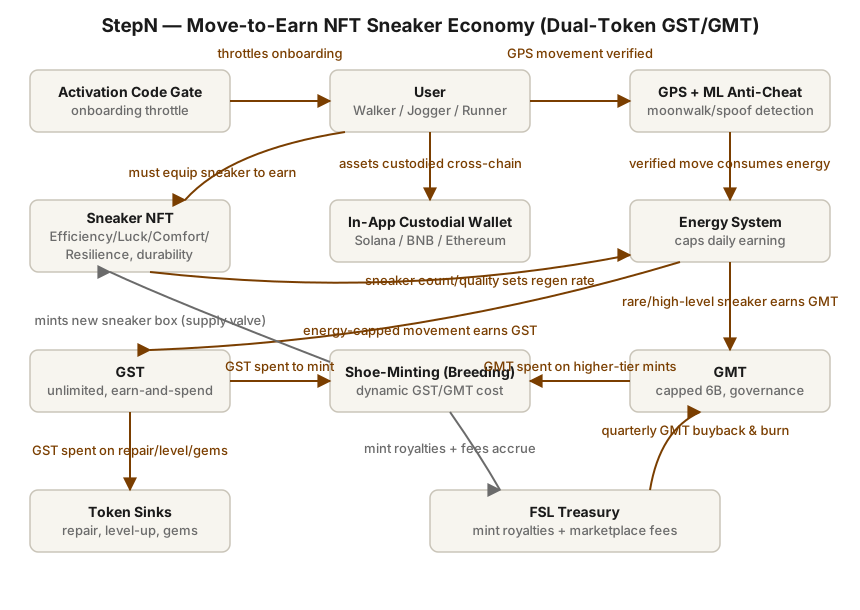 Open full-size diagram
Summary
StepN was the defining "move-to-earn" experiment: a mobile lifestyle app in which users bought NFT sneakers and earned tradeable tokens for GPS-verified walking, jogging, or running. Built by Find Satoshi Lab (FSL), an Australia-based studio founded by neighbors Yawn Rong and Jerry Huang, the project was conceived in August 2021, won the Gaming Track of Solana's Ignition Hackathon in October 2021, and launched its app in beta around December 2021, followed by a GMT token sale on Binance Launchpad in March 2022. Within months it became one of the fastest-growing consumer crypto apps ever — at peak it claimed roughly 1 million daily users (all-time high on June 2, 2022), several million monthly users, and about 20% of Solana's active user base — and reported $122.5M in Q2 2022 profit from marketplace and royalty fees. Its unlimited-supply reward token GST then collapsed more than 99% from its late-April 2022 high as new-user inflows stalled, exposing the Ponzi-like dependence of earnings on sneaker demand. The company itself survived: FSL kept operating StepN ("STEPN OG"), and launched a successor, StepN GO, with a new token (GGT) in 2024.
Design (Mechanism)
StepN's core loop married a fitness tracker to a breeding-style NFT game economy:
- NFT sneakers. Users needed at least one sneaker NFT (types: Walker, Jogger, Runner, Trainer, tuned to different movement speeds) with four attributes — Efficiency (earnings), Luck (mystery-box drops), Comfort, and Resilience (durability). Sneakers wore down with use and had to be repaired with earned tokens.
- Energy system. Earnings accrued only while the user had "energy," which regenerated slowly and scaled with the number/quality of sneakers held. This capped daily extraction per user and created demand for owning multiple sneakers.
- Dual token model. GST (Green Satoshi Token) had unlimited supply and was the everyday earn-and-spend token; GMT (Green Metaverse Token) was capped at 6 billion, positioned as the governance/premium token, earnable only with high-level or rare sneakers. GST sinks included shoe-minting, HP/repair, leveling, gem/socket upgrades, and mystery boxes.
- Shoe-minting ("breeding"). Two sneakers could mint a new sneaker box for GST (and later GMT), with dynamic costs the team tuned to throttle sneaker supply — the primary supply/demand valve of the economy.
- Onboarding throttle and anti-cheat. Activation codes rationed new-user inflow; GPS plus machine-learning "moonwalking" detection filtered spoofed movement. The app used a semi-custodial in-app wallet on Solana (later expanding to BNB Chain and an Ethereum realm), with chain tokens used only for gas.
- Profit recycling. From Q2 2022, FSL committed protocol profits (marketplace fees, minting royalties) to a quarterly GMT buyback-and-burn.
Outcome
Explosive success, then a canonical reflexive collapse — while the operating company remained profitable. GST peaked near $8–9 in late April 2022; sneaker floor prices reached thousands of dollars. In May 2022, StepN announced it would block mainland-China users (about 5% of ~3M users) to comply with regulation, and GST/GMT fell 26–40% in days amid broader market decline. As new-buyer inflows slowed, GST earnings outpaced sinks and the token fell below one cent by late 2022; sneaker prices and daily actives followed, dropping well over 90% from peak. Users logged 67M+ miles overall, and FSL banked over $100M in a single quarter, but late entrants who bought sneakers near the top suffered large losses. FSL diversified (MOOAR marketplace, Gas Hero, FSL ID) and launched StepN GO with the GGT token in 2024; the original app persists with a small fraction of peak activity. GMT still trades on major venues. Verdict: a genuine product-distribution breakthrough and a profitable business, attached to an unsustainable user-facing token economy — partial success.
Why it worked
- Legible real-world hook. "Get paid to walk" required zero crypto literacy to understand; the fitness framing (and COVID-era outdoor habits) gave crypto a mainstream on-ramp, especially in Asia.
- Polished mobile UX with custodial abstraction. The in-app wallet, fiat-ish flows, and game-like progression hid chain complexity better than nearly any prior dapp.
- Well-tuned short-term game loops. Energy caps, durability/repair sinks, and dynamic minting costs gave the team real levers, and daily habit mechanics drove retention that pure DeFi never achieved.
- Real protocol revenue. Marketplace and minting fees generated nine-figure quarterly profit, funding buybacks and the studio's survival beyond the bubble.
Where the design broke
- Reflexive tokenomics. Earnings were denominated in an unlimited-supply token whose price depended on new sneaker buyers; ROI-motivated users treated sneakers as bonds, so the moment growth slowed, sell pressure overwhelmed sinks — a classic death spiral shared with Axie's SLP.
- Speculators crowded out fitness users. Sneaker prices in the thousands of dollars selected for yield farmers, not joggers, making the user base maximally flighty.
- Exogenous shocks amplified fragility. The China ban and the May–June 2022 market crash hit a system with no shock absorbers other than falling earnings.
- Levers were discretionary, not credible. Constant manual tuning of mint costs and earnings meant users bore policy risk from an unaccountable central team.
Lessons
- An unlimited-supply reward token whose only demand is re-entry by new participants will collapse once growth slows; sinks must generate demand from non-speculative utility, not just recycle emissions.
- Requiring a large upfront NFT purchase to participate selects for ROI-seekers and prices out the organic users (here, fitness enthusiasts) who would give the token real, non-reflexive demand.
- Real revenue at the studio layer can outlive a dead user-side economy — StepN's fee model made FSL durable even as GST holders were wiped out; these are separate solvency questions and should be analyzed separately.
- Custodial, mobile-first UX was the actual innovation that drove millions of installs; the mechanism that acquired users and the mechanism that retained value were different systems, and only the first worked.
- Geographic regulatory exposure is a tokenomics variable: a 5% user ban triggered a 40% repricing because marginal-buyer expectations, not current cash flows, set the price.
Redesign (EDITORIAL — hypothesis, not fact)
This section is editorial hypothesis, not historical fact. A redesigned StepN would decouple exercise rewards from ponzi-financed yield: (1) fund rewards from an explicit, capped sponsorship pool (brands, health insurers, protocol revenue share) so earnings reflect real external demand rather than new-user inflows; (2) denominate user earnings in points that vest into the capped token via a bonding-curve or epoch-auction mechanism, making dilution transparent instead of hiding it in GST inflation; (3) replace the four-figure sneaker paywall with free or cheap soulbound starter sneakers plus optional premium NFTs, so the base of users is fitness-motivated and speculators are the marginal, not the median, participant; (4) publish the emission-tuning policy as an on-chain controller (e.g., earnings rate targeting a GST price band) so users price policy rules rather than team discretion; and (5) hold a protocol-owned reserve funded in the boom that automatically supports repair-cost stability in the bust, smoothing the reflexive cycle it cannot fully eliminate.
Sources
- STEPN Whitepaper — Tokenomics — primary (docs)
- STEPN Whitepaper — GMT Vesting & Utility — primary (docs)
- StepN: GMT Token on BscScan — primary (contract)
- GMT token on Solana Explorer — primary (contract)
- STEPN Announces Q2 Profits & Initiates Quarterly GMT Buyback & Burn (official Medium) — primary (retrospective)
- Founder Stories: Yawn Rong — Stepn (Morningstar Ventures) (retrospective)
- Solana-Based STEPN Reports $122.5M in Q2 Profits (CoinDesk) (news)
- Stepn 'Move-to-Earn' Cryptocurrencies Plummet After App Says It Will Block Users in China (Decrypt) (news)
- Users logged over 67 million miles on Stepn since launch (The Block) (news)
- Stepn Was a Runaway Success During COVID but Can It Keep Moving Forward? (CoinDesk) (analysis)
- FSL 2024 Recap: A Year of Bold Steps (official Medium) — primary (retrospective)
- STEPN Audit (Verilog Solutions) — primary (audit)
Related experiments
Last verified: 2026-07-27 · Spot an error? Suggest a correction