Story Protocol
A16z-backed Layer 1 blockchain that tried to make intellectual property "programmable" — onchain IP registration, licensing, and royalty-splitting for creators and AI — before pivoting away from IP entirely and rebranding as DATA Foundation after its $IP token fell ~98% from its all-time high.
▶ Run interactive simulation animated mechanism with editable parameters
How it works onchain
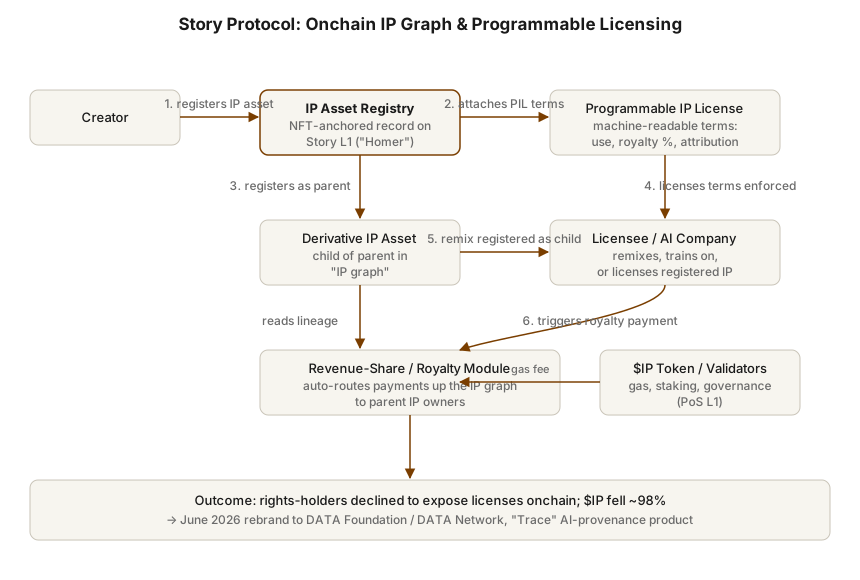 Open full-size diagram
Summary
Story Protocol was a purpose-built Layer 1 blockchain (Cosmos-SDK-based, EVM-compatible) designed to make intellectual property a native onchain asset class. Founded in 2022 by Seung Yoon "Sy" Lee (previously co-founder of the fiction/webnovel app Radish), Jason Zhao (formerly at Google DeepMind), and Jason Levy (formerly at Pocket Gems, Apple, and Amazon), the project raised roughly $140M across multiple rounds, including an $80M Series B led by Andreessen Horowitz (a16z) that valued the company at $2.25B, with additional backing from Paris Hilton's 11:11 Media. Story's public mainnet, codenamed "Homer," launched February 13, 2025, alongside the Token Generation Event (TGE) for its native $IP token and an airdrop for early contributors and testnet participants. The pitch: let creators register any IP (characters, music, art, AI models, brands) onchain as programmable assets with machine-readable licensing terms, so that derivatives, remixes, and AI training could automatically trigger royalty payments and attribution up an onchain "IP graph" — replacing what the team called the "rent-seeking intermediaries" of traditional IP licensing (labels, agencies, lawyers).
Design (Mechanism)
Story's core primitive was the onchain IP Asset: any piece of intellectual property could be registered on the chain as an NFT-anchored record, then attached to a "Programmable IP License" (PIL) — a machine-readable license template (commercial-use terms, royalty percentages, revenue-share splits, attribution requirements) enforced by smart-contract modules rather than legal boilerplate alone. Derivative works (a remix, a fan comic, an AI-generated output trained on registered IP) could be registered as children of a parent IP Asset, building an "IP graph" that traced lineage and automatically routed royalties back up the tree via revenue-sharing modules. The $IP token (1B total supply) was used for gas/transaction fees on the L1 and for protocol governance/staking under a proof-of-stake validator set. The system targeted three constituencies simultaneously: individual creators wanting provenance and monetization, Web3/NFT projects wanting licensable IP, and — increasingly, as the AI boom accelerated — AI companies needing a way to license and pay for training data at scale.
Outcome
The mainnet launch drew significant attention given the a16z backing and the "first IP-native blockchain" framing, and $IP saw early trading enthusiasm, reaching an all-time high of $14.74 in September 2025. From there the token entered a sustained decline, ultimately losing roughly 98% of its value, trading around $0.30 (market cap ~$106M) by mid-2026. In February 2026, a delay to a scheduled token unlock drew criticism from the community; co-founder Sy Lee publicly acknowledged the network needed "more time" to build real usage. On June 25, 2026, the company rebranded entirely — Story Protocol became "DATA Foundation," the chain became the "DATA Network," and $IP holders were migrated 1:1 into a new $DATA token. Andrea Muttoni took over as CEO; the company pivoted away from general IP tokenization toward a narrower product (a "Trace" platform generating cryptographic provenance/consent receipts for AI training datasets), partnering with Kled AI to register 1.5 billion user-contributed data records. The rebrand amounted to an admission that the original IP thesis had not found product-market fit.
Why it worked
- The team secured unusually large, high-profile funding ($140M, a16z-led, unicorn valuation) and genuine mainstream press coverage, proving the narrative of "IP as an onchain asset class" was fundable and compelling to VCs and media even before real usage existed.
- The Programmable IP License concept was a legitimate, well-specified design contribution — a genuine attempt to make licensing terms machine-enforceable rather than just an NFT wrapper — and its modular royalty/derivative-graph architecture was cited by other projects as a reference design.
- The pivot itself showed some organizational strength: rather than quietly winding down, the team redirected substantial capital and infrastructure toward a real, timely problem (AI training-data provenance and copyright liability) with a live partner integration (Kled AI) rather than abandoning the project outright.
Where the design broke
- Adoption did not materialize from the constituency the model most needed: professional rights-holders. CEO Andrea Muttoni pointed directly to this as the core problem — owners of valuable music, games, and brand IP were unwilling to expose licensing terms to a permissionless, onchain system and preferred to retain tight, centralized control over their assets.
- The token economics front-ran the product: a large TGE/airdrop and a $2.25B valuation created massive early liquidity and speculative interest disconnected from actual IP-licensing volume, so once speculative demand faded there was no organic usage to support the price, contributing to the ~98% drawdown.
- "Programmable IP" tried to solve a legal/institutional problem (IP licensing, which depends on enforceability, jurisdiction, and trust between named counterparties) with a blockchain/token solution, when the actual friction in IP licensing is rarely technical — it is negotiation, valuation, and legal enforceability, none of which a smart contract alone resolves.
- The February 2026 token-unlock delay signaled to the market that usage/revenue were not tracking token supply growth, damaging credibility ahead of the eventual rebrand.
Lessons
- A well-designed technical primitive (programmable licenses, derivative graphs) is necessary but not sufficient — if the people who own the underlying asset (major rights-holders) have no incentive to expose it to a new system, the primitive has no supply side to operate on.
- Large speculative token launches can substitute for product-market fit in the short term (funding, press, market cap) but make the eventual reckoning more visible and more damaging when usage fails to follow.
- Pivoting a chain's entire narrative and token (IP → AI training-data provenance) after a failed launch is a real strategic option, but it also functions as a public admission of failure and a stress test of user/investor trust that not every project can survive.
- Infrastructure aimed at a two-sided market (creators/IP owners and licensees/AI companies) needs at least one side to have a forcing function (legal requirement, cost savings, or new revenue unlocked) to move first; "voluntary" onchain registration rarely beats institutional inertia.
Redesign (EDITORIAL — hypothesis, not fact)
Rather than launching a general-purpose "IP blockchain" and hoping rights-holders would opt in, Story could plausibly have started narrower and demand-led: begin as a compliance/provenance layer specifically for AI companies who face acute, near-term legal liability (copyright lawsuits over training data) — exactly the pivot they eventually made in 2026, but as the day-one product rather than the last resort. That gives the protocol an initial customer with a genuine forcing function (litigation risk) instead of asking creative-industry incumbents to voluntarily give up control. IP registration for individual creators (webcomics, indie musicians, NFT projects) could then be layered on as a secondary, lower-stakes market once the AI-provenance rails and revenue model were proven, rather than being the flagship use case competing for a $2.25B valuation on day one. Token issuance could also have been staged against measurable usage (registered datasets, licensing revenue) rather than a large upfront TGE/airdrop, reducing the mismatch between speculative price and real adoption that likely amplified the eventual 98% decline.
Sources
- Story Protocol Launches to Let People to Register IP and Get Paid for It (CoinDesk, Feb 13 2025) — primary (news)
- Story Protocol Debuts Mainnet to Bypass IP's 'Rent-Seeking Intermediaries' (Decrypt) — primary (news)
- a16z-backed crypto firm rebrands, shifts focus to solving AI's global copyright headache (CoinDesk, June 25 2026) — primary (news)
- Story Protocol rebrands as DATA Foundation, migrates $IP token to $DATA amid AI training pivot (news)
- Story Protocol Price, IP to USD, Research, News & Fundraising (Messari) (data)
- Story Protocol official site — primary (official)
Related experiments
Last verified: 2026-07-27 · Spot an error? Suggest a correction