This Artwork Is Always On Sale
Simon de la Rouviere's 2019 Ethereum artwork that can never be held off the market: its owner must always name a sale price and pay continuous Harberger-tax patronage to the artist, or be foreclosed.
▶ Run interactive simulation animated mechanism with editable parameters
How it works onchain
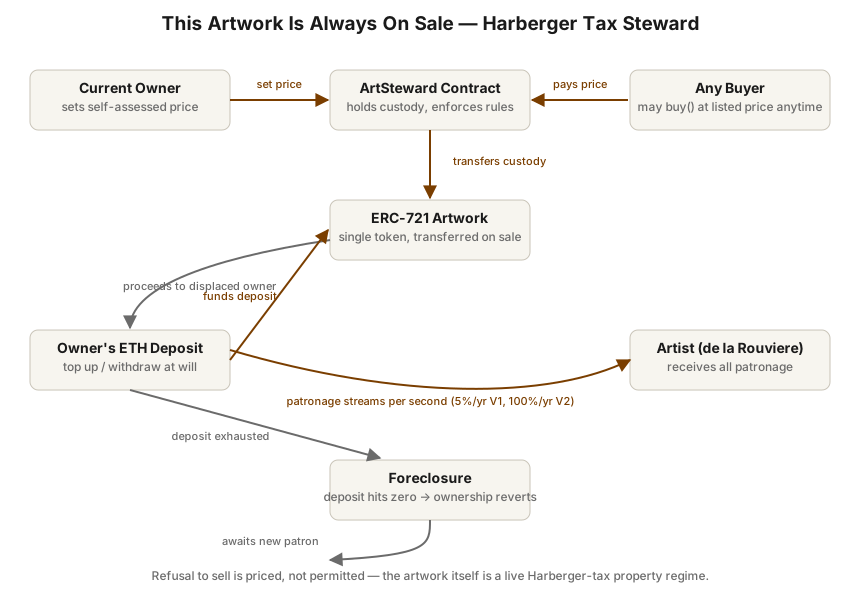 Open full-size diagram
Summary
This Artwork Is Always On Sale (TAIAOS) is a single digital artwork released on Ethereum on 21 March 2019 by South African artist-engineer Simon de la Rouviere, an early ConsenSys/Ujo Music builder and bonding-curve pioneer. It is widely cited as the first NFT governed by a modified Harberger tax (the "COST"/partial-common-ownership model from Posner and Weyl's Radical Markets): the owner must at all times publish a self-assessed sale price at which anyone can buy the piece instantly, and pays a continuous tax on that self-assessed value — 5% per year in V1 — which streams to the artist as perpetual patronage. If the owner's deposit runs dry, a smart-contract "steward" forecloses the artwork. A second edition (V2) with a deliberately punitive 100% annual patronage rate launched in June 2020, and in February 2021 the original was "restored" after a contract bug was discovered — an onchain conservation performance in its own right. The project earned roughly 18.4 ETH of patronage in its first ~15 months, was self-assessed at 240 ETH by mid-2020, was longlisted for the 2022 Lumen Prize NFT Award, and appears in Taschen's On NFTs (2025). It remains live and maintained (site refactor in 2026).
Design (Mechanism)
The system splits the artwork (a plain ERC-721 token) from an ArtSteward contract that permanently holds custody and enforces the property regime:
- Self-assessed price, always buyable. The owner sets any sale price. Anyone can call buy at that price at any moment; the proceeds go to the displaced owner. There is no way to take the artwork off the market — refusal to sell is priced, not permitted.
- Continuous patronage (Harberger tax). Tax accrues per-second on the self-assessed price: 5% per annum in V1; 100% per annum in V2, meaning holding V2 for a year costs its full stated price. De la Rouviere framed the rate as roughly "the probability the artwork sells in a year." All tax goes to the artist, not a commons — a deliberate modification turning Harberger taxation into an artist-patronage stream (a precursor to programmable royalties, but continuous and unavoidable rather than event-based).
- Deposit and foreclosure. The owner posts an ETH deposit from which patronage is drawn. When the deposit is exhausted, the steward forecloses: ownership reverts and the piece awaits a new patron. Owners can top up or withdraw the deposit (adjusting their effective holding horizon) and change the price at will.
- Restoration mechanics (2021). Jason Smythe (Wildcards) reported medium-severity bugs in V1 — including that a contract-based owner which reverts on receiving ETH could block all future sales, and profitable front-running paths. On 8 February 2021 a purpose-built
Restorercontract bought the damaged original, and the patron (address 0x5A36c5bB86b1D8037576FdA54422e60823067063) received a fixed V1 with the old token merged in; a token deposit keeps the merged state stable for ~2 million years. The repair was executed entirely through the artwork's own market mechanism — the broken piece was bought, not admin-migrated.
Outcome
V1 changed hands three times before settling with a long-term patron. By June 2020 it had generated ~18.4 ETH in cumulative patronage to the artist and carried a 240 ETH self-assessed price; V2 launched at 3 ETH. The 2021 restoration succeeded with full patron cooperation, and the piece has stayed continuously on sale for over seven years — through the 2021 NFT mania and after — making it one of the longest-running live mechanism-design artworks on Ethereum. Institutional recognition (Lumen Prize longlist 2022, Taschen's On NFTs) confirmed its art-historical standing. Its direct descendants include Wildcards (Harberger-taxed conservation NFTs), zeroAlpha, and the broader "partial common ownership" research thread at RadicalxChange. Commercially it was modest by NFT-boom standards — patronage in the tens of ETH, not thousands — hence partial_success: a landmark proof-of-concept whose economic flywheel stayed niche.
Why it worked
- Concept–mechanism unity. The artwork is the property regime; owning it means living inside a Harberger tax. This made it legible to both the art world and mechanism-design researchers, giving it unusual longevity and citation density.
- Radical simplicity. One token, one steward contract, three rules (price, tax, foreclosure). No governance, no token, no upgradability theater — easy to reason about and to fork.
- Aligned patron selection. A 5% continuous carry filters for owners who genuinely value the piece, while guaranteeing the artist income proportional to the piece's declared value into perpetuity — royalties that cannot be bypassed by marketplaces.
- Graceful failure handling. Even the bug became art: the "restoration" used the market itself to repair the work, strengthening rather than undermining the piece's thesis.
Why it failed or underperformed
- Low turnover defeats the always-on auction. Harberger theory predicts allocative efficiency through frequent trades; in practice one patron simply held V1 at a high self-assessed price, and 5%/yr was cheap enough to make it a de facto private good.
- V2's 100% rate overshot. Pricing a year of ownership at the full artwork price made holding nearly irrational, suppressing demand rather than accelerating circulation.
- Unaudited code carried real risk. The sale-blocking and front-running bugs required an elaborate restoration; a less cooperative patron could have left the work permanently damaged.
- Self-assessed prices drifted from market prices. With one asset and thin demand, the "valuation" (240 ETH) was a signal, not a clearing price — patronage revenue therefore tracked bravado more than liquidity.
Lessons
- Harberger/partial-common-ownership mechanisms need market depth to deliver their promised turnover; on a single unique asset they behave mostly as a continuous royalty, not an allocation engine.
- The tax rate is the entire game: 5% approximated a holdable collectible, 100% approximated an unholdable hot potato — rate selection should model desired holding periods explicitly.
- Continuous, protocol-enforced patronage predates and outperforms marketplace royalty flags: it cannot be opted out of, a lesson the 2022-23 royalty wars re-taught the NFT industry.
- Foreclosure requires deposits, and deposits require careful ETH-transfer handling; any path where a recipient contract can revert on receiving funds can brick an always-on-sale system (pull-payments over push-payments).
- Bugs in art contracts can be metabolized narratively — an onchain "restoration" performed via the artwork's own rules preserved both funds and meaning.
Redesign (EDITORIAL — hypothesis, not fact)
This section is editorial hypothesis, not fact. A modern revival could: (1) set the patronage rate dynamically — e.g., decay toward 2-3% during long holds and spike after sales — to target a desired expected holding period instead of guessing a static rate; (2) use pull-based escrow (WETH or claim-pattern payouts) so no owner contract can block sales, eliminating the V1 failure class; (3) split the tax stream between artist and a commons (public-goods pool or co-owned curation treasury), restoring the original Harberger "common ownership" flavor that the all-to-artist modification dropped; (4) issue a liquid "patronage receipt" token to past owners proportional to tax paid, converting sunk patronage into provenance equity and softening the deterrent of the carry cost; and (5) apply the steward pattern to a series rather than a single piece so the always-on auction has enough assets for genuine price discovery. The core insight to preserve: make refusal to sell expensive, not impossible to price.
Sources
- thisartworkisalwaysonsale (GitHub repo, ArtSteward.sol, deploy scripts with mainnet addresses) — primary (contract)
- This Artwork Is Always On Sale (official site) — primary (docs)
- This Artwork Is Always On Sale — launch announcement (Simon de la Rouviere, Medium) — primary (retrospective)
- This Artwork Is Always On Sale v2 (simondlr.com) — primary (retrospective)
- The Story of Restoring A Digital Artwork That Is Always On Sale (simondlr.com) — primary (retrospective)
- V1 vulnerability issue (GitHub issue #18) — primary (audit)
- Taxation without Representation (Outland) (analysis)
Related experiments
Last verified: 2026-07-27 · Spot an error? Suggest a correction