Venus Protocol XVS Liquidation Cascade
A thinly-liquid governance token (XVS) used as loan collateral was pumped on Binance and borrowed against on Venus, then crashed, triggering cascading liquidations and $100M+ of bad debt.
▶ Run interactive simulation animated mechanism with editable parameters
How it works onchain
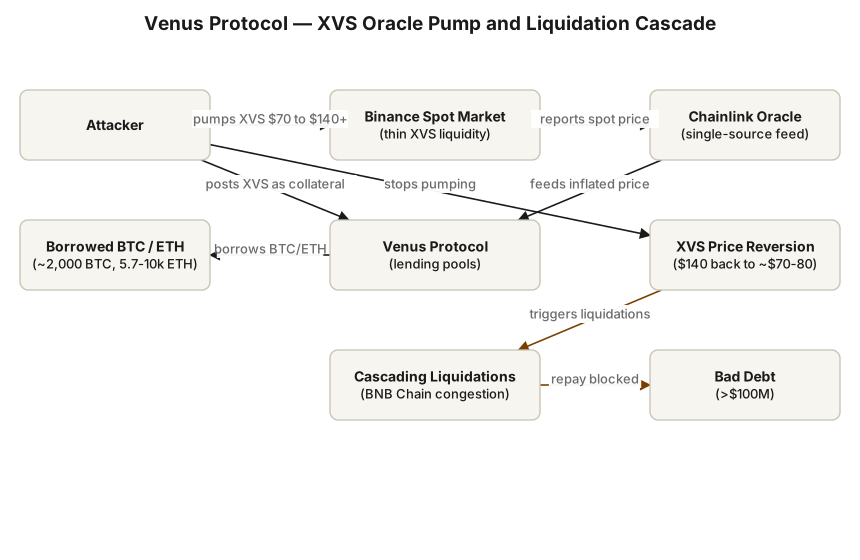 Open full-size diagram
Summary
Venus Protocol is a Compound-style money market on BNB Chain (originally built by the team behind Swipe, led by Joselito Lizarondo) that let users deposit assets — including its own governance token, XVS — as collateral to borrow other assets. On May 18-19, 2021, an account exploited the thin liquidity of XVS on Binance's spot market to rapidly pump its price from roughly $70-80 to over $140-145 within a few hours. Venus's Chainlink price oracle sourced XVS price data solely from Binance, so the inflated price was accepted as legitimate collateral value. The account used the artificially high-priced XVS as collateral to borrow large amounts of high-quality assets from Venus — reported figures include roughly 2,000 BTC and 5,700-10,000 ETH. When the pumping stopped, XVS's price collapsed back toward its starting level within about four hours, triggering cascading liquidations of undercollateralized positions across the protocol during a period of BNB Chain network congestion that made timely repayment or self-liquidation difficult for affected users. The unwind left Venus with over $100 million in bad debt, on top of roughly $200 million in total liquidations across the protocol that day.
Design (Mechanism)
Venus followed the standard Compound/Aave-derived overcollateralized lending model: users supply assets into shared pools, receive interest-bearing tokens, and can borrow against their supplied collateral up to a protocol-defined collateral factor. If a borrower's debt exceeds the liquidation threshold relative to their collateral value, liquidators can repay part of the debt in exchange for a discounted claim on the collateral, per the whitepaper capped at 50% of the loan value per liquidation event.
The critical design choice that enabled the exploit was allowing XVS — Venus's own low-liquidity governance/utility token — to be posted as first-class collateral for borrowing blue-chip assets, combined with a price oracle that read XVS spot price from a single centralized exchange (Binance) rather than an aggregated, deeper, or time-weighted source. This created a direct, low-cost lever: manipulate the reference price on one thin market, and the entire lending protocol treats that manipulated number as ground truth for how much can be borrowed against a XVS position.
Outcome
The attacker(s) extracted roughly 2,000 BTC and thousands of ETH in borrowed assets against collateral that was worth a fraction of its recorded value once the price reverted. Cascading liquidations during the crash, compounded by BNB Chain network congestion that limited borrowers' ability to top up collateral or repay in time, pushed liquidation rates for some accounts well above the whitepaper's documented 50% cap, per a formally filed GitHub issue from an affected user. Venus was left holding over $100 million in bad debt from the unrecovered borrow positions. Venus's founder characterized the event publicly as market volatility causing cascading liquidations that the protocol "worked as intended" through, attributing the initial XVS price spike partly to market excitement over the then-upcoming Venus Reward Token (VRT) launch rather than solely to deliberate manipulation. The protocol continued operating and was not shut down, but the bad debt was a durable balance-sheet scar, and Venus went on to suffer further oracle-related incidents in subsequent years (e.g., a 2022 LUNA oracle-freeze incident and later token-specific manipulation exploits), suggesting the underlying oracle/collateral-design lessons were not fully internalized after this event.
Why it worked
- Venus's price oracle for XVS relied on a single centralized exchange (Binance) as its data source, and XVS had comparatively low order-book depth there, making the reference price cheap to move with concentrated buy/sell pressure.
- Allowing the protocol's own governance token to serve as high-collateral-factor backing for borrowing unrelated blue-chip assets meant that manipulating XVS price directly and immediately expanded borrowing capacity against it, with no circuit breaker or price-deviation sanity check to catch the anomaly.
- BNB Chain network congestion during the unwind prevented affected borrowers from repaying or adding collateral in time, amplifying the scale of forced liquidations beyond what an orderly market would have produced.
Where the design broke
- Single-source, unaggregated price oracles are trivially manipulable when the underlying market is thin; Venus had no time-weighted average price (TWAP), no multi-exchange aggregation, and no price-move circuit breaker for XVS at the time.
- Accepting a native/governance token as high-LTV collateral for borrowing external blue-chip assets is inherently reflexive and risky: the token's price can be driven up specifically to unlock borrowing against it, unlike collateral with deep, external, harder-to-manipulate liquidity.
- The liquidation engine's actual behavior under stress (network congestion, cascading triggers) diverged from the documented 50%-per-event cap, indicating the liquidation logic and risk parameters were not stress-tested against a scenario of correlated congestion plus rapid price reversal.
Lessons
- Never rely on a single centralized exchange as the sole price feed for an asset used as loan collateral; use aggregated, liquidity-weighted, and/or time-weighted oracle sources, especially for thinly traded tokens.
- Governance/native tokens used as collateral for borrowing external assets should carry conservative collateral factors and/or borrow caps precisely because their price is more susceptible to being moved by the same actors who benefit from the borrow.
- Liquidation mechanics need to be stress-tested against combined failure modes (network congestion + rapid price swings), since documented safety caps (like a 50% max liquidation) can be violated in practice when users cannot interact with the chain in time.
- Public post-mortems that frame catastrophic bad debt as the protocol "working as intended" can undercut a project's incentive to fix root causes, as evidenced by Venus's recurrence of oracle-related losses in later years.
Redesign (EDITORIAL)
EDITORIAL — hypothesis, not fact. A more resilient design would (1) exclude low-liquidity native/governance tokens from being posted as collateral for borrowing external blue-chip assets altogether, or cap their effective collateral value with steep haircuts and hard borrow ceilings; (2) require multi-source, TWAP-smoothed oracle pricing with automatic pausing of new borrows/collateral increases when a single-block or single-hour price move exceeds a defined threshold (a "circuit breaker"); and (3) decouple liquidation eligibility from momentary oracle snapshots by using a grace-period or graduated liquidation curve that reduces incentive for cascading forced-sell pressure during network congestion. None of this is confirmed to be how Venus (or any successor version) actually addressed the issue — it is a plausible mitigation sketch based on the failure modes observed here.
Sources
- Venus Protocol Liquidation Manipulation Incident – What Happened? (news)
- Cascading liquidation violates whitepaper (GitHub Issue #48) — primary (primary/github)
- $200M Venus Protocol hack analysis (analysis)
- Venus protocol exploit, $200m liquidated, $100m bad debt (analysis)
- BSC's Venus Protocol Left With Bad Debt After Liquidations (news)
Related experiments
Last verified: 2026-07-27 · Spot an error? Suggest a correction