Deus Finance DEI
A hybrid algorithmic/collateralized stablecoin minted against the DEUS governance token that lost its dollar peg amid repeated exploits and the broader 2022 algo-stablecoin collapse.
▶ Run interactive simulation animated mechanism with editable parameters
How it works onchain
 Open full-size diagram
Summary
DEI was a "hybrid" stablecoin issued by DEUS Finance, a multi-chain DeFi protocol built around the DEUS governance/utility token. Unlike a pure algorithmic stablecoin, DEI could be minted against a mix of hard collateral (USDC, DAI, WBTC, FTM) and the protocol's own DEUS token, with the stated goal of keeping DEUS's supply reflexively tied to DEI demand. DEI launched across Fantom, Ethereum, Polygon and later Arbitrum during 2021-2022 as part of DEUS Finance's "V2 Apollo" expansion. In the space of about six weeks in spring 2022, the protocol suffered two large flash-loan/oracle-manipulation exploits (roughly $3M in March and $13.4M in April), and shortly after — compounded by the broader panic following TerraUSD's collapse — DEI itself lost its dollar peg, falling as low as $0.52 in May 2022. A further ~$6M exploit hit the protocol later that year. DEI never durably recovered its peg and the project is widely cited alongside UST as an example of the 2022 algorithmic-stablecoin failure wave.
Design (Mechanism)
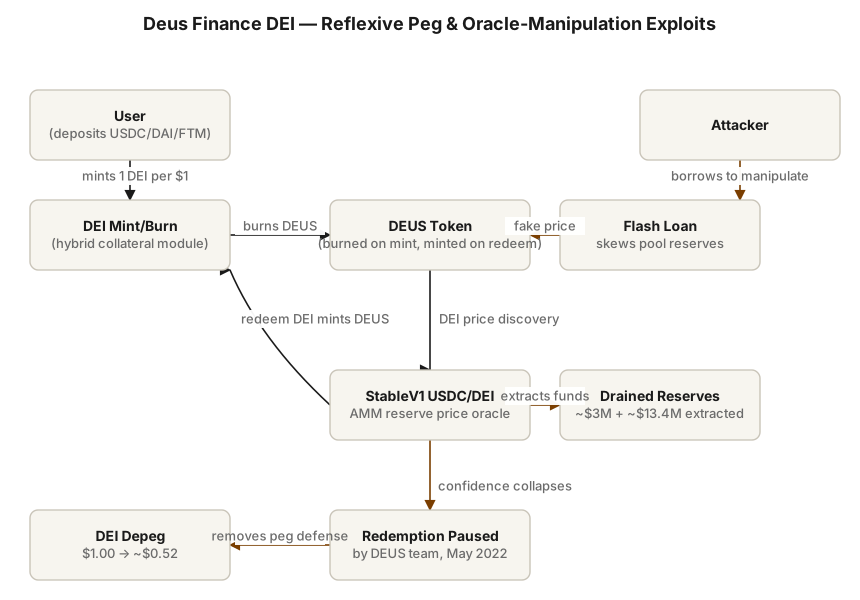
DEI's peg mechanism linked minting/burning of DEI to the DEUS token: buying/minting DEI could burn DEUS, while selling/redeeming DEI could mint new DEUS, intended to create deflationary pressure on DEUS as DEI demand grew and to give DEUS holders (via governance and "stablefarms") a claim on protocol activity. Users could mint 1 DEI per $1 of eligible collateral (USDC, FTM, DAI, WBTC, or DEUS+USDC combinations). A vote-escrow layer, veDEUS, let DEUS holders lock tokens for 1 day to 4 years in exchange for a share of protocol fees and anti-dilution protection, modeled on the veCRV/Curve-style vote-locking design popular in DeFi at the time. Price discovery and redemption for DEI relied on AMM pools (notably a Solidly/StableV1-style USDC/DEI pair on Fantom) whose price oracle read directly from pool reserves — a design that made it a target for flash-loan price manipulation, since an attacker could temporarily skew the pool price, use the manipulated price to borrow or mint far more value than actual collateral posted, and drain the pool in a single transaction.
Outcome
The mechanism failed in stages. On March 15, 2022, attackers used a flash loan to manipulate the price oracle on Deus Finance's Fantom marketplace, draining roughly $3M in DAI and ETH. On April 28, 2022, a similar but larger attack manipulated the StableV1 USDC/DEI AMM oracle to extract about $13.4M, again largely on Fantom/Ethereum. Weeks later, in the aftermath of Terra/UST's collapse, liquidity providers fled stablecoin pools broadly; DEUS developers reportedly paused DEI's redemption mechanism, removing a key peg-defense tool, and DEI's price fell over 30% in a day, bottoming near $0.52 with market cap dropping from roughly $100M to about $52M. A separate ~$6M exploit was reported later in 2022. DEI never sustainably regained its $1 peg and the DEI/DEUS ecosystem's TVL and usage declined sharply after 2022; outcome is classified as failed.
Why it worked
For a period in 2021-early 2022, the DEUS/DEI system attracted meaningful TVL and cross-chain adoption (Fantom, Ethereum, Polygon, Arbitrum) by offering yield through "stablefarms" and veDEUS fee-sharing, and the hybrid collateral model let it grow faster than fully-collateralized alternatives by using DEUS itself as partial backing during a bull market when DEUS had high market value.
Where the design broke
The failure had two compounding causes. First, security: the protocol's reliance on AMM-reserve-based price oracles for undercollateralized/flash-loan-friendly borrowing created a repeatedly exploited attack surface, leading to two multi-million-dollar exploits within six weeks. Second, reflexivity risk inherent to the design: because DEI's backing partly depended on DEUS's market value, and DEUS's value partly depended on demand for DEI, a shock to confidence (the hacks, then the systemic panic after UST's collapse) triggered a self-reinforcing death spiral — falling DEUS value weakened DEI's backing, which weakened confidence in DEI, accelerating redemptions/sell-offs at the exact moment the team paused redemptions, removing the peg's main defense mechanism.
Lessons
- Reflexive collateral (backing a stablecoin partly with the issuing protocol's own governance token) reintroduces the same death-spiral dynamics seen in Terra/UST, just with a different token pair.
- AMM-reserve price oracles are a well-known flash-loan attack vector; protocols that skip time-weighted or externally-validated oracles for the sake of speed/simplicity should expect exploitation, especially on lower-liquidity chains like Fantom.
- Pausing redemptions during a depeg, while sometimes necessary to prevent further drain, removes the market's primary peg-restoring mechanism and can accelerate loss of confidence rather than buy time.
- Stacking multiple unresolved security incidents (two exploits in six weeks) erodes the trust buffer a stablecoin needs to survive a subsequent market-wide shock.
Redesign (EDITORIAL)
EDITORIAL — hypothesis, not fact. A more resilient version of DEI would likely have required: (1) fully removing DEUS-token backing from the direct collateral basis and instead using DEUS purely as a governance/fee-capture token, so DEI's solvency never depended on DEUS's market price; (2) requiring all minting to route through time-weighted, multi-source oracles (or Chainlink-style external feeds) rather than spot AMM reserves, closing the flash-loan manipulation path that was exploited twice; (3) maintaining an always-available, rate-limited redemption channel (rather than an on/off pause) so users could exit gradually at a market-clearing discount instead of the team fully halting redemption during stress; and (4) publishing regular, audited proof-of-collateral reporting so market participants could distinguish a liquidity-driven wobble from an actual insolvency, which might have limited the panic-driven cascade that followed the UST collapse.
Sources
- Algorithmic Stablecoin From DEUS Finance Loses Dollar Peg, Plunging 30% (news)
- Deus Finance's dollar-pegged stablecoin DEI falls below 60 cents (news)
- How Deus Finance Was Exploited for $13.4M on Fantom (news)
- Deus Finance DAO suffers $3 million flash loan attack (news)
- Deus Finance loses $6M following stablecoin hack (news)
- DEUS Finance official site — primary (official)
Related experiments
Last verified: 2026-07-27 · Spot an error? Suggest a correction