Lens Protocol
Aave-team decentralized social graph that turned profiles, follows, and content into composable NFTs on Polygon, then migrated to its own GHO-gas Lens Chain after losing the SocialFi user race to Farcaster.
▶ Run interactive simulation animated mechanism with editable parameters
How it works onchain
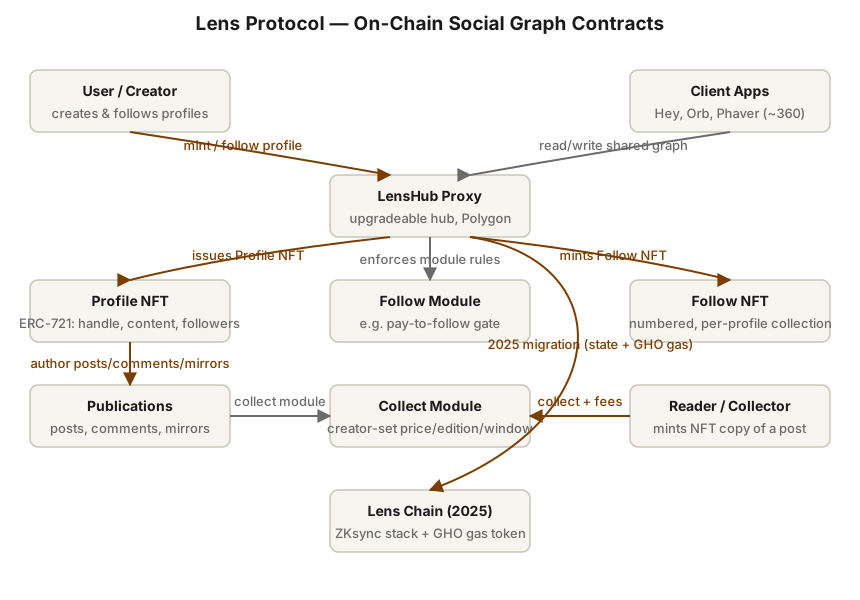 Open full-size diagram
Summary
Lens Protocol is the most ambitious attempt to put an entire social network's data model — profiles, follows, posts, comments, reposts — on-chain as ownable, composable objects. Built by the Aave Companies team led by Stani Kulechov and announced in early 2022, it launched on Polygon mainnet on May 18, 2022, with a $15M raise from IDEO CoLab, General Catalyst, Blockchain Capital and angels including Hayden Adams and Sandeep Nailwal. The pitch: your social graph should be a portable asset you own, not a database row a platform can confiscate, and any developer should be able to build a client on top of the shared graph. Lens spawned a real app ecosystem (Lenster/Hey, Phaver, Orb, Buttrfly and roughly 360 registered applications), shipped a major v2 in November 2023, then — after losing the SocialFi attention war to Farcaster through 2024 — migrated the whole graph in 2025 to its own purpose-built L2, Lens Chain (ZKsync stack, Avail data availability, Aave's GHO stablecoin as gas).
Design (Mechanism)
The core contract is LensHub (proxy at 0xDb46d1Dc155634FbC732f92E853b10B288AD5a1d on Polygon), an upgradeable hub that mints Profile NFTs: an ERC-721 that owns your handle, content pointers, and follower relationships. Because the profile is a token, it can be held by a multisig or DAO, sold, or delegated — identity as property.
Social actions are NFTs or NFT-generating too:
- Follow NFTs: following a profile mints a numbered NFT from that profile's dedicated follow collection; follow modules let creators gate follows (e.g., pay-to-follow) and follow NFTs can carry governance weight.
- Publications (posts, comments, mirrors/reposts) live as content URIs referenced on-chain under the author's profile, so content provenance is native.
- Collect modules: any publication can be made collectible; readers mint an NFT of a post under creator-set conditions (price, limited edition, time window, referral fees for mirrorers) — monetization as a protocol primitive rather than a platform feature.
- Modularity: whitelisted follow/collect/reference modules made the rules market-extensible; v2 (audited via a public Code4rena competition in July 2023) generalized this into "open actions," letting arbitrary smart contracts (mint, swap, donate) be attached to publications, plus profile-to-profile follows and improved account abstraction.
Because everything is on a shared chain state, the graph is credibly neutral: Hey, Orb, and Phaver all rendered the same follows and posts, and a user banned from one client kept their audience in all others. The 2025 Lens Chain migration (v3) kept this model but moved it to a dedicated ZKsync-stack validium using Avail for data availability and GHO as the native gas token, so fees are denominated in a stablecoin — a deliberate UX bet that social users won't tolerate volatile gas pricing. Over 125GB of state — profiles, ~28M follow edges, ~16M posts — was migrated from Polygon.
Outcome
Technically, Lens largely delivered: the NFT-graph model worked, v2 passed a large public audit competition, hundreds of apps built on it, and the 2025 chain migration moved the graph intact. Commercially and socially, it underperformed. Access was invite-gated for nearly two years (open profile minting only arrived with the v2 era), capping growth exactly when web3-social attention peaked. Through 2024, Farcaster — with off-chain hubs, cheap onboarding, and Frames — pulled decisively ahead; analyses tracked Lens daily actives collapsing from tens of thousands at hype peaks to low single-digit thousands, and new-profile creation dropping ~99%. Flagship social app Phaver wound down operations, and the ecosystem's engagement-token experiments (e.g., BONSAI) didn't reverse the trend. The Lens Chain mainnet launch in April 2025 was a full strategic reboot: from "social graph on Polygon" to "own the social chain." As of mid-2026 Lens continues as a live, developing platform, but far from mainstream social scale — hence: technically successful, commercially unsuccessful (with the v3 chapter still open).
Why it worked
- Right abstraction for ownership: NFTs for profiles and follows made "you own your audience" literal and enforceable, not metaphorical; portability across ~360 apps was demonstrated in practice.
- Modular monetization: collect modules and mirror referral fees gave creators protocol-level revenue rails no web2 platform offers.
- Credible team and capital: Aave's DeFi pedigree attracted serious builders, auditors (public Code4rena competition), and a real client ecosystem quickly.
- Composability dividends: profiles held by DAOs, token-gated follows, and posts with attached smart-contract actions showed genuinely new design space.
Why it failed or underperformed
- Invite-gating during the window of maximum attention: scarcity marketing worked for NFTs but is fatal for social networks, whose value is superlinear in users. Farcaster onboarded faster.
- Everything-on-chain costs: even on Polygon, per-action transactions and signature prompts created friction that off-chain-first rivals (Farcaster hubs) avoided; Lens spent years retrofitting gasless/dispatcher UX.
- Financialization outran fun: pay-to-follow and collect mechanics attracted mercenary engagement farming rather than durable communities; when incentives cooled, activity cratered.
- No killer app: the protocol was the product; clients were thin variations of Twitter, and none found a native use case the way Farcaster channels/Frames briefly did.
- Strategy churn: Polygon → v2 → whole-chain migration reset developer integrations three times in three years.
Lessons
- Social protocols compete on onboarding velocity, not architectural purity — gating access during a hype cycle permanently forfeits network effects.
- Putting the graph on-chain is the easy half; making on-chain actions feel free and instant is the actual product problem (Lens's stablecoin-gas chain is a late acknowledgment).
- Creator monetization as a protocol primitive is powerful but, introduced before organic community exists, selects for engagement farming over durable community formation.
- Identity-as-NFT is a genuinely reusable primitive even if the flagship network stalls — Lens profiles outlived several of their client apps, which is precisely the portability thesis working.
- A protocol whose clients are interchangeable has no distribution moat; someone in the stack must own a habit-forming product.
Redesign (EDITORIAL — hypothesis, not fact)
This is editorial speculation. A redesigned Lens would launch permissionless from day one with sponsored (protocol-subsidized) transactions, keeping only profile ownership and the follow graph on-chain while treating posts as signed off-chain data with periodic on-chain checkpoints — Farcaster's cost model with Lens's ownership model. Monetization modules would be disabled until an app hits an organic-retention threshold, decoupling speculation from bootstrapping. Rather than 360 undifferentiated clients, the core team would ship one opinionated flagship app around a niche Twitter ignores (e.g., creator-collector patronage), and use the chain migration budget instead on an aggressive "export your X/Instagram graph" onboarding funnel. The GHO-gas idea is worth keeping: stable, predictable micro-fees are the right long-term answer for social — but only after users have a reason to be there.
Sources
- LensHub proxy contract (Polygon) — primary (contract)
- Introducing Lens Protocol (lensprotocol.eth on Mirror) — primary (docs)
- Lens Protocol v2 audit competition (Code4rena, July 2023) — primary (audit)
- GHO: Stablecoin as Gas on Lens Chain (official) — primary (docs)
- Aave's Decentralized Social Media Platform Arrives on Polygon (CoinDesk, May 2022) (news)
- Aave Companies launches Lens V2 on Polygon (The Block, Nov 2023) (news)
- Lens releases Lens Chain mainnet with Avail DA and ZKsync tech (The Block, Apr 2025) (news)
- Lens Chain plans to adopt Aave's GHO stablecoin as native gas token (The Block, Feb 2025) (news)
- The Rise and Fall of Lens Protocol (Open Source Insights) (analysis)
- Lens Chain Goes Live: Scaling SocialFi with Avail & ZKsync (Avail blog) (analysis)
Related experiments
Last verified: 2026-07-27 · Spot an error? Suggest a correction